Romanov Gallery
The Romanov Gallery of the Winter Palace
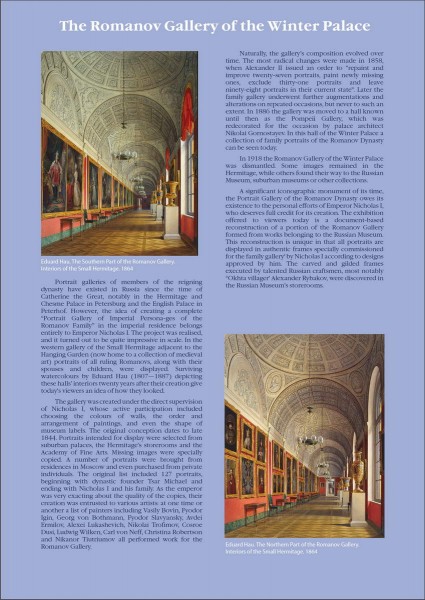
Portrait galleries of members of the reigning dynasty have existed in Russia since the time of Catherine the Great, notably in the Hermitage and Chesme Palace in Petersburg and the English Palace in Peterhof. However, the idea of creating a complete “Portrait Gallery of Imperial Personages of the Romanov Family” in the imperial residence belongs entirely to Emperor Nicholas I. The project was realised, and it turned out to be quite impressive in scale. In the western gallery of the Small Hermitage adjacent to the Hanging Garden (now home to a collection of medieval art) portraits of all ruling Romanovs, along with their spouses and children, were displayed. Surviving watercolours by Eduard Hau (1807‒1887) depicting these halls’ interiors twenty years after their creation give today's viewers an idea of how they looked.
The gallery was created under the direct supervision of Nicholas I, whose active participation included choosing the colours of walls, the order and arrangement of paintings, and even the shape of museum labels. The original conception dates to late 1844. Portraits intended for display were selected from suburban palaces, the Hermitage’s storerooms and the Academy of Fine Arts. Missing images were specially copied. A number of portraits were brought from residences in Moscow and even purchased from private individuals. The original list included 127 portraits, beginning with dynastic founder Tsar Michael and ending with Nicholas I and his family. As the emperor was very exacting about the quality of the copies, their creation was entrusted to various artists: at one time or another a list of painters including Vasily Bovin, Fyodor Igin, Georg von Bothmann, Fyodor Slavyansky, Avdei Ermilov, Alexei Lukashevich, Nikolai Trofimov, Cosroe Dusi, Ludwig Wilken, Carl von Neff, Christina Robertson and Nikanor Tiutriumov all performed work for the Romanov Gallery.
Naturally, the gallery’s composition evolved over time. The most radical changes were made in 1858, when Alexander II issued an order to “repaint and improve twenty-seven portraits, paint newly missing ones, exclude thirty-one portraits and leave ninety-eight portraits in their current state". Later the family gallery underwent further augmentations and alterations on repeated occasions, but never to such an extent. In 1886 the gallery was moved to a hall known until then as the Pompeii Gallery, which was redecorated for the occasion by palace architect Nikolai Gornostayev. In this hall of the Winter Palace a collection of family portraits of the Romanov Dynasty can be seen today.
In 1918 the Romanov Gallery of the Winter Palace was dismantled. Some images remained in the Hermitage, while others found their way to the Russian Museum, suburban museums or other collections.
A significant iconographic monument of its time, the Portrait Gallery of the Romanov Dynasty owes its existence to the personal efforts of Emperor Nicholas I, who deserves full credit for its creation. The exhibition offered to viewers today is a document-based reconstruction of a portion of the Romanov Gallery formed from works belonging to the Russian Museum. This reconstruction is unique in that all portraits are displayed in authentic frames specially commissioned for the family gallery' by Nicholas I according to designs approved by him. The carved and gilded frames executed by talented Russian craftsmen, most notably “Okhta villager' Alexander Rybakov, were discovered in the Russian Museum’s storerooms.