About the exhibition
The sixth exhibition in the Romanov Family Saga cycle is devoted to a vivid but contradictory era in Russian history: the reign of Emperor Nicholas I. This era received a one-sided and distorted assessment by Soviet historiography, which denied the emperor any personal virtues or role in the high achievements of Russian culture and political successes of the state, which it regarded exclusively in terms of democratic protest against the deeply and unequivocally reactionary ambitions of “Nicholas the Cudgeler".
The exhibition’s purpose is to illuminate the ways in which Nicholas' personality, statesmanship and foreign policy, as well as the life of society, the Court and the emperor's family, were reflected in painting, drawing, numismatics, and applied and decorative art. Manifest within the fruitful and contradictory unity of the era's artistic praxis was the key ideological doctrine of “Orthodoxy, Autocracy and Nationality" formulated by Minister of Education Sergei Uvarov. For many years this idea was unjustly regarded as purely reactionary.
Much attention in the showing is also devoted to personal qualities of the sovereign that were overlooked until recently, or interpreted in a biased way: his patriotism, honesty and integrity in affairs of both family and state; his deep understanding of Russia’s historical situation with respect to both foreign and domestic policy; and finally, his emotionality and devotion to his children.
Many important enterprises in the era’s artistic and social life (the Romanov Gallery of the Winter Palace, important urban-planning projects in Petersburg and Moscow, the reforms at the Academy of Fine Arts and others) were carried out on the emperor’s direct initiative and under his close supervision.
Nicholas' reign was a multifaceted and contradictory era in which total ideological and political control — the establishment of censorship and strengthening of the police apparatus — combined, paradoxically on the surface but quite understandably on a deeper level, with a flourishing of art, architecture, political writing, art criticism, journalism and literature.
The middle of Nicholas I’s reign was marked by the burgeoning activities of the society for the Encouragement of Artists, the creation of new art schools in Russian cities and the establishment of the Moscow Art Society’s School of Painting and Sculpture. The Academy of Fine Arts received special status, and Russian artists' stipendiary trips abroad, to Italy in particular, became more frequent. Splendid palaces, imposing government buildings and magnificent churches (St Isaac’s Cathedral and the Cathedral of Christ the Savior) were erected. The Imperial Porcelain Factory acquired widespread renown both in Russia and abroad. The emperor himself enjoyed a penchant for drawing, and portraits and caricatures done by his hand still survive in our day.
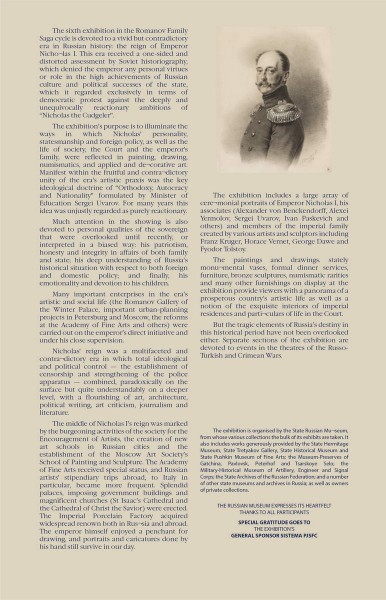
The exhibition includes a large array of ceremonial portraits of Emperor Nicholas I, his associates (Alexander von Benckendorff, Alexei Yermolov, Sergei Uvarov, Ivan Paskevich and others) and members of the imperial family created by various artists and sculptors including Franz Kruger, Horace Vernet, George Dawe and Fyodor Tolstoy.
The paintings and drawings. stately monumental vases, formal dinner services, furniture, bronze sculptures, numismatic rarities and many other furnishings on display at the exhibition provide viewers with a panorama of a prosperous country’s artistic life as well as a notion of the exquisite interiors of imperial residences and particulars of life in the Court.
But the tragic elements of Russia’s destiny in this historical period have not been overlooked either. Separate sections of the exhibition are devoted to events in the theatres of the Russo- Turkish and Crimean Wars.
The exhibition is organised by the State Russian Museum, from whose various collections the bulk of its exhibits are taken. It also includes works generously provided by the State Hermitage Museum, State Tretyakov Gallery, State Historical Museum and State Pushkin Museum of Fine Arts; the Museum-Preserves of Gatchina, Pavlovsk, Peterhof and Tsarskoye Selo; the Military-Historical Museum of Artillery, Engineer and Signal Corps; the State Archives of the Russian Federation; and a number of other state museums and archives in Russia; as well as owners of private collections.
THE RUSSIAN MUSEUM EXPRESSES ITS HEARTFELT THANKS TO all participants.
SPECIAL GRATITUDE GOES TO THE EXHIBITION’S GENERAL SPONSOR SISTEMA PJSFC