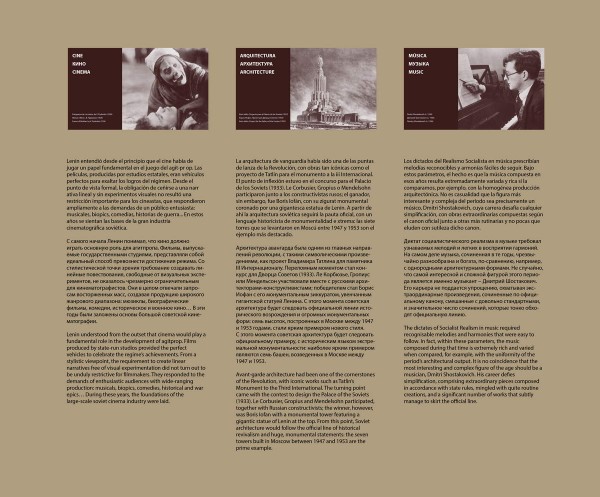
SOCIALIST REALISM CINEMA, ARCHITECTURE, MUSIC
Lenin understood from the outset that cinema would play a fundamental role in the development of agitprop. Films produced by state-run studios provided the perfect vehicles to celebrate the regime’s achievements. From a stylistic viewpoint, the requirement to create linear narratives free of visual experimentation did not turn out to be unduly restrictive for filmmakers. They responded to the demands of enthusiastic audiences with wide-ranging production: musicals, biopics, comedies, historical and war epics… During these years, the foundations of the large-scale soviet cinema industry were laid.
Avant-garde architecture had been one of the cornerstones of the Revolution, with iconic works such as Tatlin’s Monument to the Third International. The turning point came with the contest to design the Palace of the Soviets (1933). Le Corbusier, Gropius and Mendelsohn participated, together with Russian constructivists; the winner, however, was Boris Iofan with a monumental tower featuring a gigantic statue of Lenin at the top. From this point, Soviet architecture would follow the official line of historical revivalism and huge, monumental statements: the seven towers built in Moscow between 1947 and 1953 are the prime example.
The dictates of Socialist Realism in music required recognisable melodies and harmonies that were easy to follow. In fact, within these parameters, the music composed during that time is extremely rich and varied when compared, for example, with the uniformity of the period’s architectural output. It is no coincidence that the most interesting and complex figure of the age should be a musician, Dmitri Shostakovich. His career defies simplification, comprising extraordinary pieces composed in accordance with state rules, mingled with quite routine creations, and a significant number of works that subtly manage to skirt the official line.