SOCIALIST REALISM VISUAL ARTS, LITERATURE
Although it coexisted with other movements during the early years of the Soviet regime, Socialist Realism emerged as such in 1932 with Stalin’s decree on the reconstruction of artistic and literary organisations, and was officially announced at the I Soviet Writers’ Congress in 1934. From then on, it was to become state doctrine on all artistic output, a framework which creators had to abide by in order to succeed within the system.
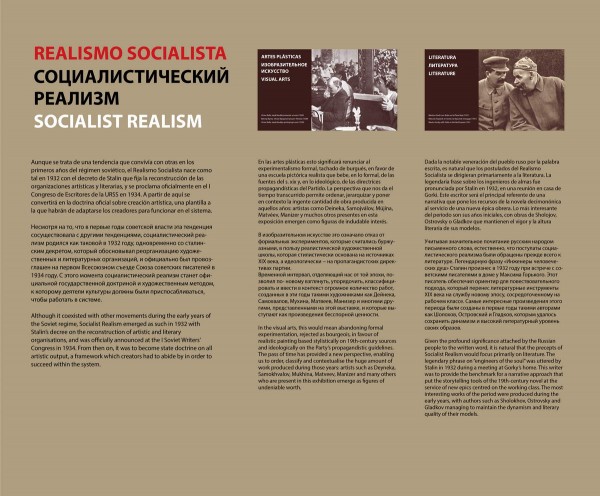
In the visual arts, this would mean abandoning formal experimentation, rejected as bourgeois, in favour of realistic painting based stylistically on 19th-century sources and ideologically on the Party’s propagandistic guidelines. The pass of time has provided a new perspective, enabling us to order, classify and contextualise the huge amount of work produced during those years: artists such as Deyneka, Samokhvalov, Mukhina, Matveev, Manizer and many others who are present in this exhibition emerge as figures of undeniable worth.
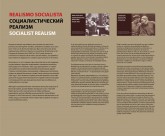
Given the profound significance attached by the Russian people to the written word, it is natural that the precepts of Socialist Realism would focus primarily on literature. The legendary phrase on “engineers of the soul” was uttered by Stalin in 1932 during a meeting at Gorky’s home. This writer was to provide the benchmark for a narrative approach that put the storytelling tools of the 19th-century novel at the service of new epics centred on the working class. The most interesting works of the period were produced during the early years, with authors such as Sholokhov, Ostrovsky and Gladkov managing to maintain the dynamism and literary quality of their models.