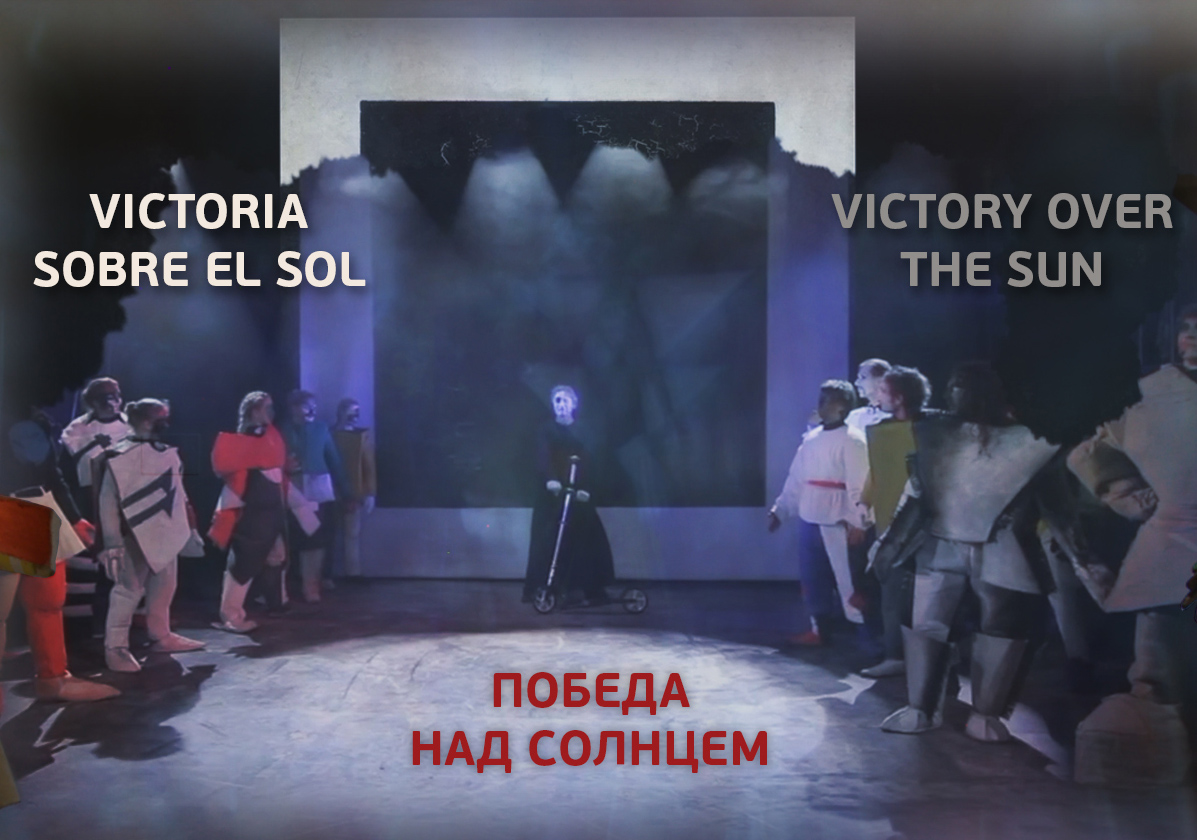
Opera "Victory over the Sun". Fragment
Russian Cubo-Futurism reached its zenith with the Futurist opera titled Victory over the Sun, which was the result of a genuine collaborative friendship between a poet, a painter and a composer. The opera’s libretto was written by Alexei Kruchenykh, the music was composed by Mikhail Matyushin, and the costumes and set were designed by Malevich.
The opera premiered in December 1913 at the Luna Park Theater in St Petersburg. It was divided into two acts: the first act depicted a military campaign against the sun, which is eventually torn down from the sky; and the second act depicted a Futurist existence after the eponymous victory over the sun. The sun symbolizes the old world, with its outmoded ideas and an antiquated concept of beauty. The campaign against the sun seeks to create a new kind of light: namely, the light of art as a new point of universality.
Malevich’s stage set was filled with images and phantasmagorical fragments of the visible world, and created a series of innovative special effects thanks to the creative use of spotlights. Years later, the artist spoke of how the experimental forms he produced for the opera had an influence on the development of his Suprematist ideas. In fact, Malevich’s iconic Black Square made its first appearance in this opera, acting as a curtain which the actors ripped, in order to symbolically overcome the bounds of “materiality” and emerge in a new and different space. The impact of this incursion was heightened by the ironic, incomprehensible text of Kruchenykh and the music of Matyushin, which was filled with discordant notes produced by an out-of-tune grand piano.
The opera’s creators understood one another particularly well and found it easy to work in harmony. Matyushin recalled the collaborative process in the following terms: “Kruchenykh, Malevich and I worked together, each of us supporting, developing and continuing the work that the other had started. The opera grew and took shape thanks to the efforts we all made in terms of the words, the music, and the imagery created by the painter for the performance space”.
This exhibition includes a video screening of an original reconstruction of the opera and the costumes designed by Malevich. These were recreated using many of the same techniques that were used to produce the originals. They were made by students from the Stieglitz State Academy of Art and Design in St Petersburg and the Olga Kalashnikova School of Design.