Advanced search collections
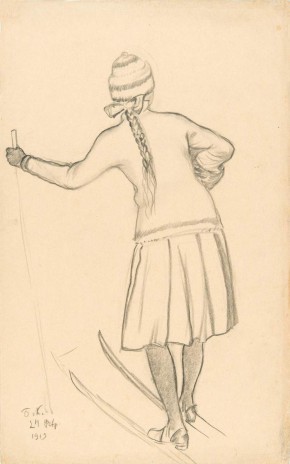
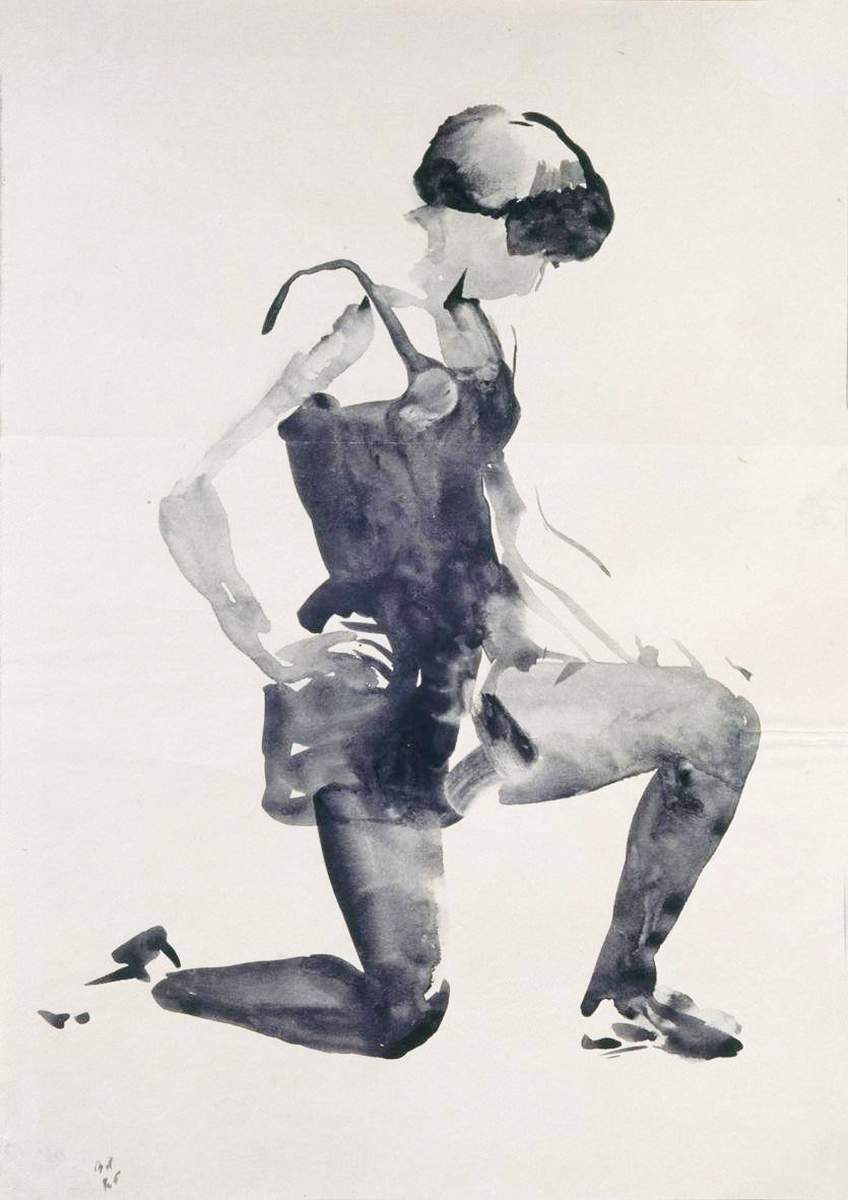
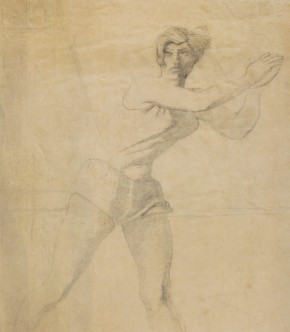
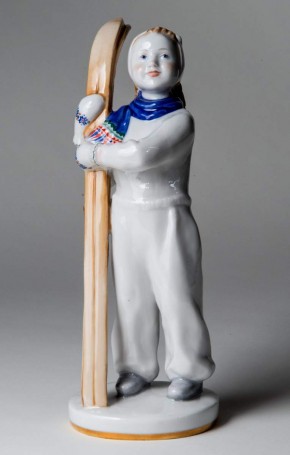
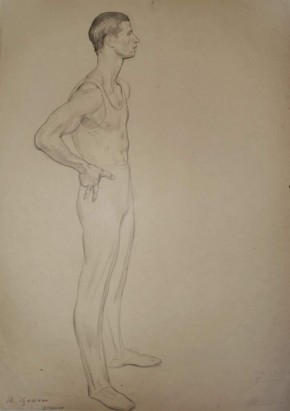
Лыжница
- 1919
- Paper, graphite pencil.
- The State Russian Museum
- РС-809
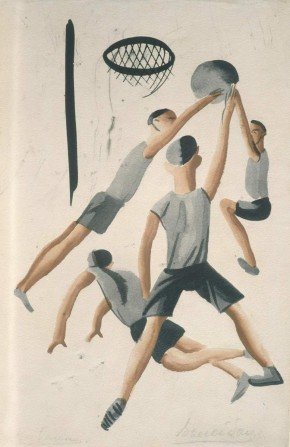
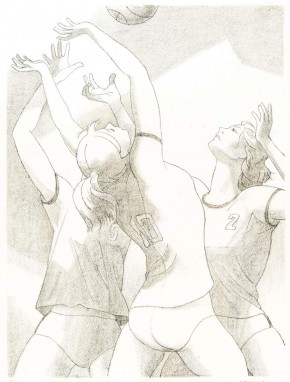
Баскетбол
- 1920–1924
- Paper, watercolours, ink. 26,5 x 17,1
- The State Russian Museum
- РС-6672
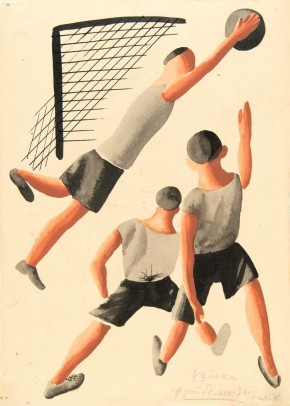
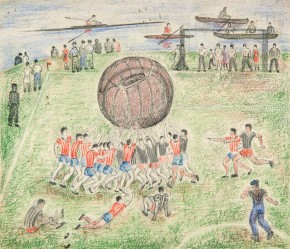
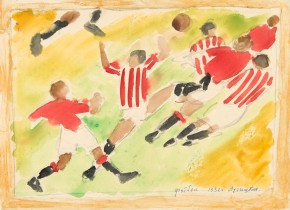
Узбеки-футболисты
- 1920-1924
- Paper, watercolours, ink. 24,8 x 18
- The State Russian Museum
- РС-6671
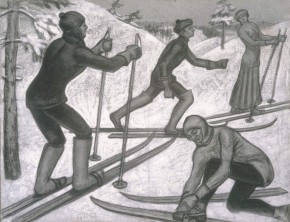
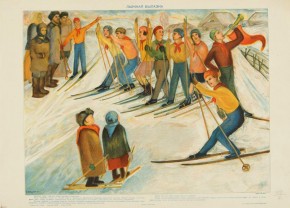
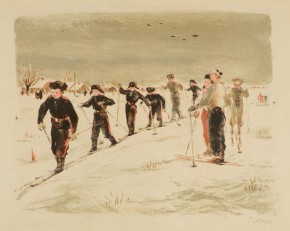
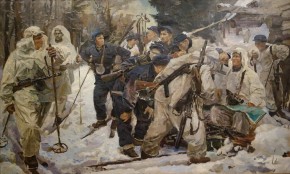
Эскиз к картине «Лыжники»
- 1922
- сharcoal , whiting. 34,5 х 44,2
- The State Russian Museum
- РС-14479
Акробатка
- 1925
- Paper, . 30,8 x 21,7
- The State Russian Museum
- РС-15872
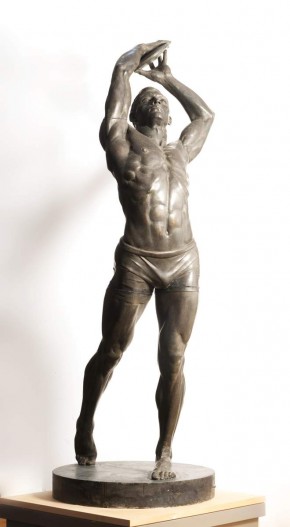
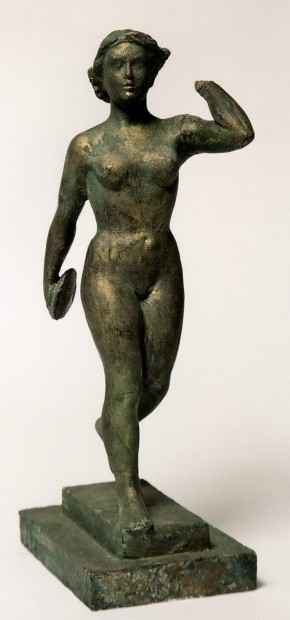
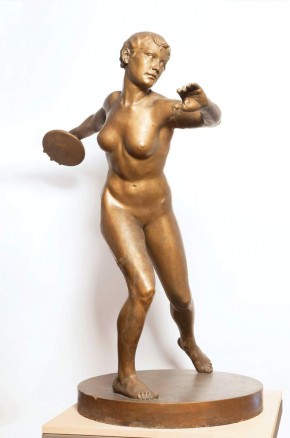
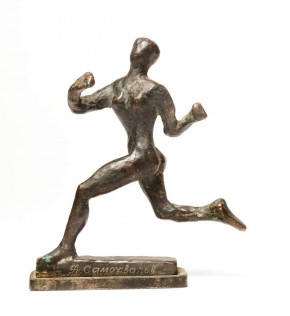
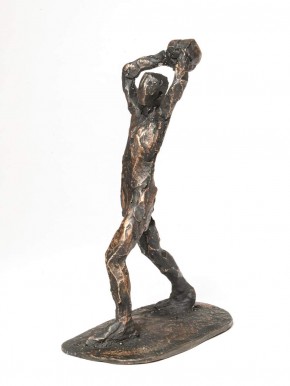
Дискометатель
- 1926
- . 243 x 87 x 85
- The State Russian Museum
- СО-2039
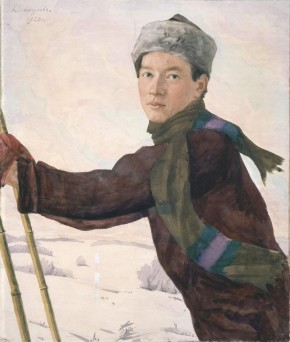
Лыжник (Верховский В. В.)
- 1926
- Paper, watercolours. 82,5 х 69
- The State Russian Museum
- РС-1170
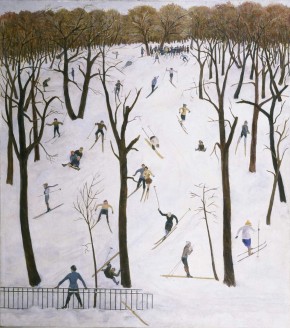
Лыжники
- 1926
- Canvas, oil. 108 x 96
- The State Russian Museum
- ЖБ-1495
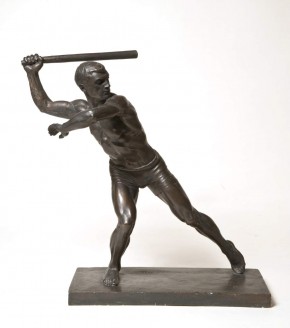
Игра в городки
- 1927
- . 37 x 38 x 18
- The State Russian Museum
- СО-2052
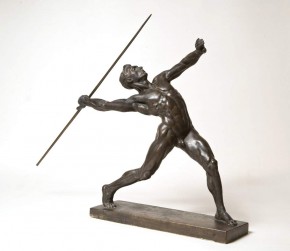
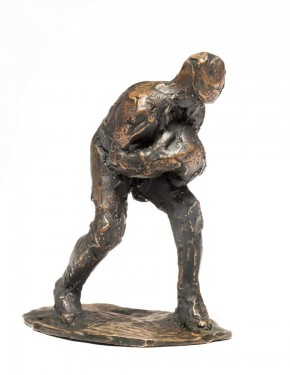
Метание копья
- 1927
- . 40,8 x 19 x 36
- The State Russian Museum
- СО-2053
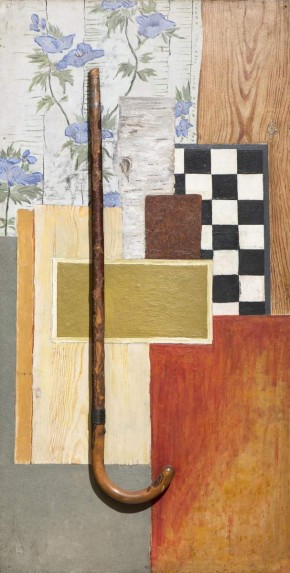
Натюрморт с шахматной доской
- plywood, oil, . 108 x 56
- The State Russian Museum
- Ж-10409
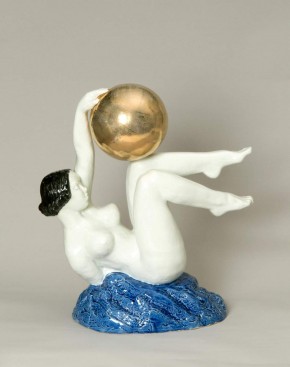
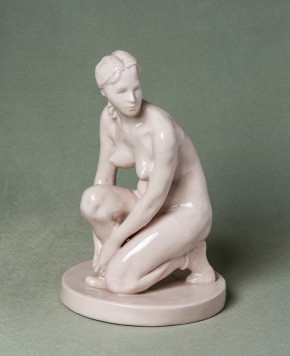
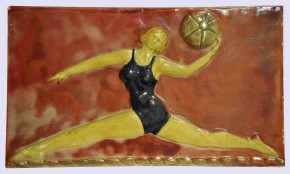
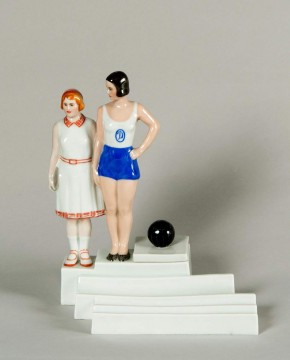
Фигура «Акробатка с шаром»
- 1927
- faience, , gilding. 39 х 35 х 17
- The State Russian Museum
- СФС-237
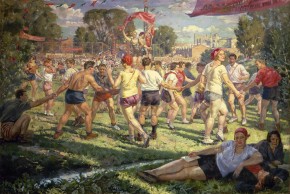
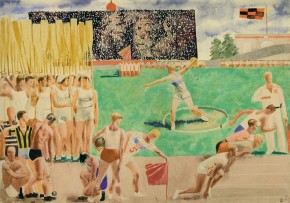
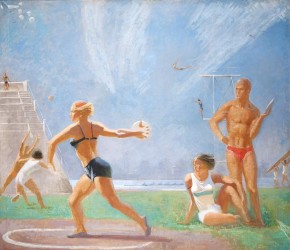
Физкультурные игры на стадионе
- 1927
- Canvas, oil. 166 x 249
- The State Russian Museum
- ЖС-93
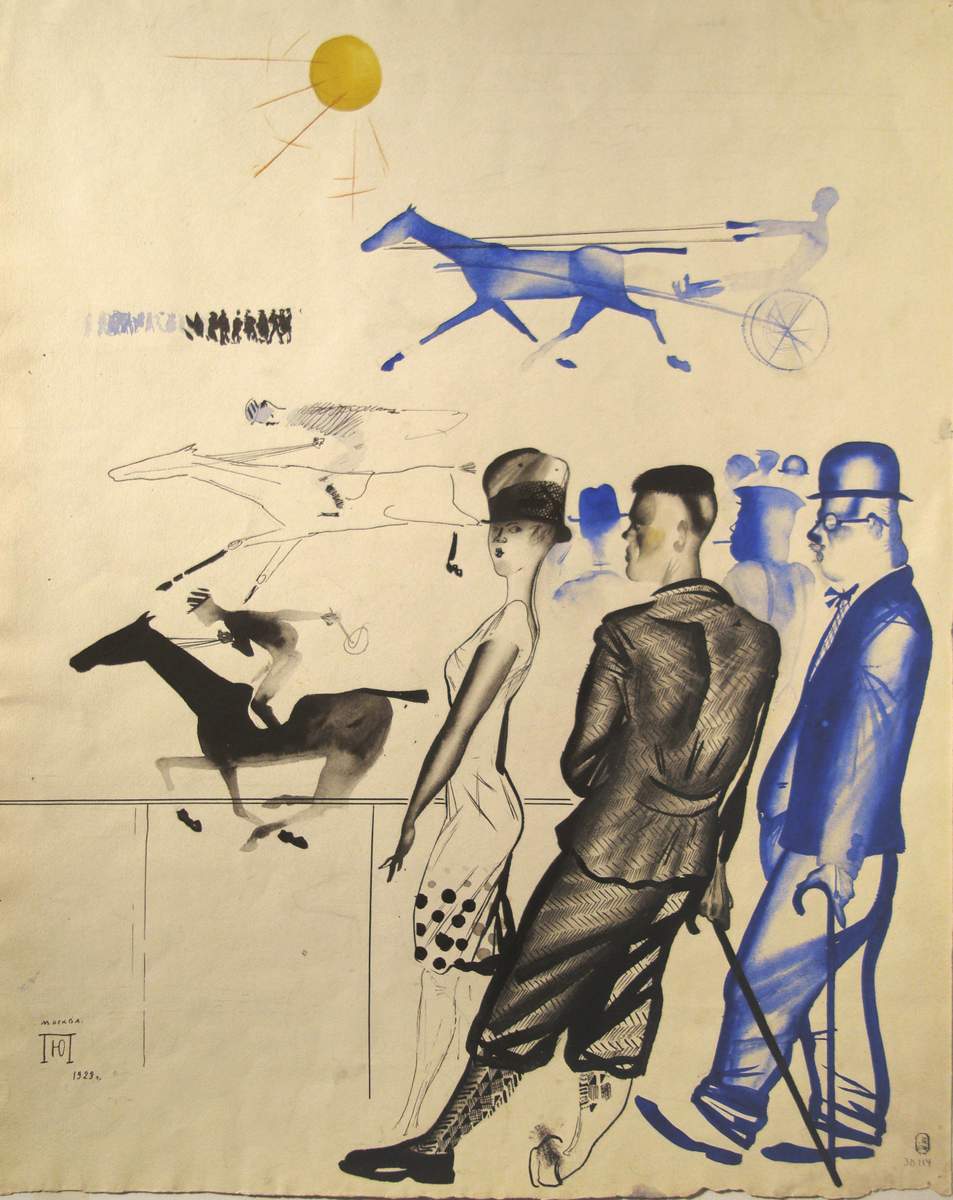
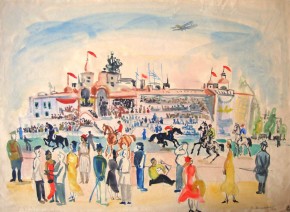
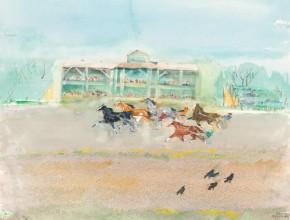
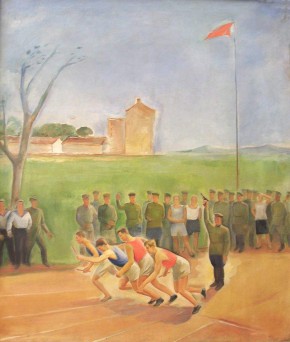
Бега
- 1928
- Paper, watercolours, ink, graphite pencil. 49 х 39,1
- The State Russian Museum
- РС-2758
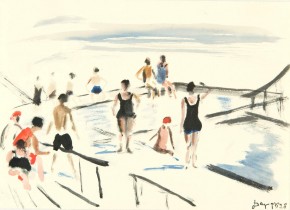
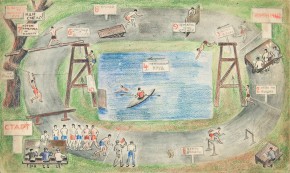
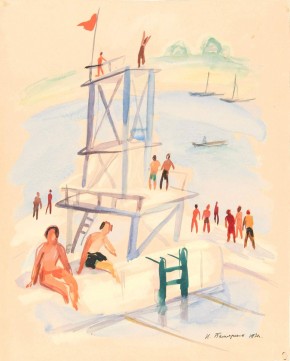
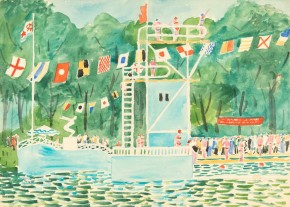
Водная станция «Динамо»
- 1928
- Paper, watercolours, ink. 24,2 x 33,8
- The State Russian Museum
- РС-484
Сливочник с крышкой
- 1927–1930
- Porcelain, . 9,5 х 12,7 х 8,8
- The State Russian Museum
- ДФ-1345 а,б
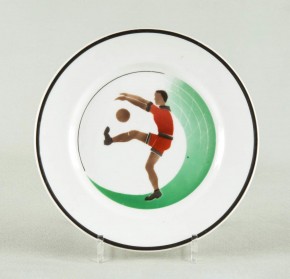
Тарелка «Футболист»
- 1927–1930
- Porcelain, painting over glaze.
- The State Russian Museum
- ДФ-1336
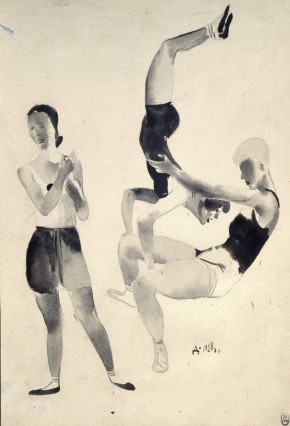
Физкультурники
- 1928
- Paper, . 28,5 x 19,4
- The State Russian Museum
- РС-8429
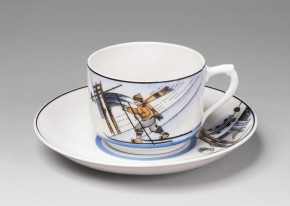
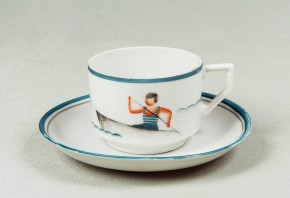
Чашка с блюдцем
- 1927–1930
- Porcelain, .
- The State Russian Museum
- ДФ-1347 а,б
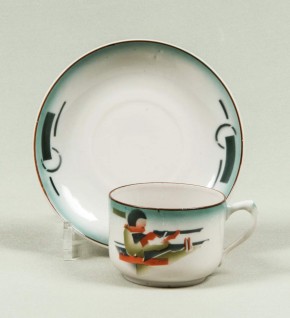
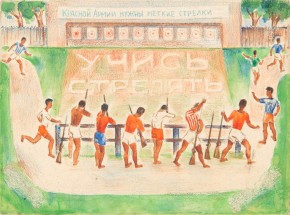
Чашка с блюдцем «Стрелок»
- 1927–1930
- Porcelain, painting over glaze.
- The State Russian Museum
- Дф-1223 а,б
Kustodiev Boris Mikhailovich
1818, Astrakhan - 1927, LeningradPainter. Studied under Vasily Savinsky and Ilya Repin at the Higher School of Art, Imperial Academy of Arts (1896-1903). Fellow of the Imperial Academy of Arts in France and Spain (1903-1904). Academician of painting (1909). Founding member of the New Society of Artists (1904) and member of the Union of Russian Artists (1907), World of Art (1910) and the Association of Artists of Revolutionary Russia (1923). Contributed to exhibitions (from 1900). Contributed to the periodical exhibitions of the Moscow Society of Lovers of the Arts (1900-1901), Spring Exhibitions of the Imperial Academy of Arts (1900-1903) and the exhibitions of the New Society of Artists (1904-1908), Union of Russian Artists (1907-1910), World of Art (1910-1924), Association of Artists of Revolutionary Russia (1923, 1925) and the International Exhibitions in Munich (1901, gold medal; 1909) and Malmo (1914, gold medal). Designed for theatres in Moscow and St Petersburg (from 1911).
Курзин Михаил Иванович
Пестинский Борис Владимирович
Lebedev Vladimir
Лучишкин Сергей Алексеевич
MANIZER Matvei Genrikhovich
1891, St Petersburg — 1966, MoscowSculptor. Studied in Petrograd / Leningrad at the Baron Stieglitz Central School of Technical Drawing (1908–1909); School of Drawing of the Society for the Encouragement of the Arts (1909–1911); Higher School of Art at the Imperial Academy of Arts (1911–1916). Contributed to exhibitions (from 1916). Vice President of the USSR Academy of Arts (1947–1966). Headed the sculpture studio at the Academy of Arts in Leningrad (1947–1952) and his studio at the Vasily Surikov Institute of Art in Moscow (from 1952). Winner of the Stalin Prize (1941, 1943, 1950). Gold medal from the Academy of Arts for the Lenin statue for the Soviet pavilion at the World Exhibition in Brussels (1958).
Ostroumova-Lebedeva Anna
Васнецов Юрий Алексеевич
Ефимов Иван Семенович
Luppov Sergei
Даран Даниил Борисович
Deineka Alexander Alexandrovich
1899, Kursk - 1969, MoscowPainter, graphic artist, sculptor, poster designer. Helped to decorate streets on Communist holidays. Studied at the Kharkiv School of Art (1914-1918) and the Free/Higher Art and Technical Studios (1920-1925). Contributed to exhibitions (from 1924). Member of the Union of Artists (from 1932). Taught at the Higher Art and Technical Institute (1928–1930), Moscow Institute of Polygraphy (1930–1934), Vasily Surikov Institute of Art (1936, 1946, 1957–1964), Moscow Institute of Applied and Decorative Art (1945–1952) and Moscow Institute of Architecture (1953–1957). Business trips to Italy, France and the USA (1935). Full member of the Academy of Arts of the USSR (1947). Vice President of Academy of Arts of the USSR (1962, 1966). People\'s Artist of the USSR (1963). Corresponding member of the Academy of Arts of the GDR (1964). Hero of Socialist Labour (1969). Awarded the Lenin Prize (1964).
Unknown Artist
Pimenov Yury (Georgy) Ivanovich
1903, Moscow – 1977, MoscowPainter, draughtsman, theatrical designer, monu¬mental and decorative artist. Studied under Vla ¬dimir Favorsky, Vadim Faliev and Sergei Malyutin at the Higher Art and Technical Studios in Moscow (1920–1925). Contributed to exhibitions (from 1924). Contributed to the Society of Easel Artists (1925–1931, founding member), Izobrigade (1931). Taught at the Institute for Raising Artists Qualifi¬cations (1936–1937) and the All-Union State Insti ¬tute of Cinematography (1945–1972). Professor (1947).People sArtistoftheUSSR(1954).Fullmem¬ber of the Academy of Arts of the USSR (1967).
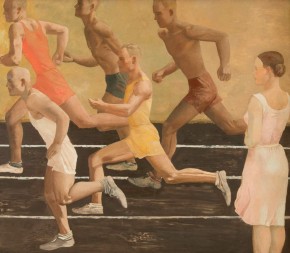
Race
- Variant of the painting of the same name (1930, Galleria d’Arte Moderna di Ca’Pesaro, Venice)
- 1932–1933
- Canvas, oil. 229 х 259
- The State Russian Museum
- Ж-7741
The art of Alexander Deineka reflects the aspiration towards new forms of public life — labour, industry, sport, and images of the new citizen. Race contains all the main formal features of Alexander Deineka’s style — a montage-rhythmic structure of the composition, laconic tones, and an austere and graphic style of painting. Race combines concrete elements, generalisation, symbols, images, the spirit of romanticism, and notes of lyricism. Man personifies the motif of freedom and resolute integrity.
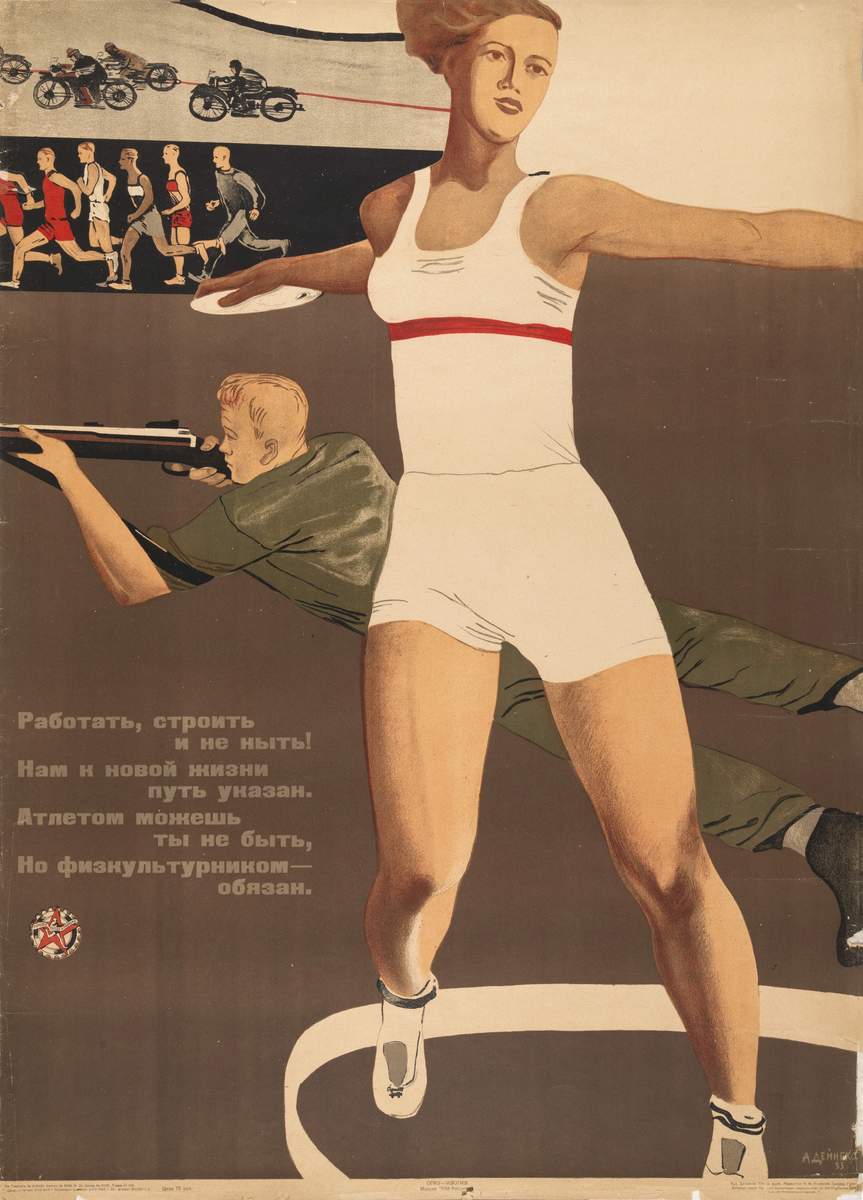
«Работать, строить и не ныть ...»
- 1933
- Paper, chromolithography. 102,2 х 73,3
- The State Russian Museum
- Гр.Пл.-2336
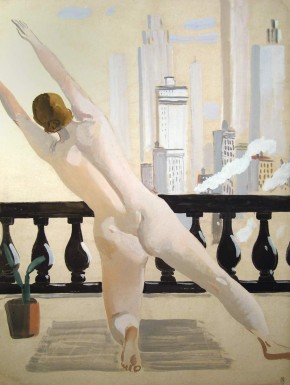
Гимнастика на крыше. (Америка)
- 1935
- Paper, gouache. 56,3 x 41,2
- The State Russian Museum
- РС-8059
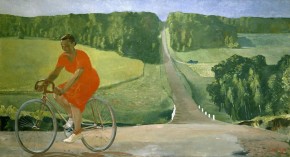
Колхозница на велосипеде
- 1935
- Canvas, oil. 120 x 220
- The State Russian Museum
- Ж-8715
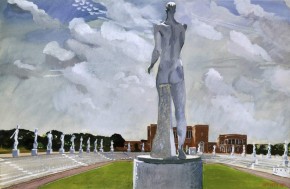
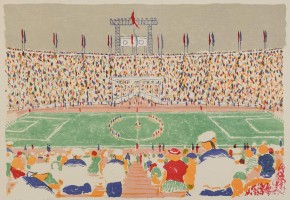
Стадион в Риме
- 1935
- Paper, watercolours, gouache. 37,3 x 54,5
- The State Russian Museum
- РС-4414
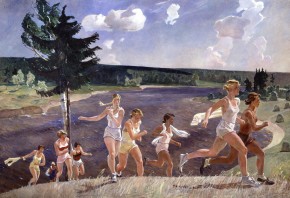
Expanse
- 1944
- Canvas, oil. 204 x 300
- The State Russian Museum
- Ж-4500
In the last year of the war, happy colours appeared in Deineka’s austere palette. In the summer of 1944, he finished the large painting Expanse, which he began before the war. The resulting painting is perceived as a joyful hymn to peaceful life against a backdrop of the vast expanses of his native land.
Фигура «Перед забегом»
- 1955
- Porcelain, . 27,3 х 17,1 х 17,1
- The State Russian Museum
- СФ-492
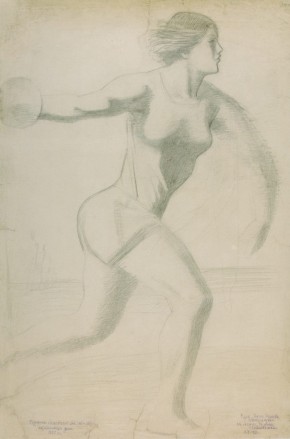
Метательница диска
- Paper, graphite pencil. 73,8 x 52,5
- The State Russian Museum
- РС-18128
Метательница дисков
- Graphite pencil.
- The State Russian Museum
- РС-23343
На стадионе
- 1931
- Paper, watercolours. 43,8 x 63,5
- The State Russian Museum
- РС-1608
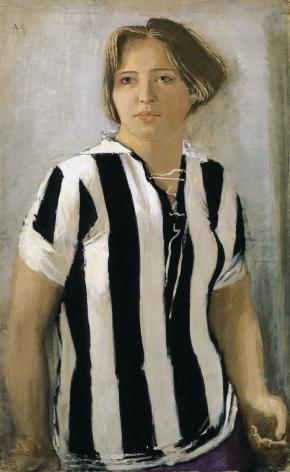
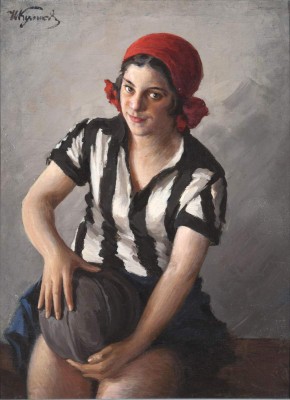
Girl in a Sports Shirt
- 1932
- Canvas, oil. 102 x 64
- The State Russian Museum
- Ж-4419
Girl in a Sports Shirt won a gold medal at the World Fair in Paris in 1937. One of the most famous works of Soviet art, it was regarded as a landmark in the artist’s oeuvre. Alexander Samokhvalov recalled: «It was a special joy to paint images of my contemporaries in those years.» The painting was acclaimed by fellow artists and critics alike, while the heroine was hailed as a «Soviet Mona Lisa» at the Exposition Universelle. The artist depicts Yevgenia Adamova, a teacher and activist who retained her freshness and vitality all her life. She is a typical Soviet citizen of the 1930s — spontaneous, enthusiastic and purposeful. Samokhvalov confirms his ideal of a simple beauty not only in his model, but also in the painting — austere, laconic and elegant.
The clear architectonics of the composition, broad painting, frescolike texture and dynamic image contain features of monumentality. Girl in a Sports Shirt embodies the artist’s concept of the era and «a remarkable contemporary, the sort of girl who did not exist before.» Russian Museum: From Icons to the Modern Times. Palace Editions, St Petersburg, 2015. P. 347.
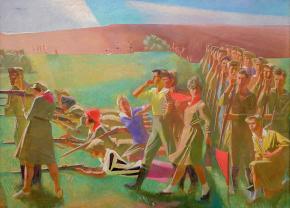
Militarised Komsomol
- 1931-1933
- Canvas, oil, tempera. 198,5 х 276
- The State Russian Museum
- Ж-8235
In this large painting, Samokhvalov depicted the members of a youth communist organisation, who displayed their determination as a group as they were training in order to defend their country. Samokhvalov painted the picture to celebrate the 15th anniversary of the Red Army. The painter was impressed by what he saw at the shooting range: “there was a group of girls, lying down and improving their sniper skills. The bright and colourful clothes of these young people enhance the painting’s colours. The formation of the Komsomol members comes right at the spectator as the girl with a gas mask brings up the rear. There are studies for this painting: “Komsomol Youth” and “Girl at the Military School”.
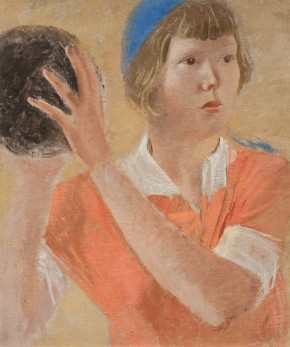
Girl with a Ball
- 1933
- Canvas, oil. 55 х 46,5
- The State Russian Museum
- Ж-9187
Like many of Samokhvalov’s paintings, this intimate work creates the impression of a lost fresco fragment. The artist was convinced that modern life should be depicted in monumental forms, and took inspiration from the art of Antiquity, the Renaissance and Ancient Rus. He strove to embed the depicted moment into historical perspective, to underline its significance, to shroud it in a romantic aura. His models were for the most part young people, the embodiment of a splendid utopian future which they were called upon to create and inhabit. In the role of a dreamy young athlete Samokhvalov depicted his eldest daughter Maria.
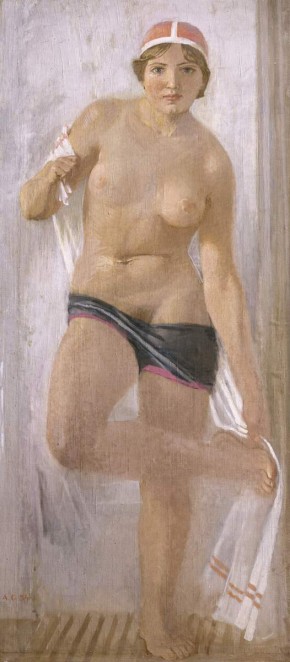
After the Cross-Country Race
- 1934–1935
- Canvas, oil. 143 х 64
- The State Russian Museum
- Ж-8191
Antique sources can be clearly seen in Samokhvalov’s works devoted to the themes of physical training and sports, which he was especially involved with in the latter half of the 30s. The heroine of Soviet athletics in the work After the Cross-Country Race arises like a Venus de Milo come to life, offering her bold nudity to the world with the dignity of a goddess.
At the Stadium
- 1934–1935
- Canvas, oil. 121 х 140,5
- The State Russian Museum
- ЖБ-1723
Sport was one of the most popular themes in Soviet art in the mid-1920s and 1930s. Called upon to form the ideal of the new man, artists discerned its prototype in athletes — handsome young men and women perfecting their bodies and hardening the spirit. Sportsmen became the main characters of the works of Alexander Samokhvalov, who dreamt of uniting them in a grandiose monumental composition. Perhaps that is why so many of his paintings of this period are like details of a large, multi-figure fresco. The artist himself described sport as an “existential joy” helping people overcome difficulties “in the struggle for the creation of a new life” and furthering their “love for humankind”. “I loved sport as the culture of healthy, vivacious and joyful people… I was attracted to the healthy creative spirit in healthy bodies,” he wrote.
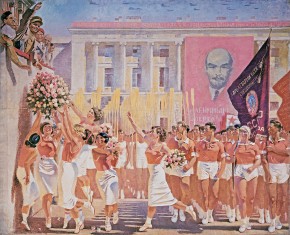
Sergei Kirov Reviews the Athletic Parade
- 1935
- Canvas, oil. 305 х 372
- The State Russian Museum
- ЖБ-1962
Sergei Mironovich Kirov (Kostrikov) (1886–1934): Communist arty functionary and member of he Soviet leadership. First secretary of the Communist Party in Leningrad (1926–34).
Following Sergei Kirov’s murder in 1934, a multitude of portraits and works on themes from his real and mythical biographies appeared in Soviet painting and sculpture. Alexander Samokhvalov painted a portrait of Kirov, Kirov on a Construction Site and his first ever large picture-panel — Sergei Kirov Receiving a Parade of Athletes. The artist had long dreamt of painting a multi-figure monumental picture resolved like a fresco. Work on the canvas lasted a long time. Striving to create a fresco-like effect, Samokhvalov experimented with colours, seeking decorative tones that would simultaneously be lifelike and natural. He finally chose a classical and solemn gamut of warm tones. The action takes place on Palace Square in Leningrad. The space is enclosed by the facade of General Headquarters with an enormous portrait of Lenin. The eyes of the athletes are rivetted on the figure of Sergei Kirov and other members of the Leningrad government on the rostrum. A group of girls break away from the main group to hand Kirov a bouquet of flowers.
The concept and painting of the panel reflect the main tendencies in the Soviet art of the 1930s. This was an aspiration towards monumentality and an image of the new Soviet citizen — a labourer, hero and romantic, morally and physically strong and handsome. Russian Museum: From Icons to the Modern Times. Palace Editions, St Petersburg, 2015. P. 349.
Юность. (Метательница диска)
- 1940s
- . 31 х 10,3 х 15
- The State Russian Museum
- СО-2081
Samokhvalov Alexander Nikolaevich
1894, Bezhetsk (Tver Province) - 1971, LeningradPainter, graphic artist, theatrical designer, applied artist, sculptor.
Studied architecture at the Higher School of Art, Imperial Academy of Arts (1914-18) and at the Free Art Studios/Higher Art and Tech¬nical Studios in Petrograd (1920-23). Contributed to exhibitions (from 1917).
Лыжники
- 1926
- Canvas, oil. 108 x 96
- The State Russian Museum
- ЖБ-1495
Физкультурные игры на стадионе
- 1927
- Canvas, oil. 166 x 249
- The State Russian Museum
- ЖС-93
Физкультурница
- 1929
- Canvas, oil. 82,5 х 63,5
- The State Russian Museum
- Ж-6379
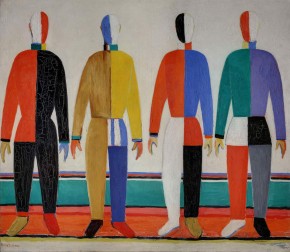
Sportsmen
- 1928–1932
- Canvas, oil. 142 x 164
- The State Russian Museum
- Ж-9439
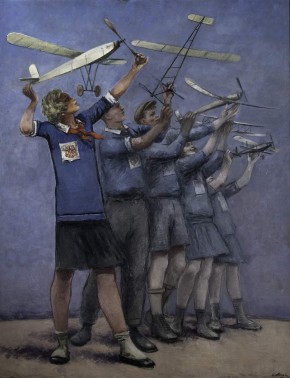
Contest of Young Modellers
- 1931
- Canvas, oil. 121 x 95
- The State Russian Museum
- ЖБ-1862
The idea of conquering space and time, key for other genres and types of Soviet art as well, became in the 1920s and 1930s extremely important in reference to works about sport. The ideological and instructional aspects of sport connected with the task of preparing physically developed people, “ready for labour and defence”, became the main focus (the legendary GTO (ready for labour and defence) pin appears in 1930, when the topic of sport is definitively confirmed as an important division of Soviet art). Sport as an integral part of preparing the Soviet individual for any difficulty becomes a leitmotif in the work of many artists, including Adlivankin.
Girl in a Sports Shirt
- 1932
- Canvas, oil. 102 x 64
- The State Russian Museum
- Ж-4419
Girl in a Sports Shirt won a gold medal at the World Fair in Paris in 1937. One of the most famous works of Soviet art, it was regarded as a landmark in the artist’s oeuvre. Alexander Samokhvalov recalled: «It was a special joy to paint images of my contemporaries in those years.» The painting was acclaimed by fellow artists and critics alike, while the heroine was hailed as a «Soviet Mona Lisa» at the Exposition Universelle. The artist depicts Yevgenia Adamova, a teacher and activist who retained her freshness and vitality all her life. She is a typical Soviet citizen of the 1930s — spontaneous, enthusiastic and purposeful. Samokhvalov confirms his ideal of a simple beauty not only in his model, but also in the painting — austere, laconic and elegant.
The clear architectonics of the composition, broad painting, frescolike texture and dynamic image contain features of monumentality. Girl in a Sports Shirt embodies the artist’s concept of the era and «a remarkable contemporary, the sort of girl who did not exist before.» Russian Museum: From Icons to the Modern Times. Palace Editions, St Petersburg, 2015. P. 347.
Militarised Komsomol
- 1931-1933
- Canvas, oil, tempera. 198,5 х 276
- The State Russian Museum
- Ж-8235
In this large painting, Samokhvalov depicted the members of a youth communist organisation, who displayed their determination as a group as they were training in order to defend their country. Samokhvalov painted the picture to celebrate the 15th anniversary of the Red Army. The painter was impressed by what he saw at the shooting range: “there was a group of girls, lying down and improving their sniper skills. The bright and colourful clothes of these young people enhance the painting’s colours. The formation of the Komsomol members comes right at the spectator as the girl with a gas mask brings up the rear. There are studies for this painting: “Komsomol Youth” and “Girl at the Military School”.
Girl with a Ball
- 1933
- Canvas, oil. 55 х 46,5
- The State Russian Museum
- Ж-9187
Like many of Samokhvalov’s paintings, this intimate work creates the impression of a lost fresco fragment. The artist was convinced that modern life should be depicted in monumental forms, and took inspiration from the art of Antiquity, the Renaissance and Ancient Rus. He strove to embed the depicted moment into historical perspective, to underline its significance, to shroud it in a romantic aura. His models were for the most part young people, the embodiment of a splendid utopian future which they were called upon to create and inhabit. In the role of a dreamy young athlete Samokhvalov depicted his eldest daughter Maria.
Race
- Variant of the painting of the same name (1930, Galleria d’Arte Moderna di Ca’Pesaro, Venice)
- 1932–1933
- Canvas, oil. 229 х 259
- The State Russian Museum
- Ж-7741
The art of Alexander Deineka reflects the aspiration towards new forms of public life — labour, industry, sport, and images of the new citizen. Race contains all the main formal features of Alexander Deineka’s style — a montage-rhythmic structure of the composition, laconic tones, and an austere and graphic style of painting. Race combines concrete elements, generalisation, symbols, images, the spirit of romanticism, and notes of lyricism. Man personifies the motif of freedom and resolute integrity.
After the Cross-Country Race
- 1934–1935
- Canvas, oil. 143 х 64
- The State Russian Museum
- Ж-8191
Antique sources can be clearly seen in Samokhvalov’s works devoted to the themes of physical training and sports, which he was especially involved with in the latter half of the 30s. The heroine of Soviet athletics in the work After the Cross-Country Race arises like a Venus de Milo come to life, offering her bold nudity to the world with the dignity of a goddess.
At the Stadium
- 1934–1935
- Canvas, oil. 121 х 140,5
- The State Russian Museum
- ЖБ-1723
Sport was one of the most popular themes in Soviet art in the mid-1920s and 1930s. Called upon to form the ideal of the new man, artists discerned its prototype in athletes — handsome young men and women perfecting their bodies and hardening the spirit. Sportsmen became the main characters of the works of Alexander Samokhvalov, who dreamt of uniting them in a grandiose monumental composition. Perhaps that is why so many of his paintings of this period are like details of a large, multi-figure fresco. The artist himself described sport as an “existential joy” helping people overcome difficulties “in the struggle for the creation of a new life” and furthering their “love for humankind”. “I loved sport as the culture of healthy, vivacious and joyful people… I was attracted to the healthy creative spirit in healthy bodies,” he wrote.
Sergei Kirov Reviews the Athletic Parade
- 1935
- Canvas, oil. 305 х 372
- The State Russian Museum
- ЖБ-1962
Sergei Mironovich Kirov (Kostrikov) (1886–1934): Communist arty functionary and member of he Soviet leadership. First secretary of the Communist Party in Leningrad (1926–34).
Following Sergei Kirov’s murder in 1934, a multitude of portraits and works on themes from his real and mythical biographies appeared in Soviet painting and sculpture. Alexander Samokhvalov painted a portrait of Kirov, Kirov on a Construction Site and his first ever large picture-panel — Sergei Kirov Receiving a Parade of Athletes. The artist had long dreamt of painting a multi-figure monumental picture resolved like a fresco. Work on the canvas lasted a long time. Striving to create a fresco-like effect, Samokhvalov experimented with colours, seeking decorative tones that would simultaneously be lifelike and natural. He finally chose a classical and solemn gamut of warm tones. The action takes place on Palace Square in Leningrad. The space is enclosed by the facade of General Headquarters with an enormous portrait of Lenin. The eyes of the athletes are rivetted on the figure of Sergei Kirov and other members of the Leningrad government on the rostrum. A group of girls break away from the main group to hand Kirov a bouquet of flowers.
The concept and painting of the panel reflect the main tendencies in the Soviet art of the 1930s. This was an aspiration towards monumentality and an image of the new Soviet citizen — a labourer, hero and romantic, morally and physically strong and handsome. Russian Museum: From Icons to the Modern Times. Palace Editions, St Petersburg, 2015. P. 349.
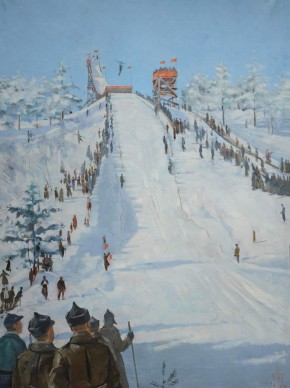
Kavgolovo Ski Jump
- 1936
- Canvas, oil. 120 x 90
- The State Russian Museum
- ЖС-1851
The Toksovo-Kavgolovo district near Petersburg (Leningrad) is the true ski center of the Karelian Isthmus. A great number of sporting facilities are located here, including the famous Kavgolovo Ski Jumps and many international-class ski trails. A natural slope around 40 to 50 meters high and extending for several kilometers forms the basis for the downhill ski trails. This is a very small slope by European standards, but thousands of Leningraders of all ages learned and perfected the basics of alpine skiing on it, some achieving the heights of mastery.
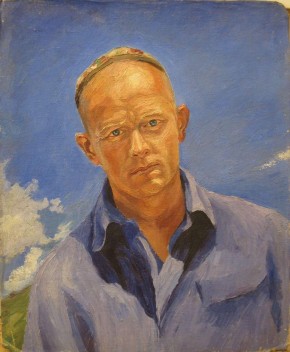
Портрет В. М. Абалакова
- 1937
- plywood, canvas, oil. 55 х 45
- The State Russian Museum
- ЖС-789
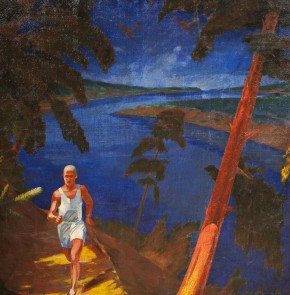
Landscape with a Red Tree (Running)
- 1938
- Canvas, oil. 136 x 132
- The State Russian Museum
- Ж-8962
The idea of a harmoniously developed person was intentionally cultivated in the 1930s and made an appearance in the work of practically every Soviet artist. This painting by Chupyatov, celebrating beauty, strength, and youth, is executed using exclusively picturesque dynamic tools. The diagonal composition, the planetary vision encompassing the Earth, the exaggerated light — all of these together work to create a buoyant image and to sing the praises of an optimistic outlook on life.
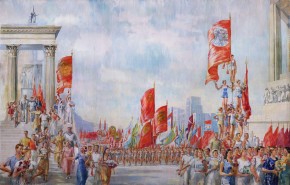
Физкультурный парад
- 1939
- Canvas, oil.
- The State Russian Museum
- Ж-6804
Gymnasts of the USSR
- 1964–1965
- Hardboard, gesso, tempera. 270 x 215
- The State Russian Museum
- Ж-8816
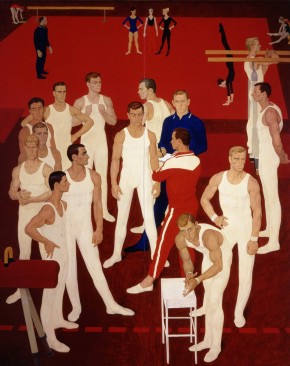
Dmitry Zhilinsky often manifested his creative aspirations in portraiture. One of the idiosyncrasies of his art was his habit of depicting in the concrete not the fleeting, but the most important element of a man’s personality. Zhilinsky preferred clear, collected and intellectual images. He was inspired by the art of the Old Masters, particularly the early Italian Renaissance and Old Russian painting. The artist openly addresses the art of the past in his modem images: «l love exactness of expression and completeness of form – in my own understanding of these words, of course». Zhilinsky’s works are distinguished by their pure and decorative tones, melodious lines, plastic silhouettes and harmonic compositions. The artist’s painting technique was also unusual; he frequently worked in tempera on Ievkas, lending a colourist sublimity to his works. «Gymnasts of the USSR» is, in essence, a group portrait of famous Soviet sportsmen, many of them world and Olympic champions. Among the figures in the background are Polina Astakhova (triple Olympic and twice world champion), Boris Shakhlin (triple Olympic and twice world champion) and Yury Titov (Olympic and world champion, later president of the International Federation of Gymnasts). An original personal «tuning» of thought, will and feelings can be seen in the heroes’ faces and expressive gestures. The distinct composition, sharp foreshortenings and pure tones are also psychological.
Возле старых сараев
- 1975
- Canvas, oil. 140 x 150
- The State Russian Museum
- Ж-9347
Kulikov Ivan Semionovich
1875 Moore, Vladimir Province. - 1941, Moore, Vladimir region.Malevich Kazimir Severinovich
1878, Kiev - 1935, LeningradPainter, graphic artist, writer on art, portraitist, landscapist, abstractionist. Studied at the Kiev School of Art (1895-1896) and Fyodor Roehrberg\'s studio in Moscow (1906-1910). Contributed to exhibitions (from 1905). Contributed to the exhibitions of the Moscow Fellowship of Artists (from 1907), Donkey\'s Tail (1912), Target (1913), Der Blaue Reiter (1912), Salon des Independants (1914), Tramcar V. First Futurist Exhibition (1915) and 0,10. Last Futurist Exhibition (1915-1916). Designed the sets and costumes for the Futurist opera "Victory Over the Sun" (1913). Member of the Union of Youth (1910) and Jack of Diamonds (1910, 1916). Founded the AFFIRMES OF THE NEW ARTgroup (1920). Worked for Department of An People\'s Commissariat of Education (1918-1919). Director of the Museum/Institute of Artistic Culture in Petrograd/Leningrad (1923-1926).
Adlivankin Samuel
PAVLOV Semyon Andreyevich
1893, St Petersburg — 1941, LeningradPainter, graphic artist. Studied at the School of Drawing of the Society for the Encouragement of the Arts (1912–1917); Higher School of Art at the Academy of Arts / Petrograd State Free Art Studios / VKhUTEMAS. Contributed to exhibitions (from 1918). Taught at the Leningrad Institute of Communal Construction Engineers (1930–1932); Ilya Repin Institute of Painting, Sculpture and Architecture (from 1932).
Пискарёва Маргарита Алексеевна
CHUPYATOV Leonid Terentyevich
1890, St Petersburg — 1941, LeningradPainter, graphic artist, theatrical designer, art theorist. Studied in St Petersburg / Pertograd / Leningrad at the School of Drawing, Society for the Encouragement of the Arts (1909–1910); Jan Tsionglinski’s studio in St Petersburg (1909–1912); Mikhail Berstein’s studio (1916); Elizaveta Zvantseva’s art school (1916–1917); Petrograd State Free Art Studios (1918–1921); Scientific Research Department at VKhUTEMAS (1922–1926), where he produced 30 paintings and the essay “The Path of True Realism in Painting”. Worked as assistant in Vladimir Tatlin’s studio. Contributed to exhibitions (from 1916). (1928). Taught at various art schools in Novgorod, Kiev and Leningrad (1919–1933). Set designer for theatres in Leningrad (1933–1941) and Lenfilm Studios (from 1940).
Žilinskij Dmitrij Dmitriyevich
1927, Volnovka (Krasnodar Region) — 2015, MoscowPainter, graphic artist, portraitist, author of thematic pictures. Studied under Chernyshev, Chuikov and Korin at the Vasily Surikov School of Art in Moscow (1946-51). Advised by Vladimir Favorsky. Contributed to exhibitions (from 1954). Honoured Artist of the RUSSIAN SOVIET FEDERATED SOCIALIST REPUBLIC.
Sidorov, Valentin Mikhailovich
Born 1928, Sorokopenie, Tver GuberniaPainter, teacher. Studied at an art studio of the Moscow Palace of Pioneers (1940–1942), Moscow Secondary School of Art (1943–1948), Ilya Repin Institute of Painting, Sculpture and Architecture (1948–1952) and the Vasily Surikov Institute of Art in Moscow (1952–1954). Contributed to exhibition (from 1951). Taught at the Vasily Surikov Institute of Art in Moscow (from 1996). Professor (1996). People’s Artist of the USSR (1988). Winner of the Ilya Repin State Prize (1974), State Prize of the USSR (1984), State Prize of Russia (1997). Awarded a silver medal of the Academy of Arts of the USSR (1972), gold medal of the Academy of Arts of Russia (1996), Order "For Merits for the Fatherland" Grade III (2008) and Grade IV (2003).
Физкультурные игры на стадионе
- 1927
- Canvas, oil. 166 x 249
- The State Russian Museum
- ЖС-93
Физкультурники
- 1928
- Paper, . 28,5 x 19,4
- The State Russian Museum
- РС-8429
Макет книги «Стадион»
- 1929
- Paper, , graphite pencil. 22,6 x 19,2
- The State Russian Museum
- РС-23784
Физкультурница
- 1929
- Canvas, oil. 82,5 х 63,5
- The State Russian Museum
- Ж-6379
Колхозник, будь физкультурником!
- 1930
- Paper, . 73,5 х 104,5
- The State Russian Museum
- Гр.Пл.-167
Спортсменка с мячом
- 1930 (?)
- . 23 x 38,7 x 3,5
- The State Russian Museum
- СО-2413
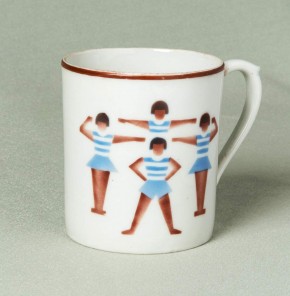
Кружка «Зарядка»
- Porcelain, painting over glaze. 8,9 х 10,9 х 8
- The State Russian Museum
- ДФ-1261
На стадионе
- 1931
- Paper, watercolours. 43,8 x 63,5
- The State Russian Museum
- РС-1608
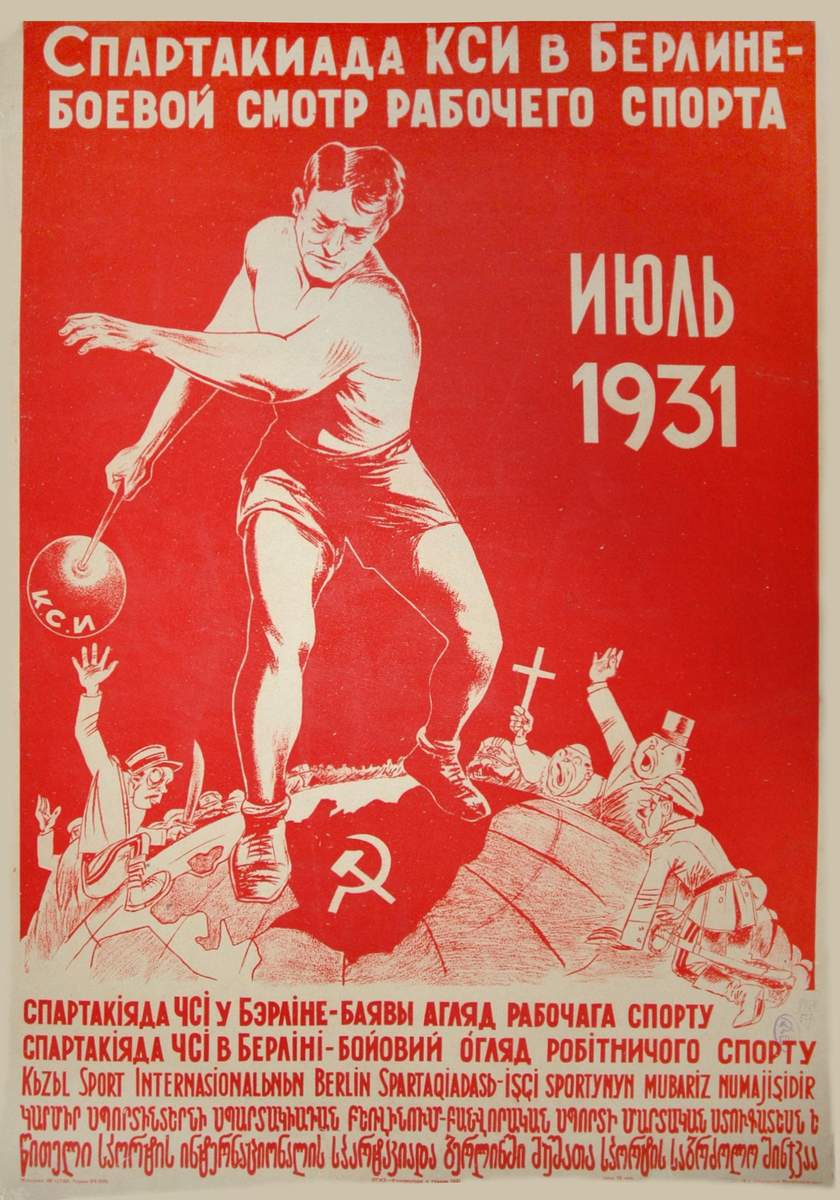
Спартакиада КСИ в Берлине - боевой смотр рабочего спорта
- 1931
- Paper, chromolithography. 72,0 х 51,0
- The State Russian Museum
- Гр.Пл.-1468
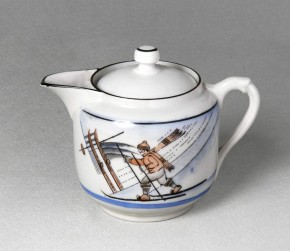
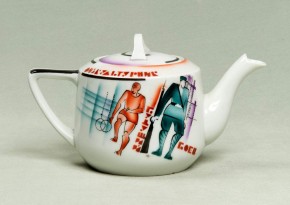
Чайник с крышкой «Физкультурник — будущий боец»
- 1930–1932
- Porcelain, painting over glaze. 12 х 21,5 х 12
- The State Russian Museum
- ДФ-1341 а,б
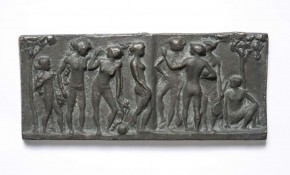
Физкультурницы
- 1932
- Bronze. 11 x 24 x 1,5
- The State Russian Museum
- СО-1669
«Работать, строить и не ныть ...»
- 1933
- Paper, chromolithography. 102,2 х 73,3
- The State Russian Museum
- Гр.Пл.-2336
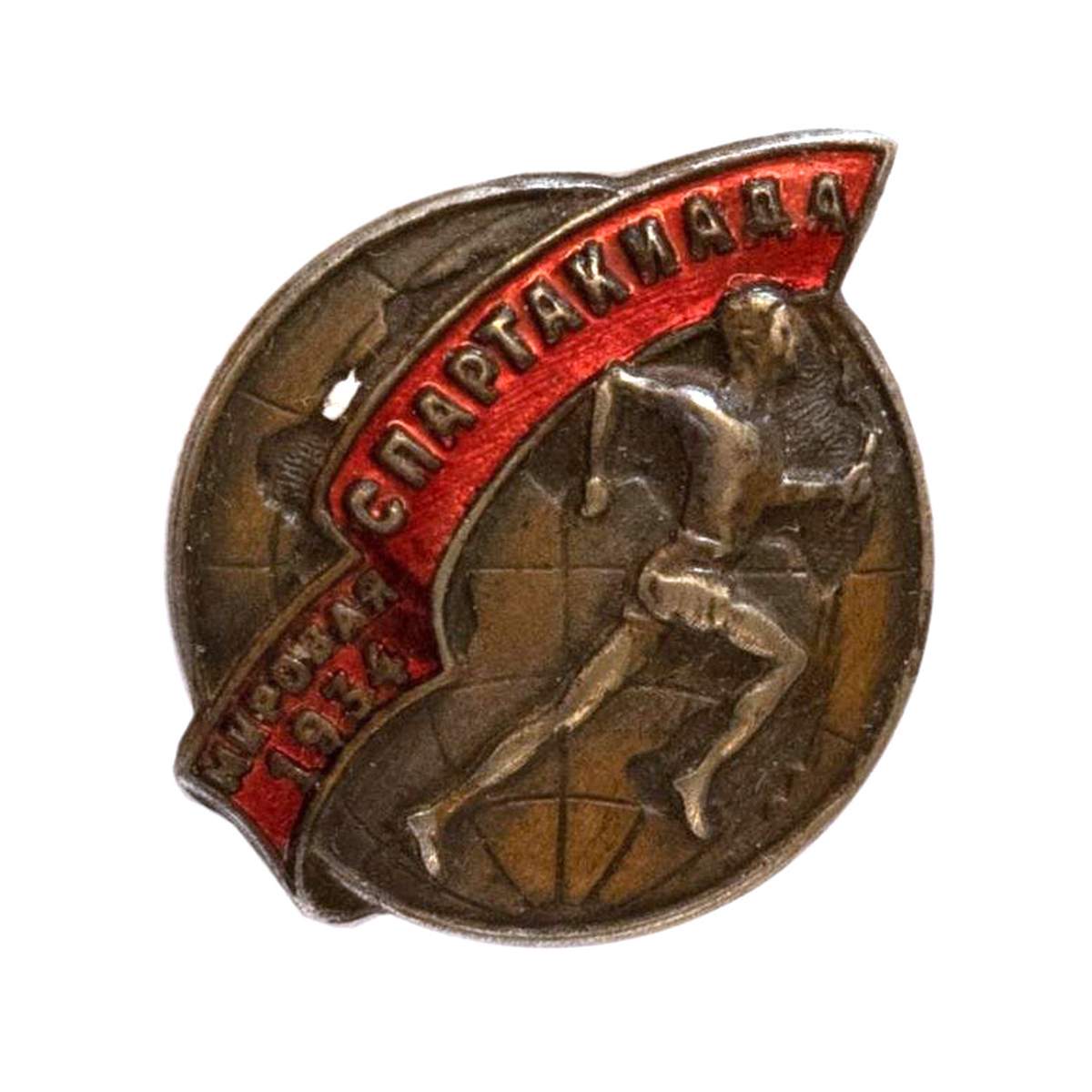
Значок «Мировая спартакиада»
- 1934
- Enamel. 21 x 24
- The State Russian Museum
- Мед.А-8292
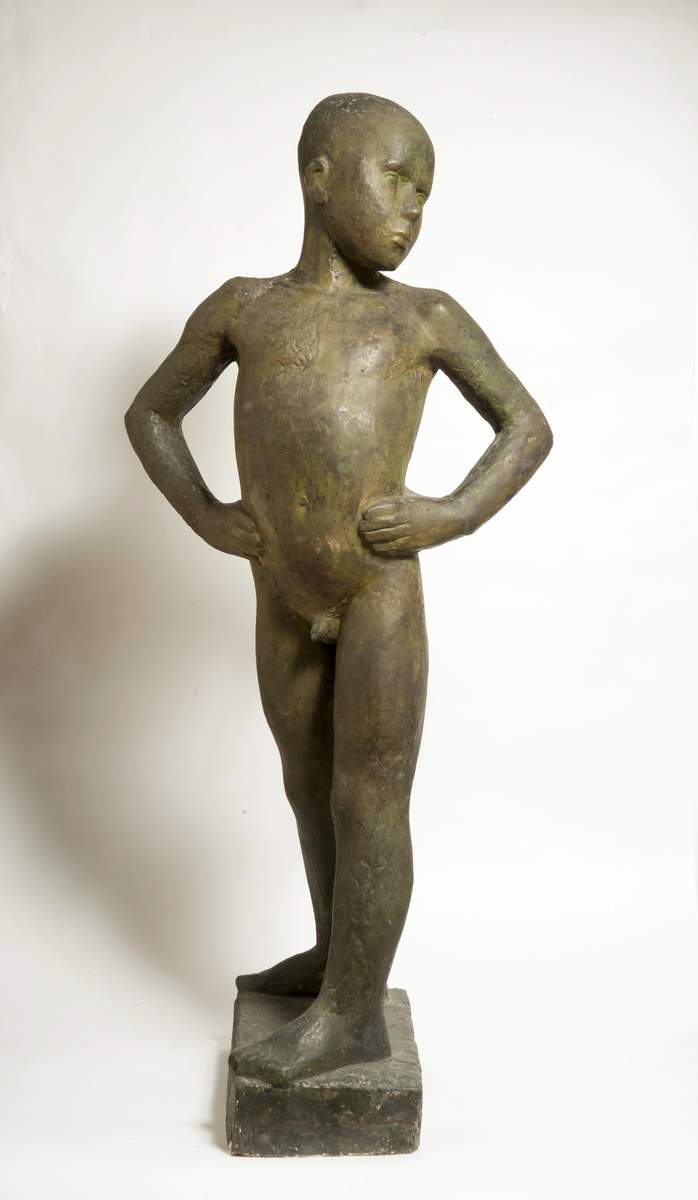
Утренняя зарядка
- 1934
- . 139 х 61 х 43
- The State Russian Museum
- СО-109
Чернильница с крышкой «Физкультурницы»
- 1933-1934
- Porcelain, painting over glaze.
- The State Russian Museum
- СФ-141/а,б
At the Stadium
- 1934–1935
- Canvas, oil. 121 х 140,5
- The State Russian Museum
- ЖБ-1723
Sport was one of the most popular themes in Soviet art in the mid-1920s and 1930s. Called upon to form the ideal of the new man, artists discerned its prototype in athletes — handsome young men and women perfecting their bodies and hardening the spirit. Sportsmen became the main characters of the works of Alexander Samokhvalov, who dreamt of uniting them in a grandiose monumental composition. Perhaps that is why so many of his paintings of this period are like details of a large, multi-figure fresco. The artist himself described sport as an “existential joy” helping people overcome difficulties “in the struggle for the creation of a new life” and furthering their “love for humankind”. “I loved sport as the culture of healthy, vivacious and joyful people… I was attracted to the healthy creative spirit in healthy bodies,” he wrote.
Sergei Kirov Reviews the Athletic Parade
- 1935
- Canvas, oil. 305 х 372
- The State Russian Museum
- ЖБ-1962
Sergei Mironovich Kirov (Kostrikov) (1886–1934): Communist arty functionary and member of he Soviet leadership. First secretary of the Communist Party in Leningrad (1926–34).
Following Sergei Kirov’s murder in 1934, a multitude of portraits and works on themes from his real and mythical biographies appeared in Soviet painting and sculpture. Alexander Samokhvalov painted a portrait of Kirov, Kirov on a Construction Site and his first ever large picture-panel — Sergei Kirov Receiving a Parade of Athletes. The artist had long dreamt of painting a multi-figure monumental picture resolved like a fresco. Work on the canvas lasted a long time. Striving to create a fresco-like effect, Samokhvalov experimented with colours, seeking decorative tones that would simultaneously be lifelike and natural. He finally chose a classical and solemn gamut of warm tones. The action takes place on Palace Square in Leningrad. The space is enclosed by the facade of General Headquarters with an enormous portrait of Lenin. The eyes of the athletes are rivetted on the figure of Sergei Kirov and other members of the Leningrad government on the rostrum. A group of girls break away from the main group to hand Kirov a bouquet of flowers.
The concept and painting of the panel reflect the main tendencies in the Soviet art of the 1930s. This was an aspiration towards monumentality and an image of the new Soviet citizen — a labourer, hero and romantic, morally and physically strong and handsome. Russian Museum: From Icons to the Modern Times. Palace Editions, St Petersburg, 2015. P. 349.
Физкультура (девушка)
- 1935
- .
- The State Russian Museum
- СО/ПФ-13
Физкультурница после плавания
- 1935
- . 63 х 25 х 15
- The State Russian Museum
- СО-151
Физкультурный парад
- 1939
- Canvas, oil.
- The State Russian Museum
- Ж-6804
Новиков Петр Васильевич
Якерсон Давид Аронович
Unknown painter
Пащинская (Пащинская-Максимова) Надежда Николаевна
Айзенштадт Меер Бенцианович
Danko Natalia
Leningrad Porcelain Factory / State Porcelain Factory named after M.V. Lomonosov
Могилевский Наум (Нохим-Лейб) Семенович (Шнеерович)
Браиловский Абрам Аронович
Янсон-Манизер Елена Александровна
Лыжная вылазка
- 1930
- Paper, chromolithography. 37,2 х 52,0
- The State Russian Museum
- Гр.Пл.-1975
Contest of Young Modellers
- 1931
- Canvas, oil. 121 x 95
- The State Russian Museum
- ЖБ-1862
The idea of conquering space and time, key for other genres and types of Soviet art as well, became in the 1920s and 1930s extremely important in reference to works about sport. The ideological and instructional aspects of sport connected with the task of preparing physically developed people, “ready for labour and defence”, became the main focus (the legendary GTO (ready for labour and defence) pin appears in 1930, when the topic of sport is definitively confirmed as an important division of Soviet art). Sport as an integral part of preparing the Soviet individual for any difficulty becomes a leitmotif in the work of many artists, including Adlivankin.
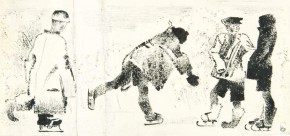
На коньках
- 1930s
- Paper, ink.
- The State Russian Museum
- РС-1270
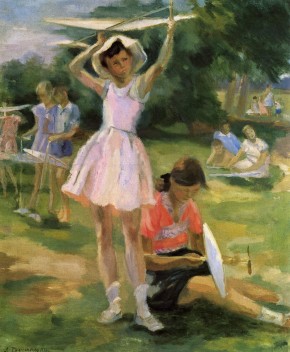
Девочка-планеристка (Девочка с авиамоделями)
- 1936
- Canvas, oil.
- The State Russian Museum
- ЖС-413
Игра в футбол
- 1936
- Paper, graphite pencil.
- The State Russian Museum
- РС-5248
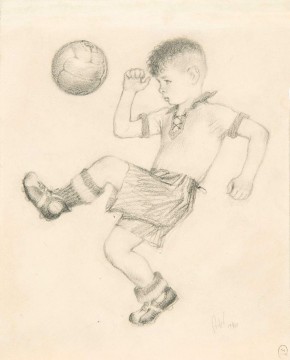
Игра в футбол
- 1940
- .
- The State Russian Museum
- С.Гр.-10265
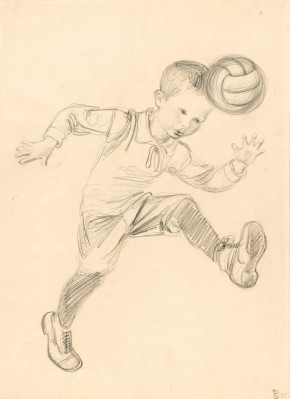
Футболист
- 1940
- Paper, graphite pencil.
- The State Russian Museum
- РС-5587
Суворовцы на лыжах
- .
- The State Russian Museum
- С.Гр.-16133
Фигура "Лыжница"
- 1953
- Porcelain, painting over glaze, gilding.
- The State Russian Museum
- СФ-459
Лыжники
- 1956
- Paper, lithography.
- The State Russian Museum
- С.Гр.-9229
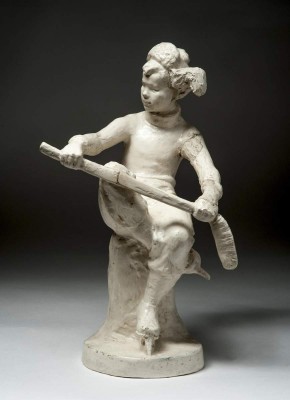
Мальчик-хоккеист
- 1956
- Lacquer. 26,5 x 14,5 x 17
- The State Russian Museum
- СО-2634
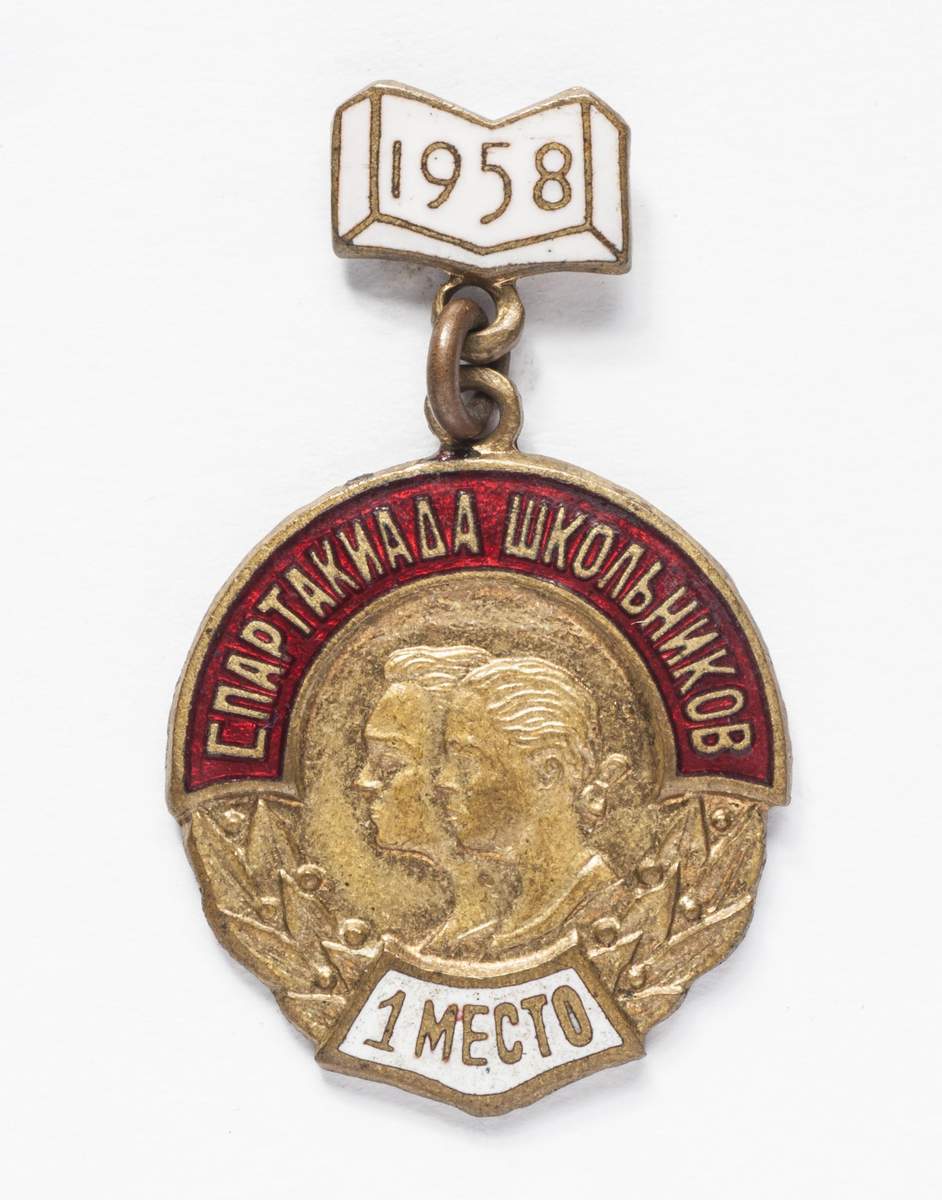
Знак нагрудный участника Спартакиады школьников, 1 место
- 1958
- Brass, enamel.
- The State Russian Museum
- Мед.А-9426
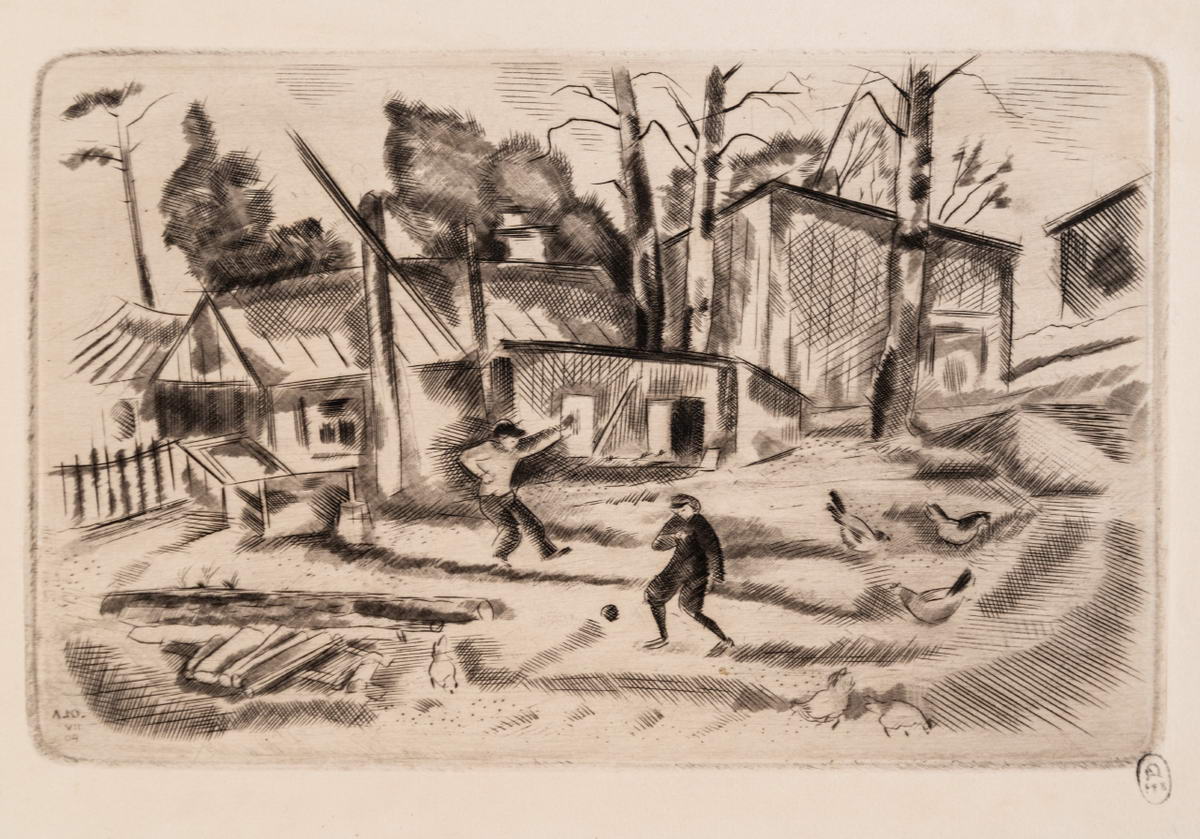
Возле старых сараев
- 1975
- Canvas, oil. 140 x 150
- The State Russian Museum
- Ж-9347
Петрушин Б.
Pakhomov Alexei Fyorovich
1900, Varlamovo, Vologda Province — 1973, LeningradPainter, graphic artist, monumentalist, book artist, sculptor, painter of portraits, genre scenes and watercolours, illustrated children’s books and journals, designed posters. Studied at the Baron Stieglitz Central School of Technical Drawing (1915–1917) in Petrograd / Leningrad; Petrograd State Free Art Studios / VKhUTEMAS / VKhUTEIN (1922–1925); Academy of Arts, graphic department (1926). Contributed to exhibitions (from 1921). Worked for the Okna ROSTA political poster studio (1921) and various publishing houses (1923–1925); produced monumental interior paintings for public buildings in Leningrad (1920s — 1930s). Taught. Professor (1949). Author of the book About My Work (1968–1969). Member of the arts council at the “Children’s Literature” and “Artist” publishing houses. Honoured Artist of the RSFSR (1945), People’s Artist of the RSFSR (1963), People’s Artist of the USSR (1971), corresponding (1958) and full (1964) member of the USSR Academy of Arts. Winner of the Stalin Prize (1946) and State Prize (1973). Awarded a major gold medal at the International Exhibition in Paris (1937) for the Children of the Soviet Land panel made for the Soviet pavilion.
Тимошенко Лидия Яковлевна
Юдин Лев Александрович
Матюх Вера Федоровна
Столбова Галина Сергеевна
Лупанова Елизавета Николаевна
Разумовский Лев Самсонович
Макет книги «Стадион»
- 1929
- Paper, , graphite pencil, watercolours, whiting. 19,2 х 22,3
- The State Russian Museum
- РС-23790
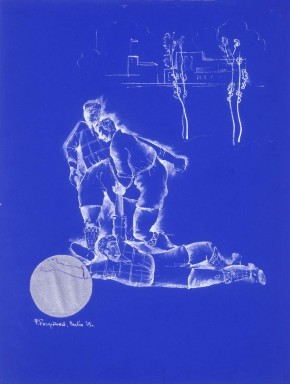
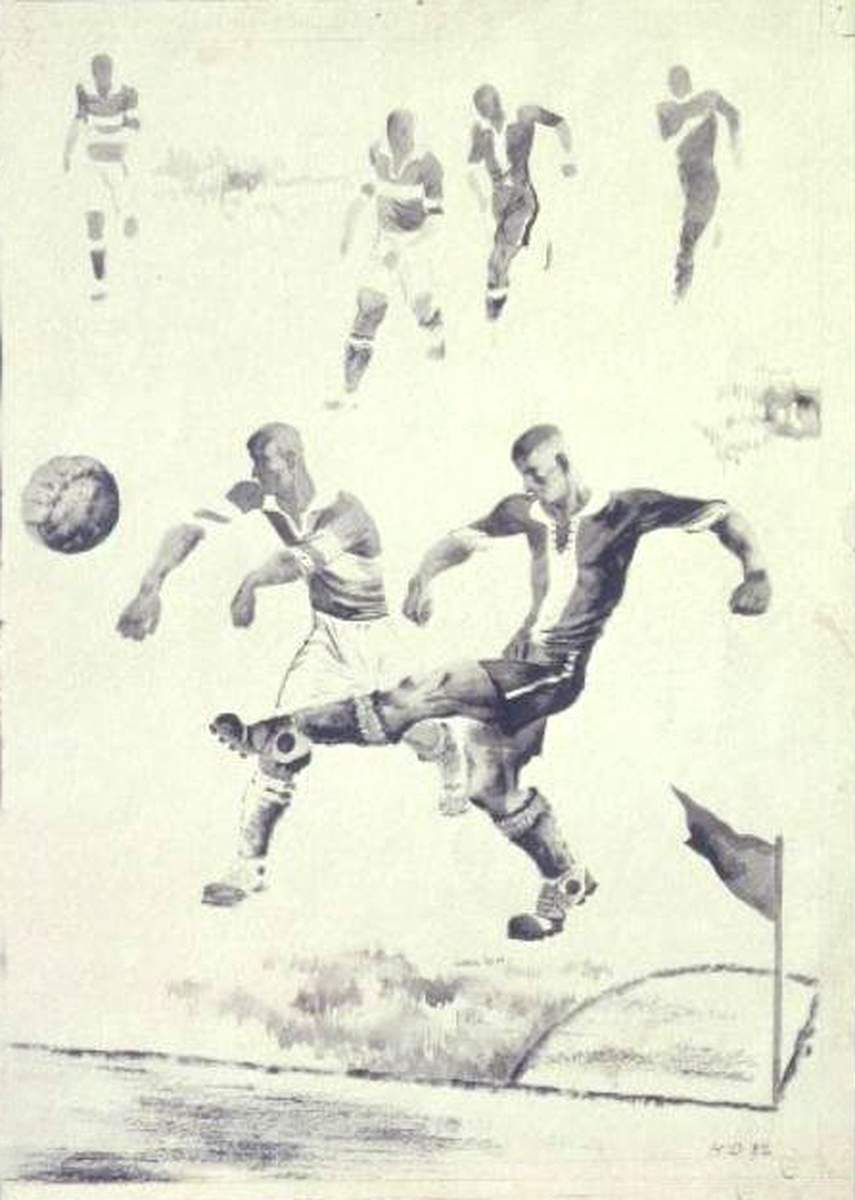
Футбол
- 1929
- whiting. 28,8 x 21,9
- The State Russian Museum
- РС-8398
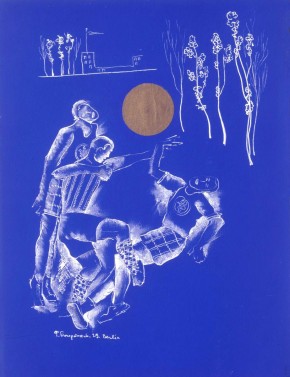
Футбол
- 1929
- whiting. 28,8 x 21,9
- The State Russian Museum
- РС-8397
Sergei Kirov Reviews the Athletic Parade
- 1935
- Canvas, oil. 305 х 372
- The State Russian Museum
- ЖБ-1962
Sergei Mironovich Kirov (Kostrikov) (1886–1934): Communist arty functionary and member of he Soviet leadership. First secretary of the Communist Party in Leningrad (1926–34).
Following Sergei Kirov’s murder in 1934, a multitude of portraits and works on themes from his real and mythical biographies appeared in Soviet painting and sculpture. Alexander Samokhvalov painted a portrait of Kirov, Kirov on a Construction Site and his first ever large picture-panel — Sergei Kirov Receiving a Parade of Athletes. The artist had long dreamt of painting a multi-figure monumental picture resolved like a fresco. Work on the canvas lasted a long time. Striving to create a fresco-like effect, Samokhvalov experimented with colours, seeking decorative tones that would simultaneously be lifelike and natural. He finally chose a classical and solemn gamut of warm tones. The action takes place on Palace Square in Leningrad. The space is enclosed by the facade of General Headquarters with an enormous portrait of Lenin. The eyes of the athletes are rivetted on the figure of Sergei Kirov and other members of the Leningrad government on the rostrum. A group of girls break away from the main group to hand Kirov a bouquet of flowers.
The concept and painting of the panel reflect the main tendencies in the Soviet art of the 1930s. This was an aspiration towards monumentality and an image of the new Soviet citizen — a labourer, hero and romantic, morally and physically strong and handsome. Russian Museum: From Icons to the Modern Times. Palace Editions, St Petersburg, 2015. P. 349.
Физкультурный парад
- 1939
- Canvas, oil.
- The State Russian Museum
- Ж-6804
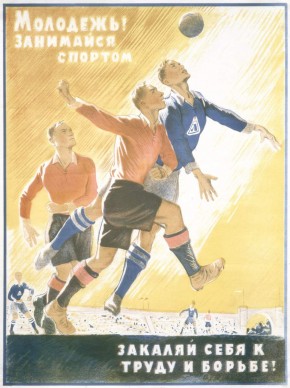
Молодежь! Занимайся спортом...
- 1945
- Paper, chromolithography.
- The State Russian Museum
- Гр.Пл.-2065
Начало игры
- 1957
- Paper, .
- The State Russian Museum
- С.Гр.-17185
Знак нагрудный участника Спартакиады школьников, 1 место
- 1958
- Brass, enamel.
- The State Russian Museum
- Мед.А-9426
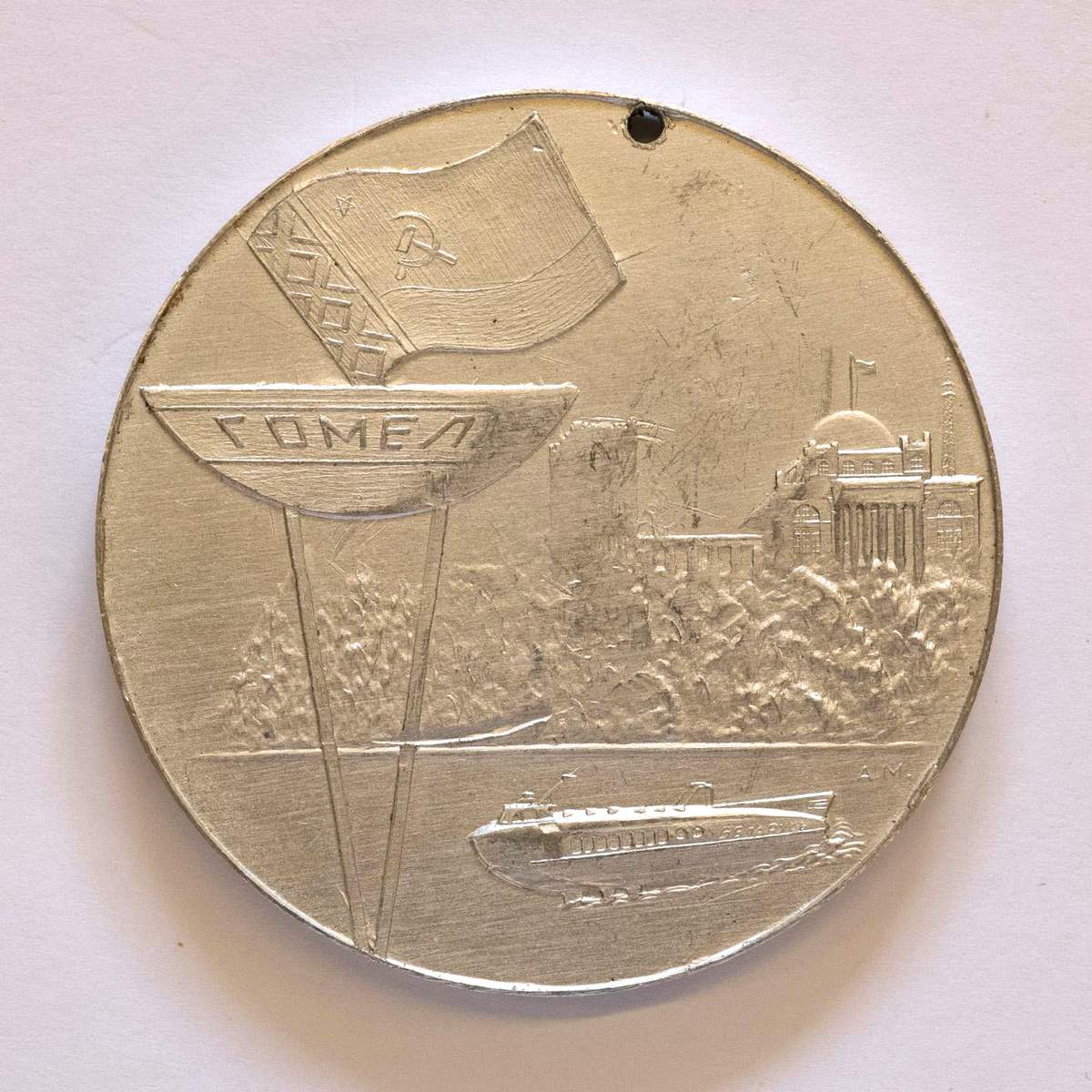
Медаль IV-й юбилейной спартакиады Гомельщины (1 место)
- 1967
- .
- The State Russian Museum
- Мед.А-7576
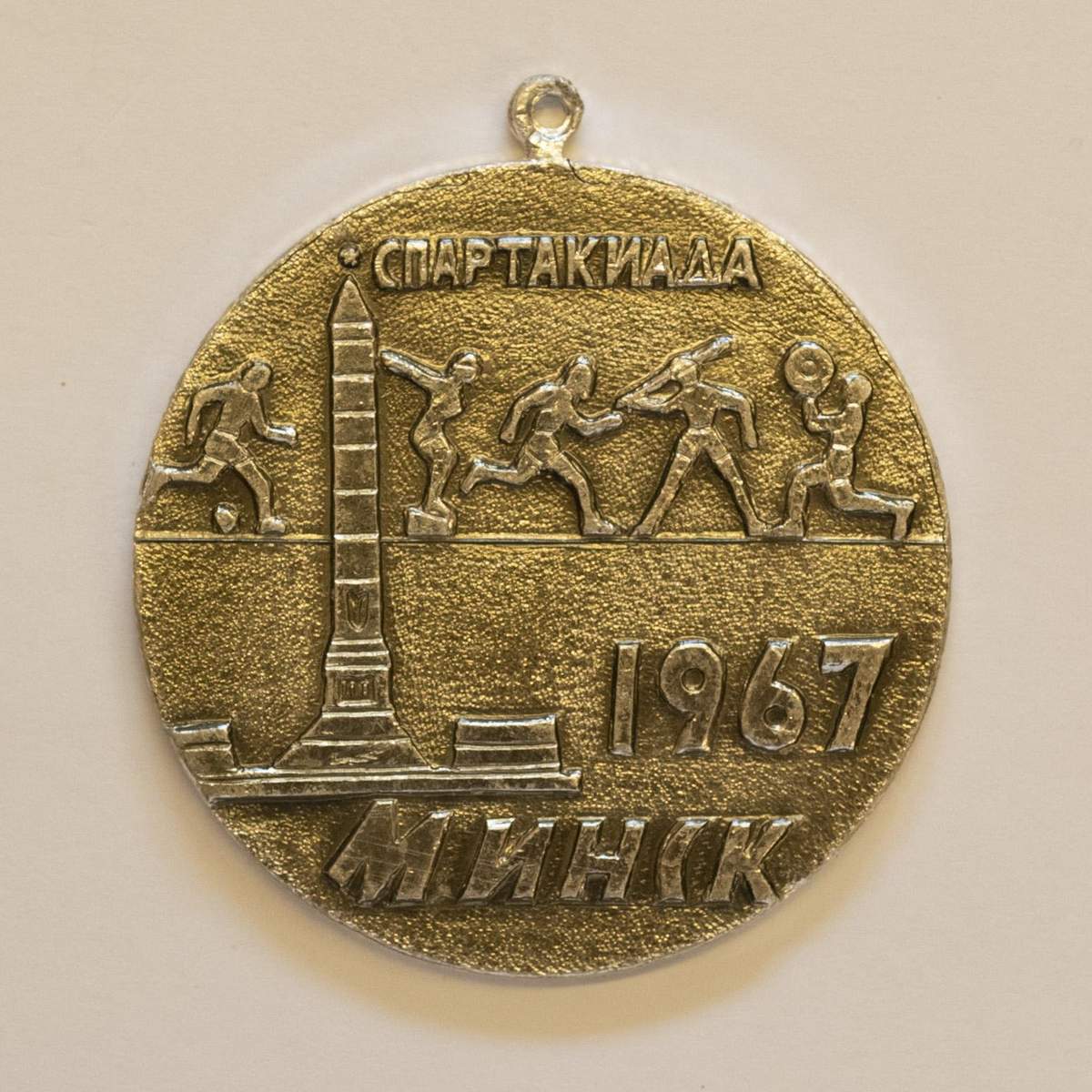
Медаль спартакиады Белорусской ССР, Минск
- 1967
- .
- The State Russian Museum
- Мед.А-7541
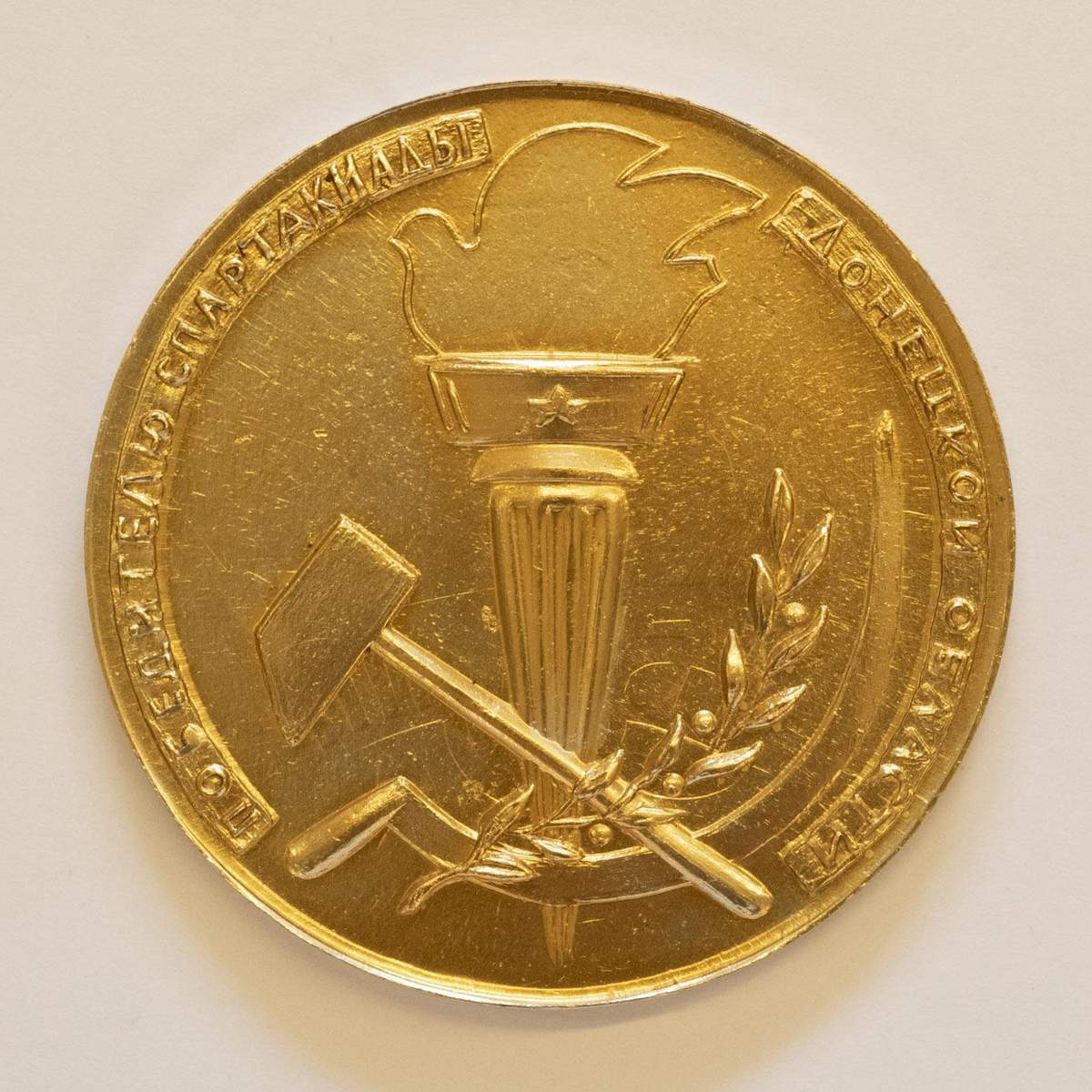
Медаль спартакиады Донецкой области
- 1967
- .
- The State Russian Museum
- Мед.А-7553
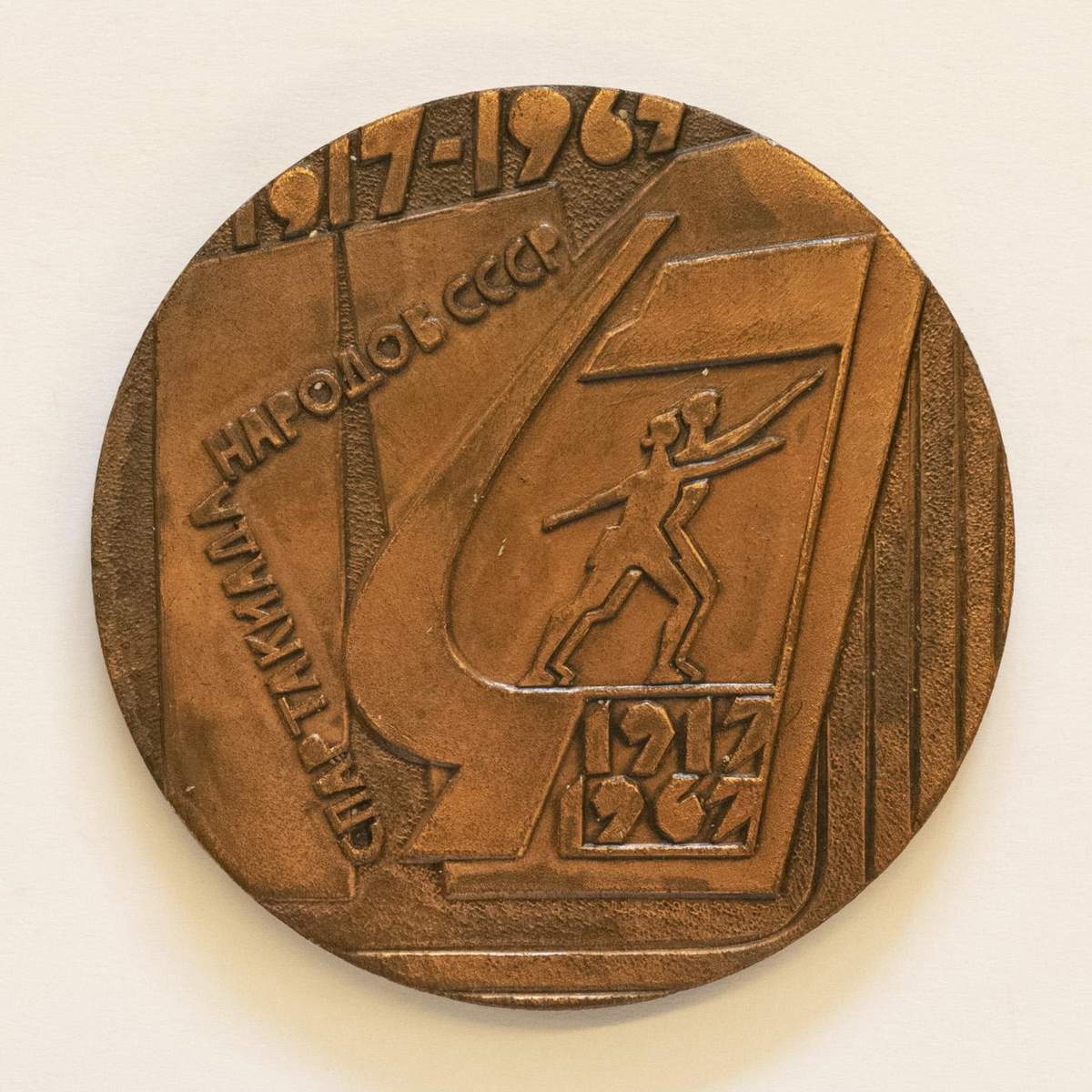
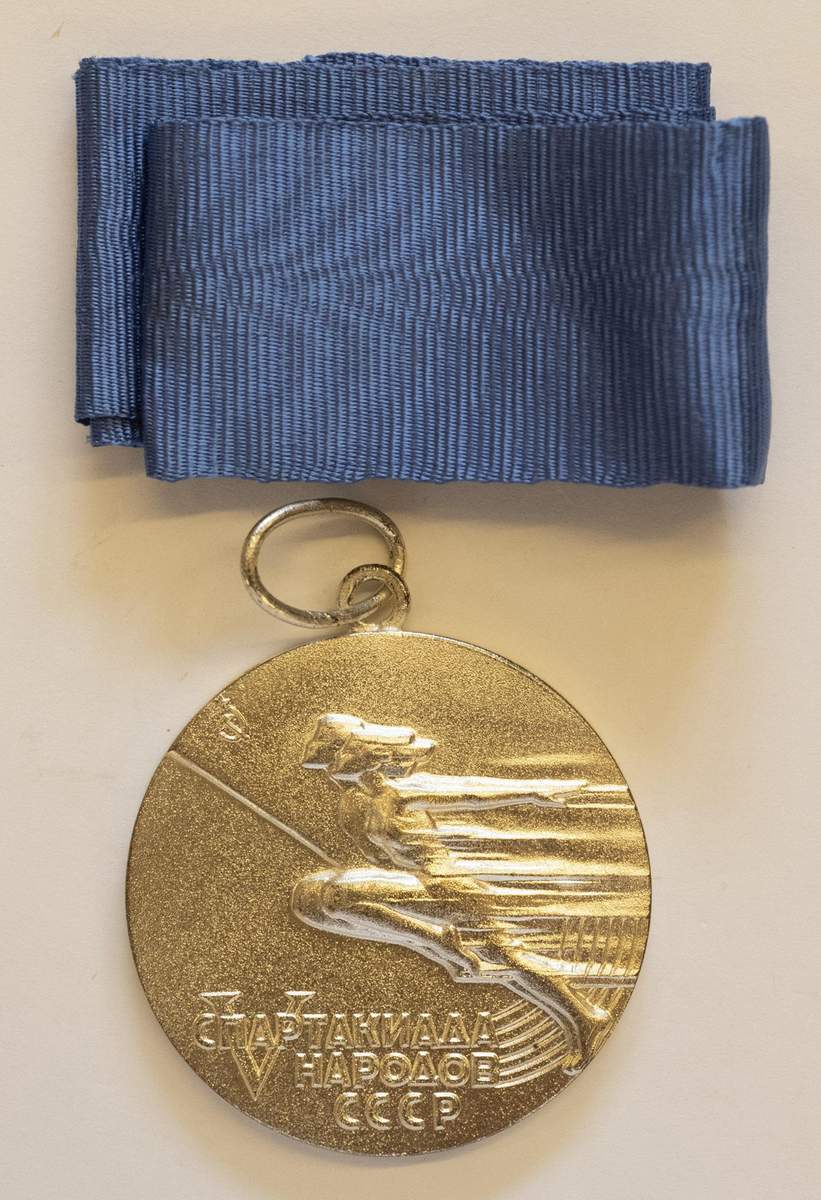
Медаль спартакиады народов СССР, в память 50-летия Великого Октября
- 1967
- .
- The State Russian Museum
- Мед.А-7587
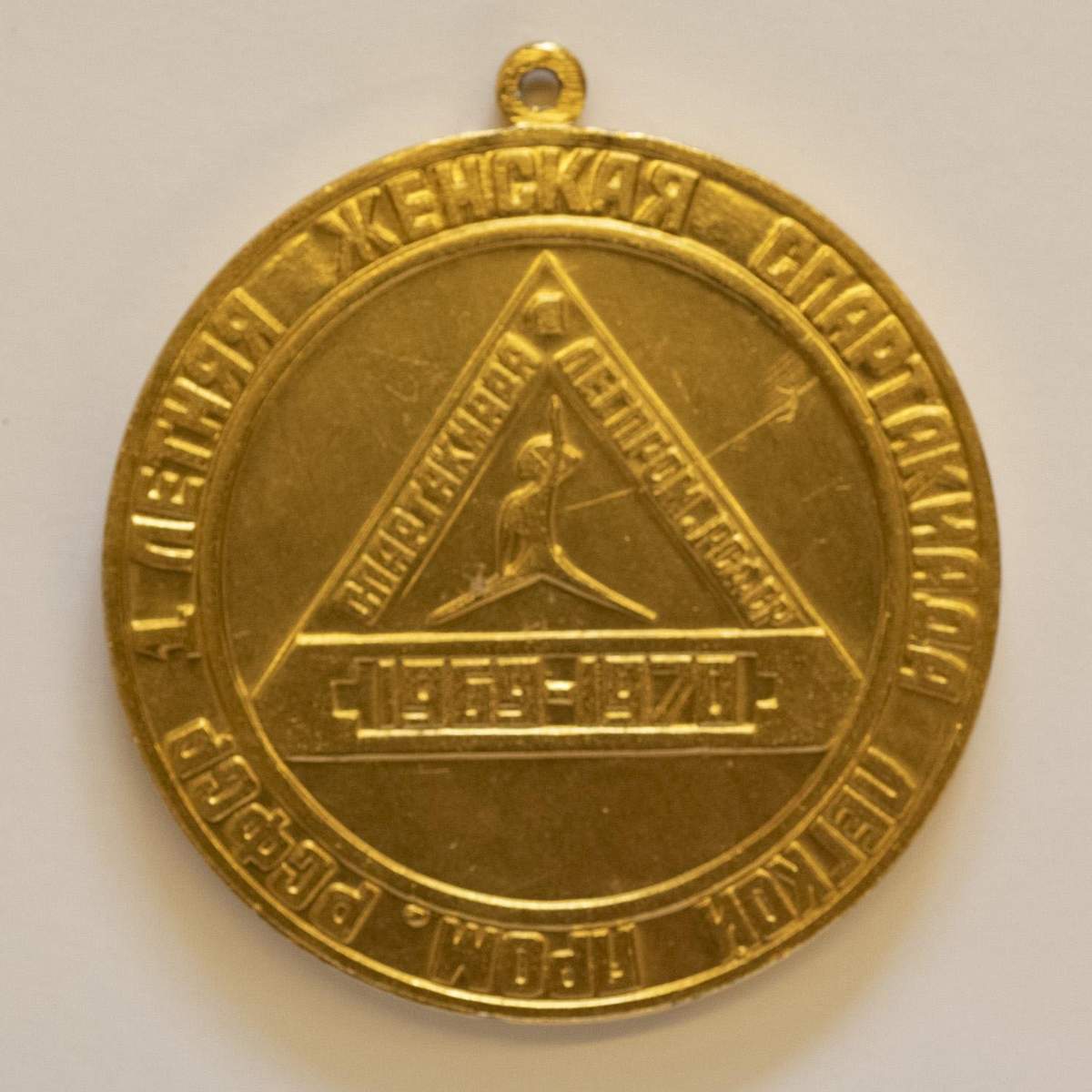
1-й женской летней спартакиады легкой промышленности
- 1969-1970
- .
- The State Russian Museum
- Мед.А-7552
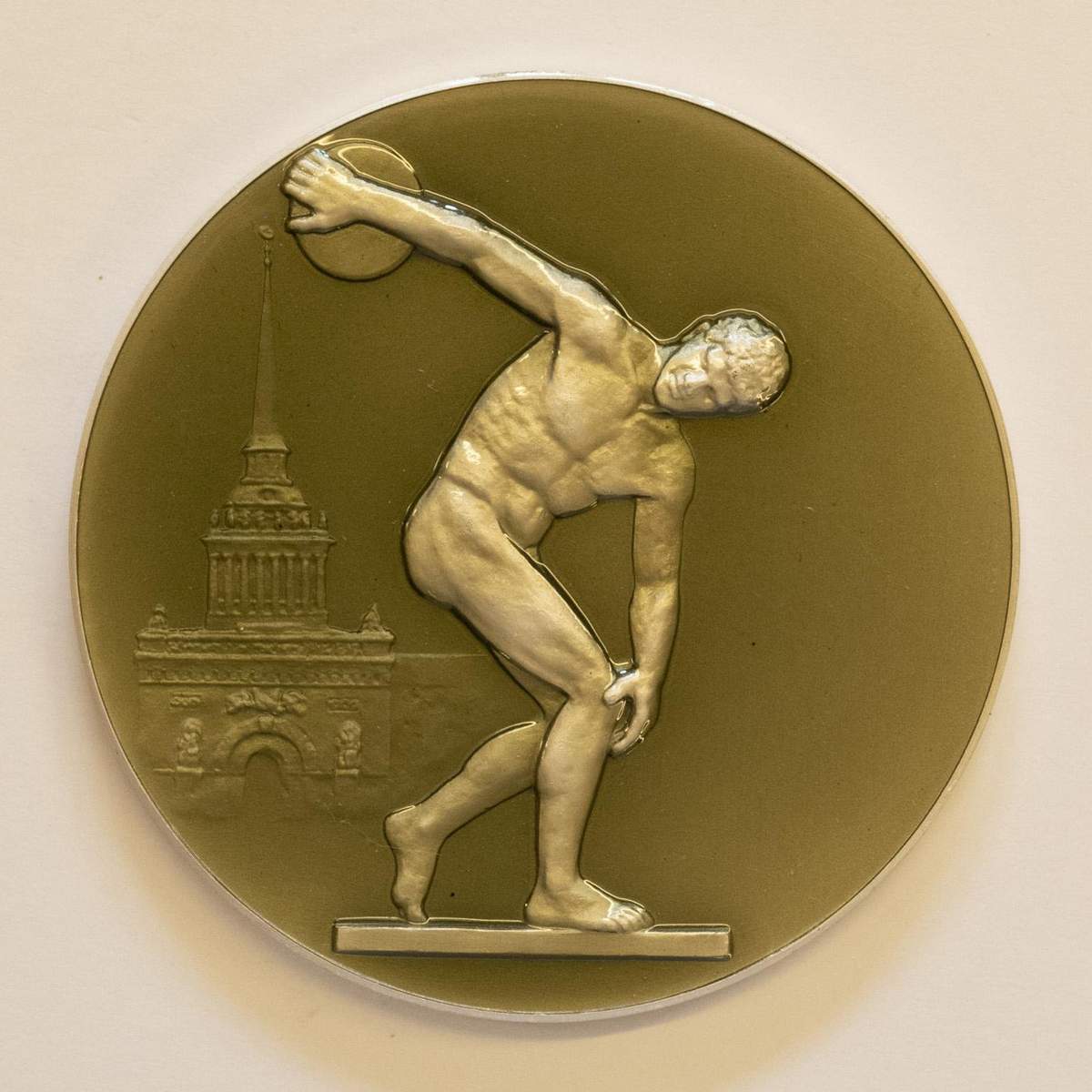
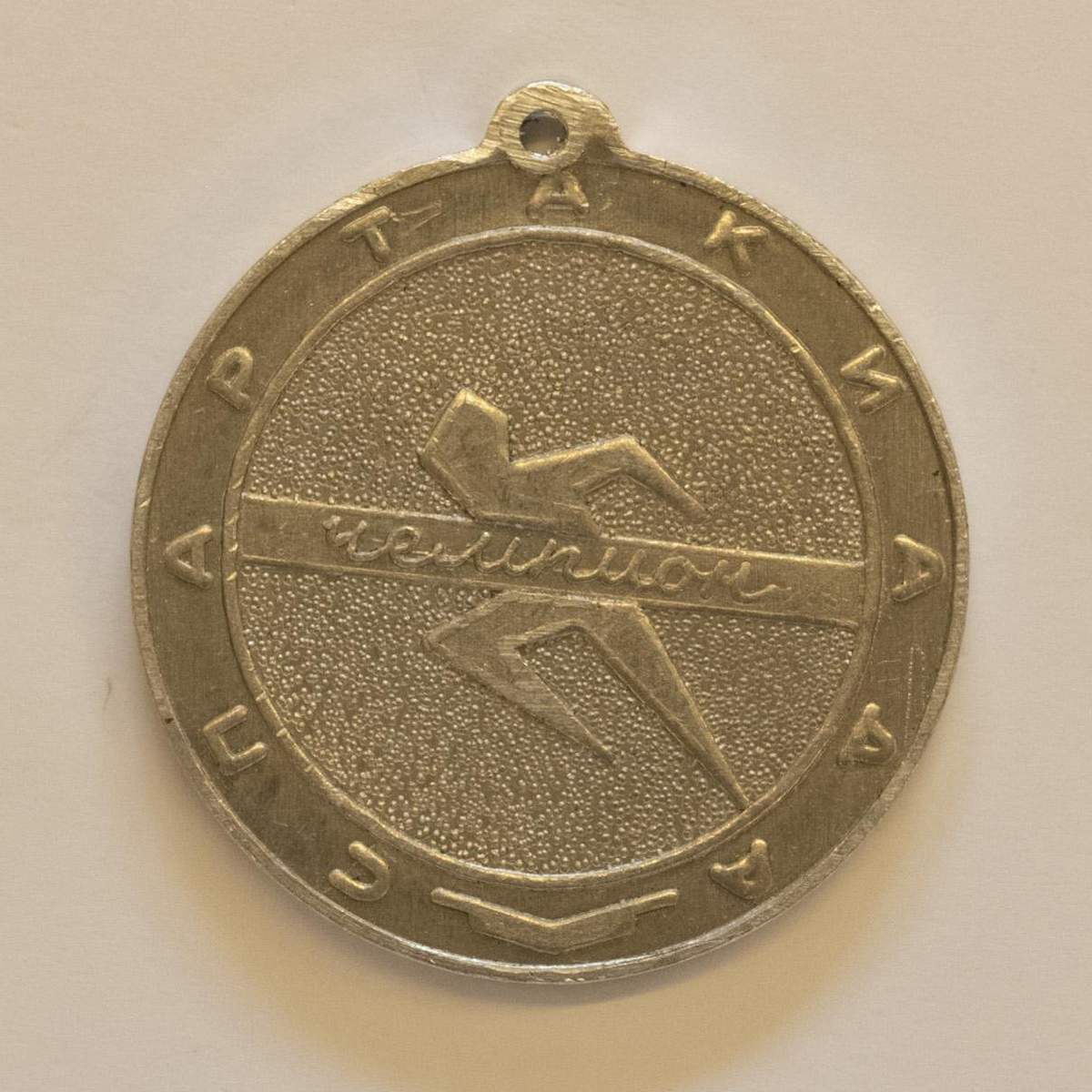
Медаль памятная «Спартакиада Ленинграда»
- .
- The State Russian Museum
- Мед.А-5630
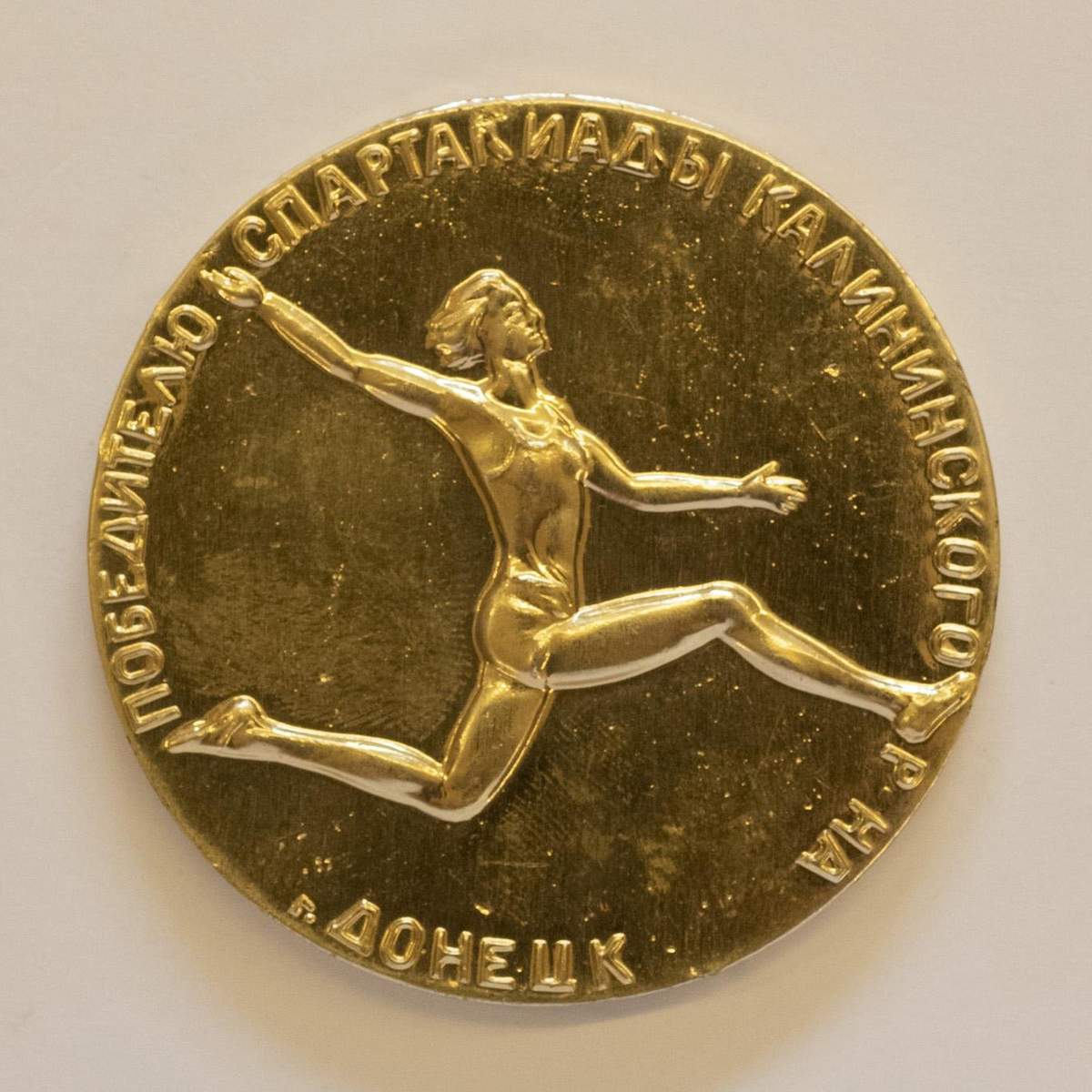
Медаль спартакиады Калининского района г. Донецка
- .
- The State Russian Museum
- Мед.А-7563
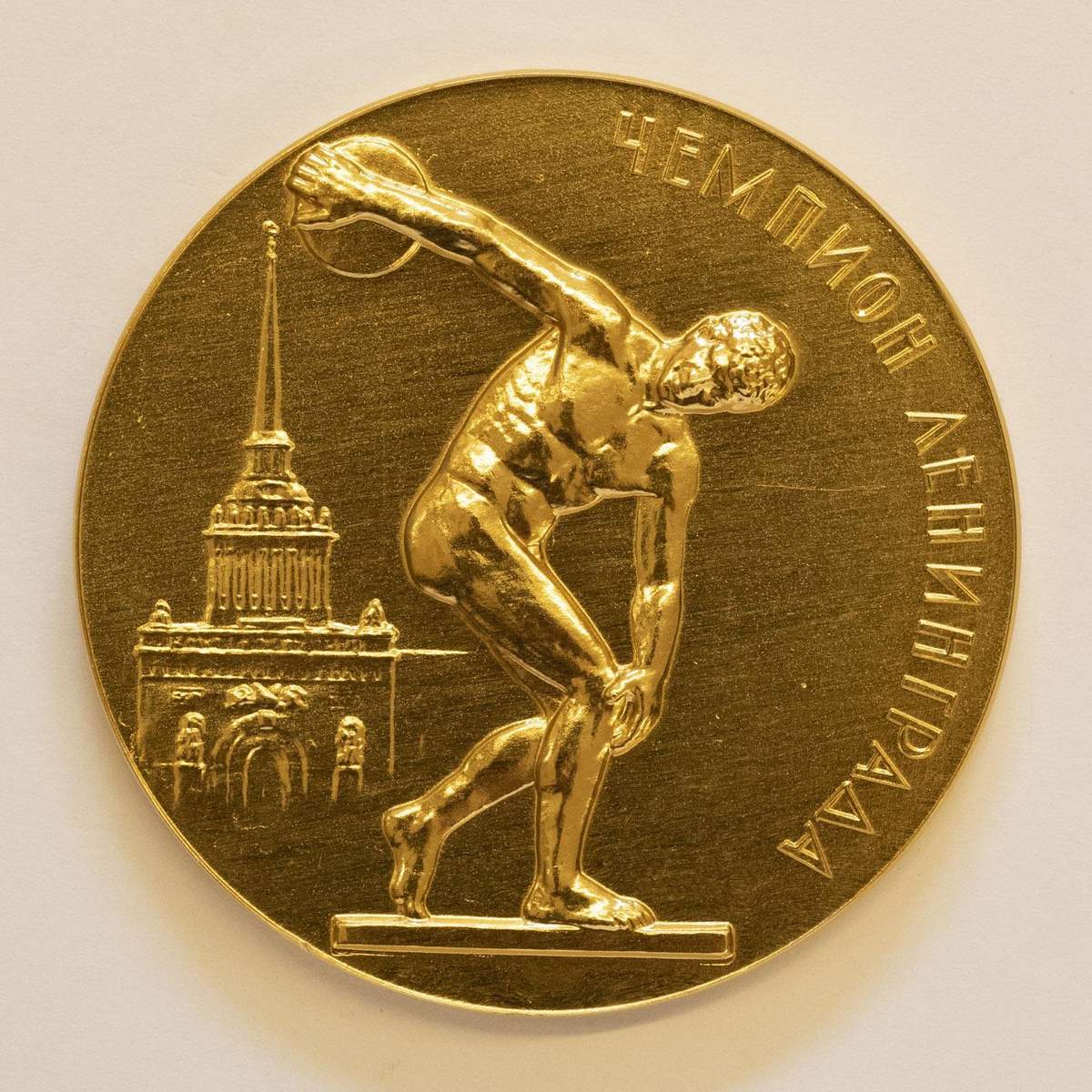
Медаль чемпиона Ленинградской Спартакиады
- .
- The State Russian Museum
- Мед.А-5631
Спартакиады спортклуба «Стрела», гор. Запорожье
- .
- The State Russian Museum
- Мед.А-7550
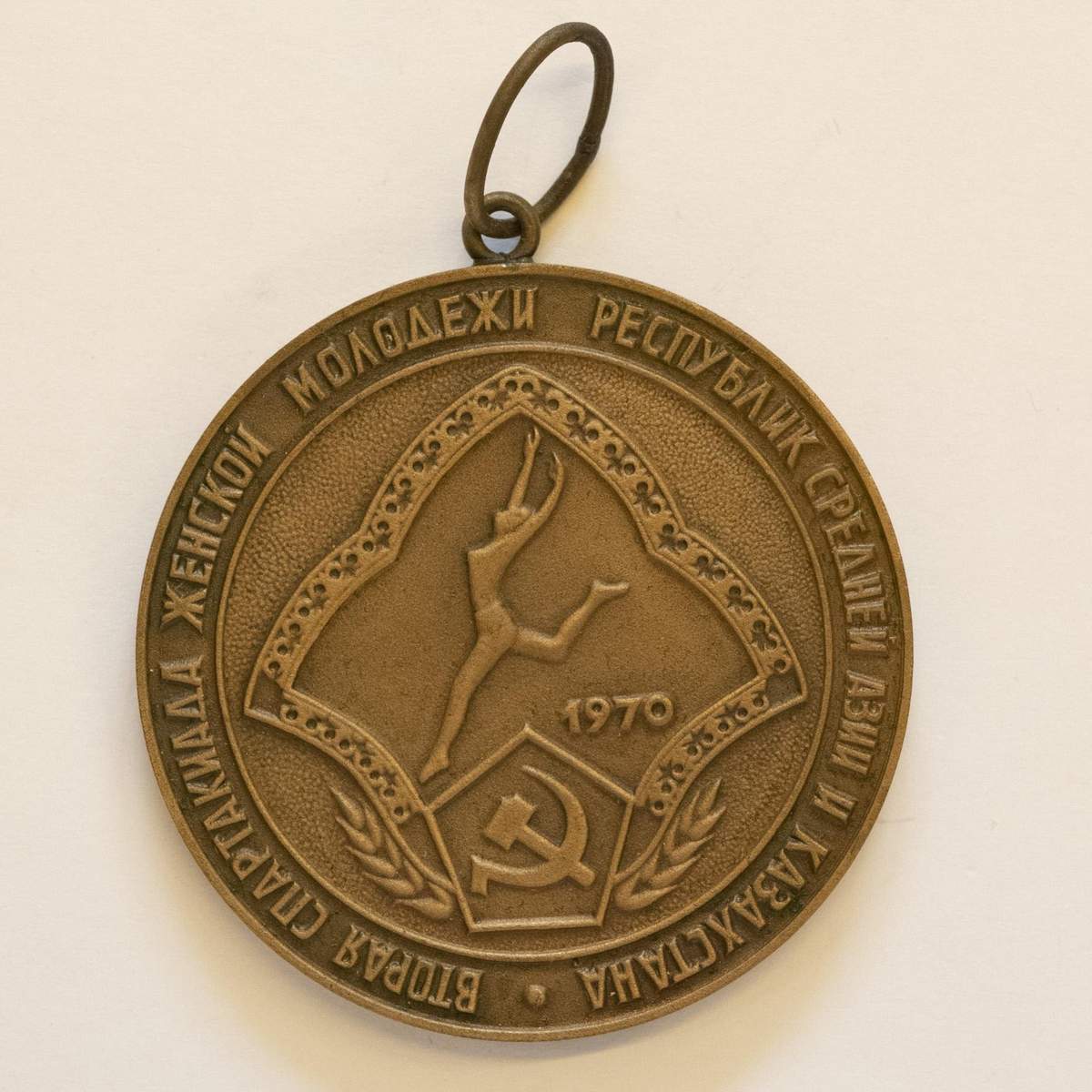
Медаль памятная спортивная «Победителю II-й спартакиады женской молодежи республик Средней Азии и Казахстана», г. Фрунзе
- 1970
- .
- The State Russian Museum
- Мед.А-12321
Медаль спортивная «Тренеру за подготовку победителя на V-й летней Спартакиаде Народов СССР»
- 1971
- .
- The State Russian Museum
- Мед.А-13088
Медаль спортивная, V-й летней Спартакиады народов СССР. II место
- 1971
- .
- The State Russian Museum
- Мед.А-13080
Bogorodsky Fyodor Semyonovich
1895, Nizhny Novgorod — 1959, MoscowPainter, graphic artist; theatrical designer. Studied at the Faculty of Law, Moscow University and studios of M. Le Blanc (1914–1916); VKhUTEMAS in Moscow (1922–1924). Contributed to exhibitions (from 1916). Professor, head of the painting and drawing department at the All-Union Institute of Cinematography (1938–1959). Honoured Artist of the RSFSR (1946), corresponding member of the USSR Academy of Arts (1947).
Кочергин Николай Михайлович
Ermolayev Boris Nikolayevich
1903, St Petersburg — 1982, LeningradGraphic artist, illustrator of books and magazines, lithographer. Studied at the Art Restoration Studios / Leningrad College of Art and Industry (1921–1925). Contributed to exhibitions (from 1928). Member of the Union of Artists (1941). Contributed to newspapers Leninskiye Iskry, Bytovaya Gazeta, and magazines Krasnaya Panorama, Yuny Proletary, Rezets, illustrated children’s books (1927–1934). Worked at the lithographic shop of the Leningrad Union of Artists (from 1940).
Модлинский А. И.
Козлов Александр Васильевич
Портрет В. М. Абалакова
- 1937
- plywood, canvas, oil. 55 х 45
- The State Russian Museum
- ЖС-789
Серафим Знаменский (Чемпион по бегу)
- 1940
- Bronze. 38 x 10 x 12,5
- The State Russian Museum
- СО-769
Конькобежка
- 1949
- . 24 х 37 х 20
- The State Russian Museum
- СО-1890
Борис Шахлин
- 1963
- Paper, . 59,5 x 37,2
- The State Russian Museum
- РС-26503
Валерий Кардемилиди
- 1963
- Paper, .
- The State Russian Museum
- РС-26498
Юрий Титов
- 1963
- Paper, . 59,5 x 42,1
- The State Russian Museum
- РС-26504
Gymnasts of the USSR
- 1964–1965
- Hardboard, gesso, tempera. 270 x 215
- The State Russian Museum
- Ж-8816
Dmitry Zhilinsky often manifested his creative aspirations in portraiture. One of the idiosyncrasies of his art was his habit of depicting in the concrete not the fleeting, but the most important element of a man’s personality. Zhilinsky preferred clear, collected and intellectual images. He was inspired by the art of the Old Masters, particularly the early Italian Renaissance and Old Russian painting. The artist openly addresses the art of the past in his modem images: «l love exactness of expression and completeness of form – in my own understanding of these words, of course». Zhilinsky’s works are distinguished by their pure and decorative tones, melodious lines, plastic silhouettes and harmonic compositions. The artist’s painting technique was also unusual; he frequently worked in tempera on Ievkas, lending a colourist sublimity to his works. «Gymnasts of the USSR» is, in essence, a group portrait of famous Soviet sportsmen, many of them world and Olympic champions. Among the figures in the background are Polina Astakhova (triple Olympic and twice world champion), Boris Shakhlin (triple Olympic and twice world champion) and Yury Titov (Olympic and world champion, later president of the International Federation of Gymnasts). An original personal «tuning» of thought, will and feelings can be seen in the heroes’ faces and expressive gestures. The distinct composition, sharp foreshortenings and pure tones are also psychological.
Футболисты (мастера спорта В. И. Панчихин и Л. Д. Бурчалкин)
- 1964
- Bronze, wood.
- The State Russian Museum
- СО-1372
Юрий Цапенко
- 1964
- Paper, . 59,3 x 41,5
- The State Russian Museum
- РС-26497
Lebedeva (Darmolatova), Sarah Dmitriyevna
1892, St Petersburg — 1967, MoscowSculptress, easel painter, portraitist. Studied at the School of Drawing, Society for the Encouragement of Arts (1906) and Mikhail Bernstein and Leonid Sherwood School of Painting, Drawing and Sculpture (1910-1914). Contributed to exhibitions (from 1918). Honoured Artist of the RSFSR (1943). Corresponding member of the Academy of Arts of the USSR (1958). Awarded silver medal at the International Exhibition in Paris (1937) and Brussels (1958).
Хаустов Андрей Иванович
Contest of Young Modellers
- 1931
- Canvas, oil. 121 x 95
- The State Russian Museum
- ЖБ-1862
The idea of conquering space and time, key for other genres and types of Soviet art as well, became in the 1920s and 1930s extremely important in reference to works about sport. The ideological and instructional aspects of sport connected with the task of preparing physically developed people, “ready for labour and defence”, became the main focus (the legendary GTO (ready for labour and defence) pin appears in 1930, when the topic of sport is definitively confirmed as an important division of Soviet art). Sport as an integral part of preparing the Soviet individual for any difficulty becomes a leitmotif in the work of many artists, including Adlivankin.
Спуск на парашюте
- 1932
- Canvas, oil. 89 х 107
- The State Russian Museum
- Ж-8571
Девочка-планеристка (Девочка с авиамоделями)
- 1936
- Canvas, oil.
- The State Russian Museum
- ЖС-413
Drevin Alexander
Баскетбол
- 1920–1924
- Paper, watercolours, ink. 26,5 x 17,1
- The State Russian Museum
- РС-6672
Под кольцом
- 1974
- Paper, .
- The State Russian Museum
- С.Гр.-13976
Баскетбол, в вихре схватки
- 1989
- Paper, .
- The State Russian Museum
- С.Гр.-17097
Власов Василий Адрианович
Видерман Владимир Семенович
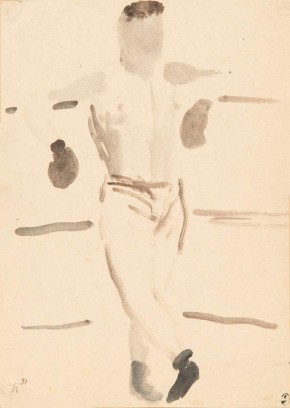
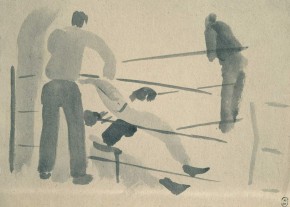
Боксер
- 1931
- Paper, watercolours. 29,2 x 20,4
- The State Russian Museum
- РС-12464
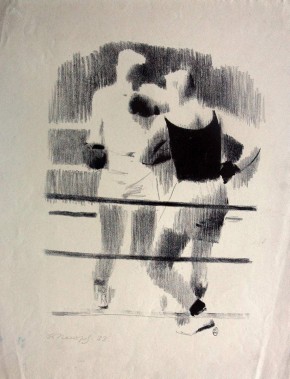
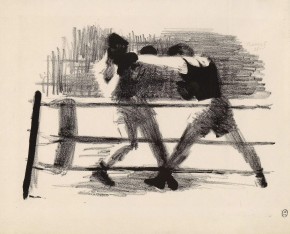
Бокс
- 1933
- Paper, lithography. 38,3 х 30,1
- The State Russian Museum
- С.Гр.-18941
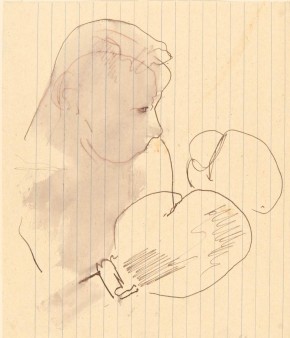
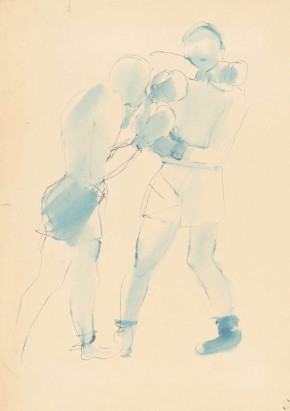
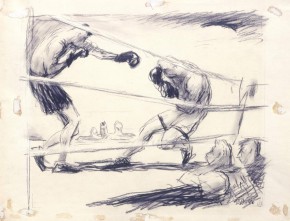
Набросок к серии «Бокс»
- Nib, brush. 22,2 x 18,9
- The State Russian Museum
- РС-24201
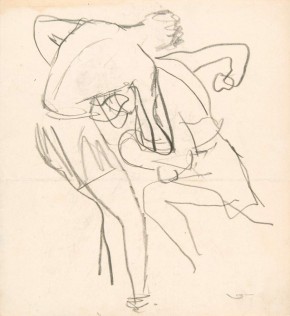
Набросок к серии «Бокс»
- Paper, . 19,9 x 32,1
- The State Russian Museum
- РС-24211
Боксеры
- 1934
- Paper, .
- The State Russian Museum
- С.Гр.-3660
Бокс
- 1930s
- Paper, , nib. 36,2 x 25,6
- The State Russian Museum
- РС-12465
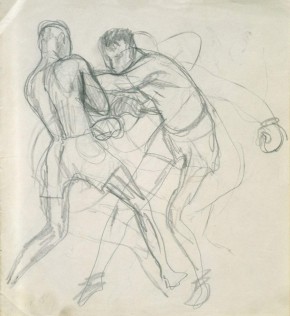
Боксеры
- 1930s
- Paper, graphite pencil. 19,4 x 17,8
- The State Russian Museum
- РС-24241
Боксеры
- 1930s
- Paper, graphite pencil. 19,5 x 18,2
- The State Russian Museum
- РС-24242
Тайм-аут
- 1930s
- Paper, watercolours. 17,7 х 25,6
- The State Russian Museum
- РС-12466
На ринге
- 1940
- Paper, . 31,6 x 44
- The State Russian Museum
- РС-11380
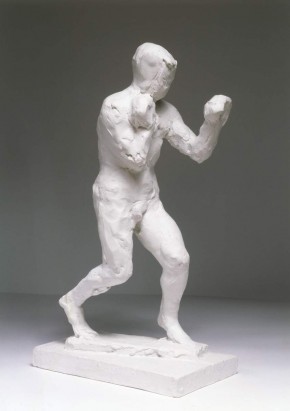
Боксер
- 1960s
- Gypsum. 37 x 12 x 20
- The State Russian Museum
- СО-2215
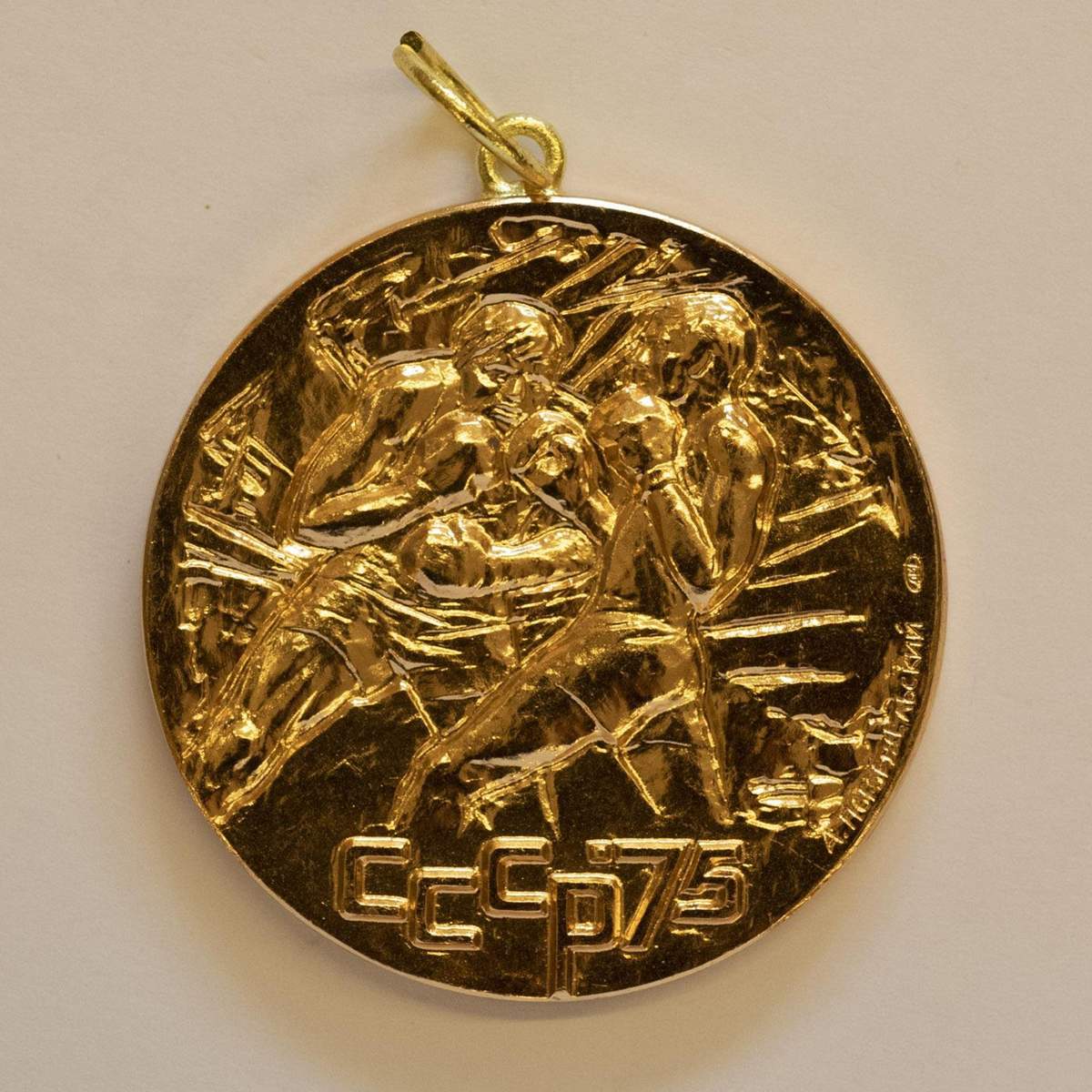
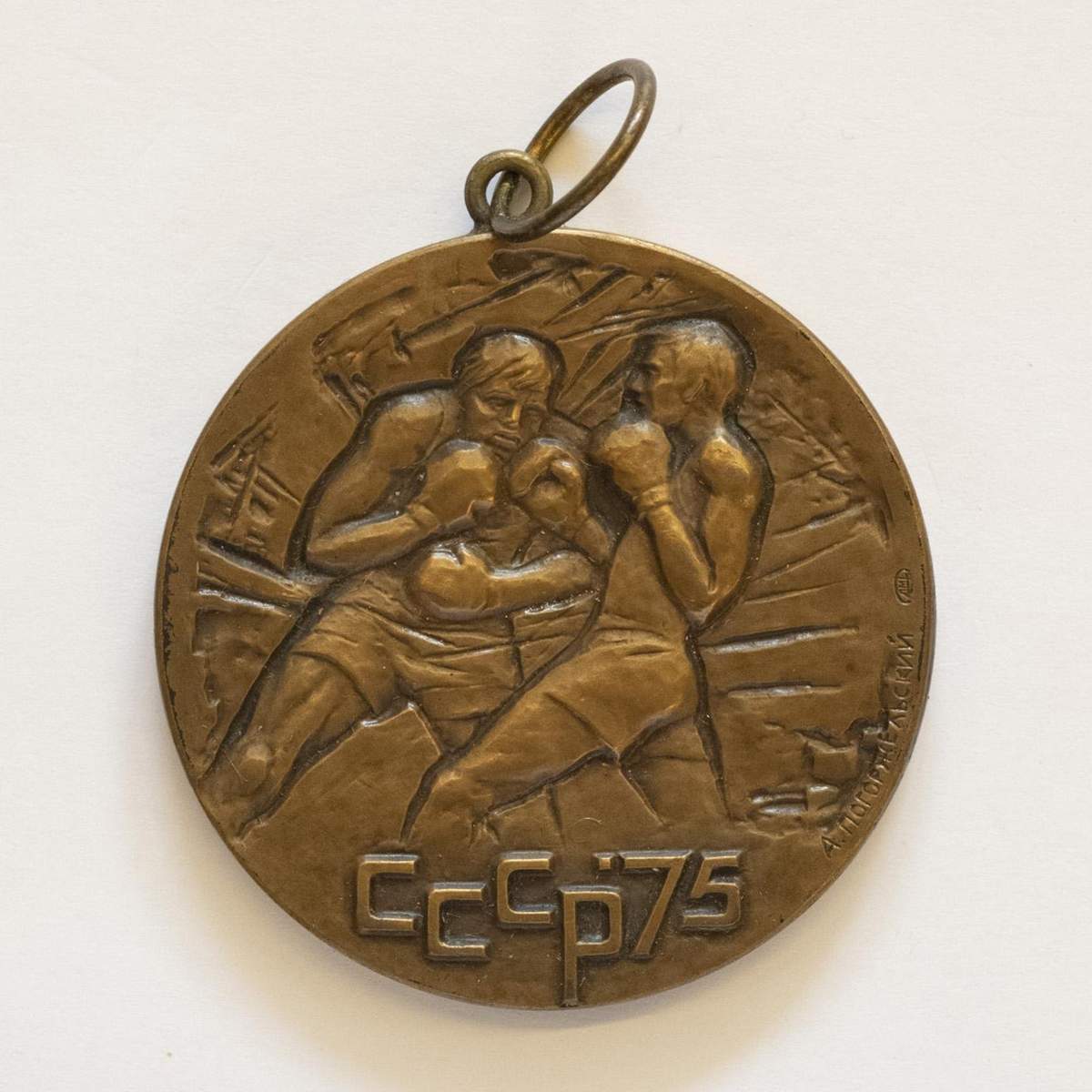
Медаль «XV Спартакиада социалистических стран», бокс. I место
- 1975
- .
- The State Russian Museum
- Мед.А-15620
Медаль «XV Спартакиада социалистических стран», бокс. III место
- 1975
- .
- The State Russian Museum
- Мед.А-15622
Петров Юрий (Георгий) Николаевич
Белинков Виктор Вениаминович
Погоржельский А.
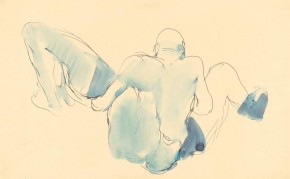
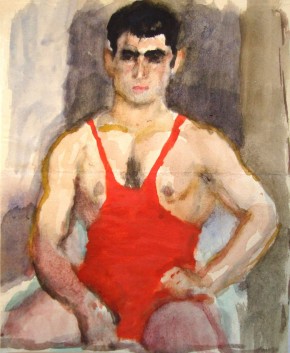
Набросок борца
- 1933
- Paper, watercolours. 19 х 15,4
- The State Russian Museum
- РС-24245
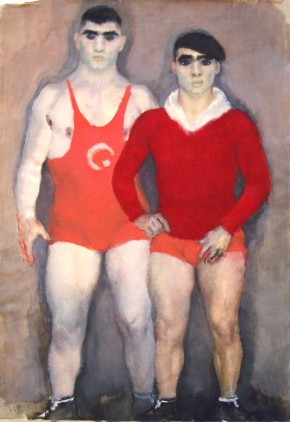
Турецкие борцы
- 1933
- Paper, watercolours, gouache. 65 x 44,2
- The State Russian Museum
- РС-8788
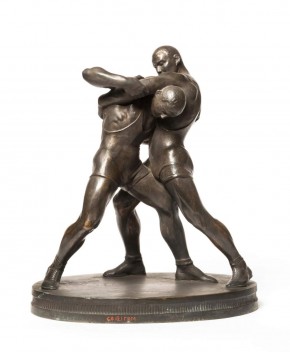
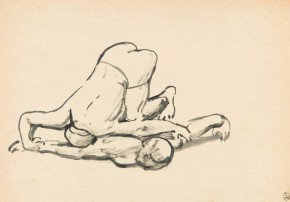
Борцы
- 1949-1951
- Bronze. 31,7 x 20,3 x 36,3
- The State Russian Museum
- СО-121
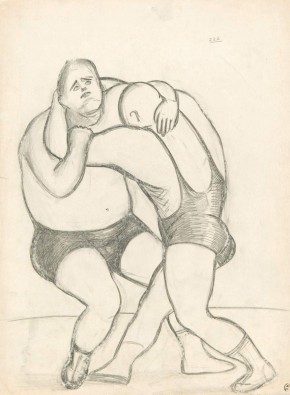
Борьба
- 1955
- Paper, graphite pencil. 41,8 x 31,1
- The State Russian Museum
- РС-15168
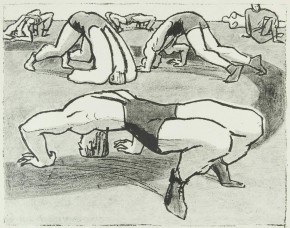
Борцы
- Paper, , brush. 19,7 x 28,3
- The State Russian Museum
- РС-18557
Разминка борцов
- 1975
- Paper, lithography.
- The State Russian Museum
- С.Гр.-18939
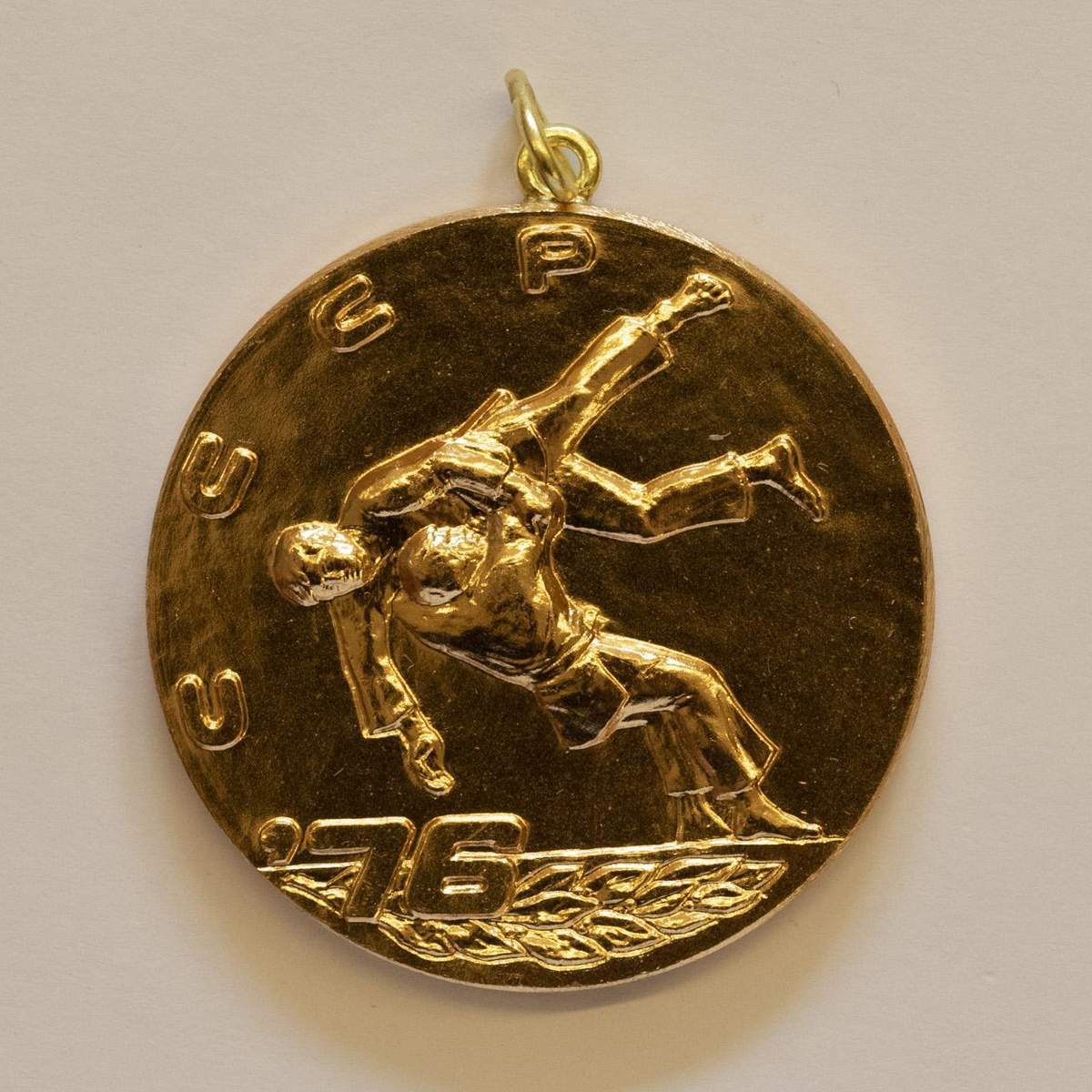
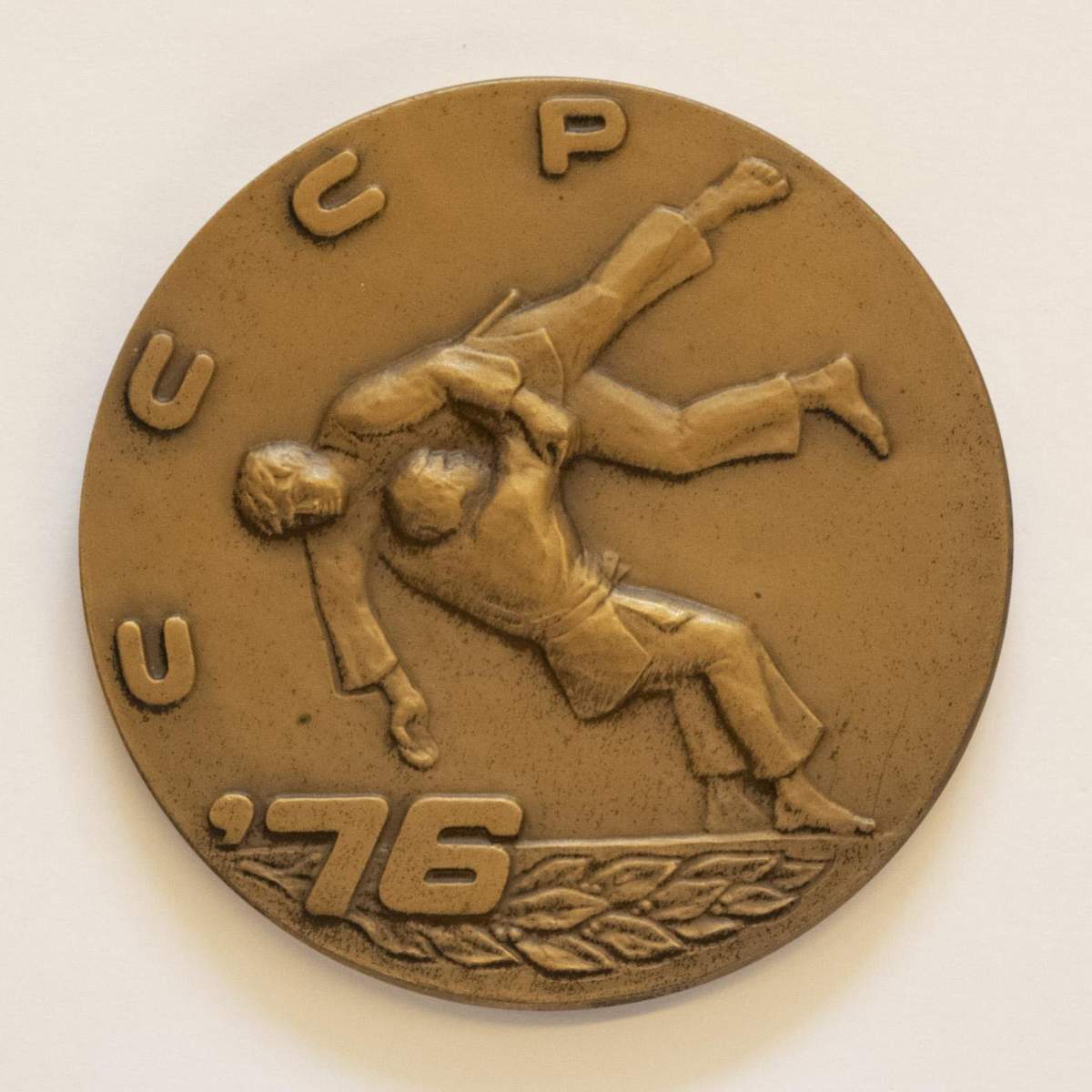
Медаль наградная, Спартакиады Социалистических стран по борьбе дзю-до. I место
- 1976
- .
- The State Russian Museum
- Мед.А-16095
Медаль памятная, Спартакиады Социалистических стран по борьбе дзю-до
- 1976
- .
- The State Russian Museum
- Мед.А-16093
Арефьев Александр Дмитриевич
Гальба (Гальберштадт) Владимир Александрович
Скалозубов (Сколозубов) Александр Сергеевич
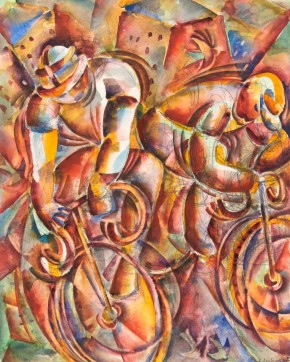
Колхозница на велосипеде
- 1935
- Canvas, oil. 120 x 220
- The State Russian Museum
- Ж-8715
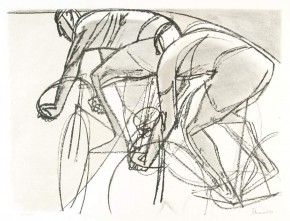
Спринт
- 1971
- Paper, .
- The State Russian Museum
- С.Гр.-15136
Прогулка
- 1973
- Paper, watercolours, graphite pencil. 51,7 x 41,5
- The State Russian Museum
- РС-12218
Власов Борис Васильевич
Агабеков Александр Суренович
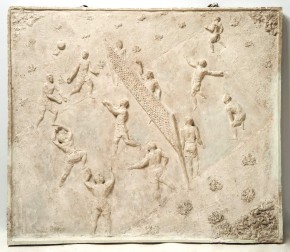
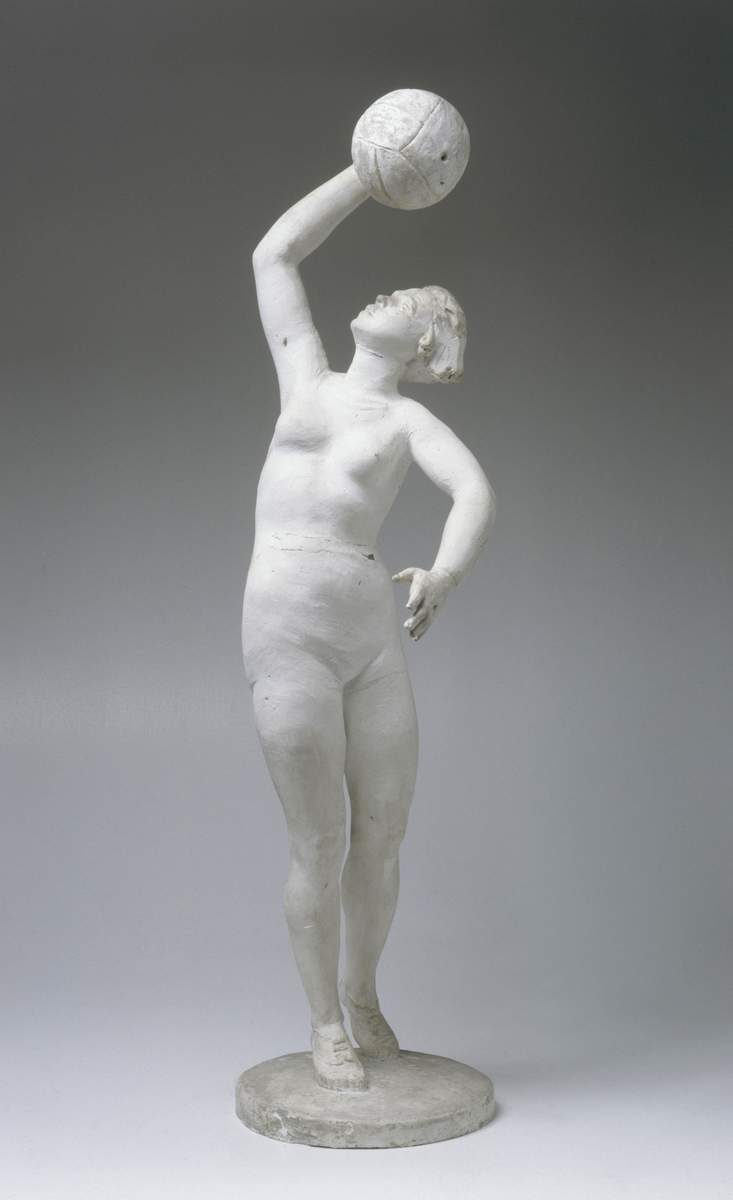
Волейбол
- Gypsum. 94 x 110 x 8
- The State Russian Museum
- СО-1412
Волейбол
- 1935
- Gypsum. 76 x 20 x 23
- The State Russian Museum
- СО-1254
Игра
- 1970
- Paper, , etching.
- The State Russian Museum
- С.Гр.-17754
Счет 14:15
- 1971
- Paper, .
- The State Russian Museum
- С.Гр.-16127
Игра в мяч
- 1987
- Canvas, oil. 90 x 80
- The State Russian Museum
- ЖС-179
Чайков Иосиф Моисеевич
Эллонен Виктор Вильгельмович
Бутрова Мария Николаевна
Гаврильчик Владлен Васильевич
Акробатка
- 1925
- Paper, . 30,8 x 21,7
- The State Russian Museum
- РС-15872
Фигура «Акробатка с шаром»
- 1927
- faience, , gilding. 39 х 35 х 17
- The State Russian Museum
- СФС-237
Гимнастика на крыше. (Америка)
- 1935
- Paper, gouache. 56,3 x 41,2
- The State Russian Museum
- РС-8059
Борис Шахлин
- 1963
- Paper, . 59,5 x 37,2
- The State Russian Museum
- РС-26503
Валерий Кардемилиди
- 1963
- Paper, .
- The State Russian Museum
- РС-26498
Юрий Титов
- 1963
- Paper, . 59,5 x 42,1
- The State Russian Museum
- РС-26504
Gymnasts of the USSR
- 1964–1965
- Hardboard, gesso, tempera. 270 x 215
- The State Russian Museum
- Ж-8816
Dmitry Zhilinsky often manifested his creative aspirations in portraiture. One of the idiosyncrasies of his art was his habit of depicting in the concrete not the fleeting, but the most important element of a man’s personality. Zhilinsky preferred clear, collected and intellectual images. He was inspired by the art of the Old Masters, particularly the early Italian Renaissance and Old Russian painting. The artist openly addresses the art of the past in his modem images: «l love exactness of expression and completeness of form – in my own understanding of these words, of course». Zhilinsky’s works are distinguished by their pure and decorative tones, melodious lines, plastic silhouettes and harmonic compositions. The artist’s painting technique was also unusual; he frequently worked in tempera on Ievkas, lending a colourist sublimity to his works. «Gymnasts of the USSR» is, in essence, a group portrait of famous Soviet sportsmen, many of them world and Olympic champions. Among the figures in the background are Polina Astakhova (triple Olympic and twice world champion), Boris Shakhlin (triple Olympic and twice world champion) and Yury Titov (Olympic and world champion, later president of the International Federation of Gymnasts). An original personal «tuning» of thought, will and feelings can be seen in the heroes’ faces and expressive gestures. The distinct composition, sharp foreshortenings and pure tones are also psychological.
Юрий Цапенко
- 1964
- Paper, . 59,3 x 41,5
- The State Russian Museum
- РС-26497
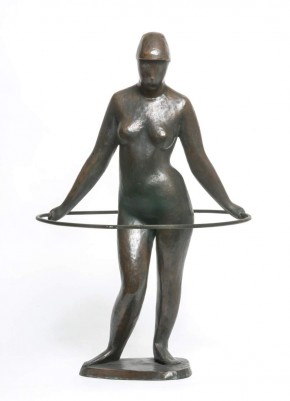
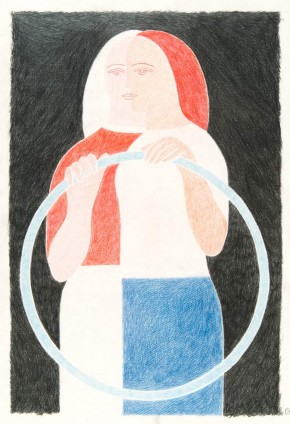
Девушка с кольцом
- 1965
- Forged copper. 52 x 32 x 32
- The State Russian Museum
- СО-1186
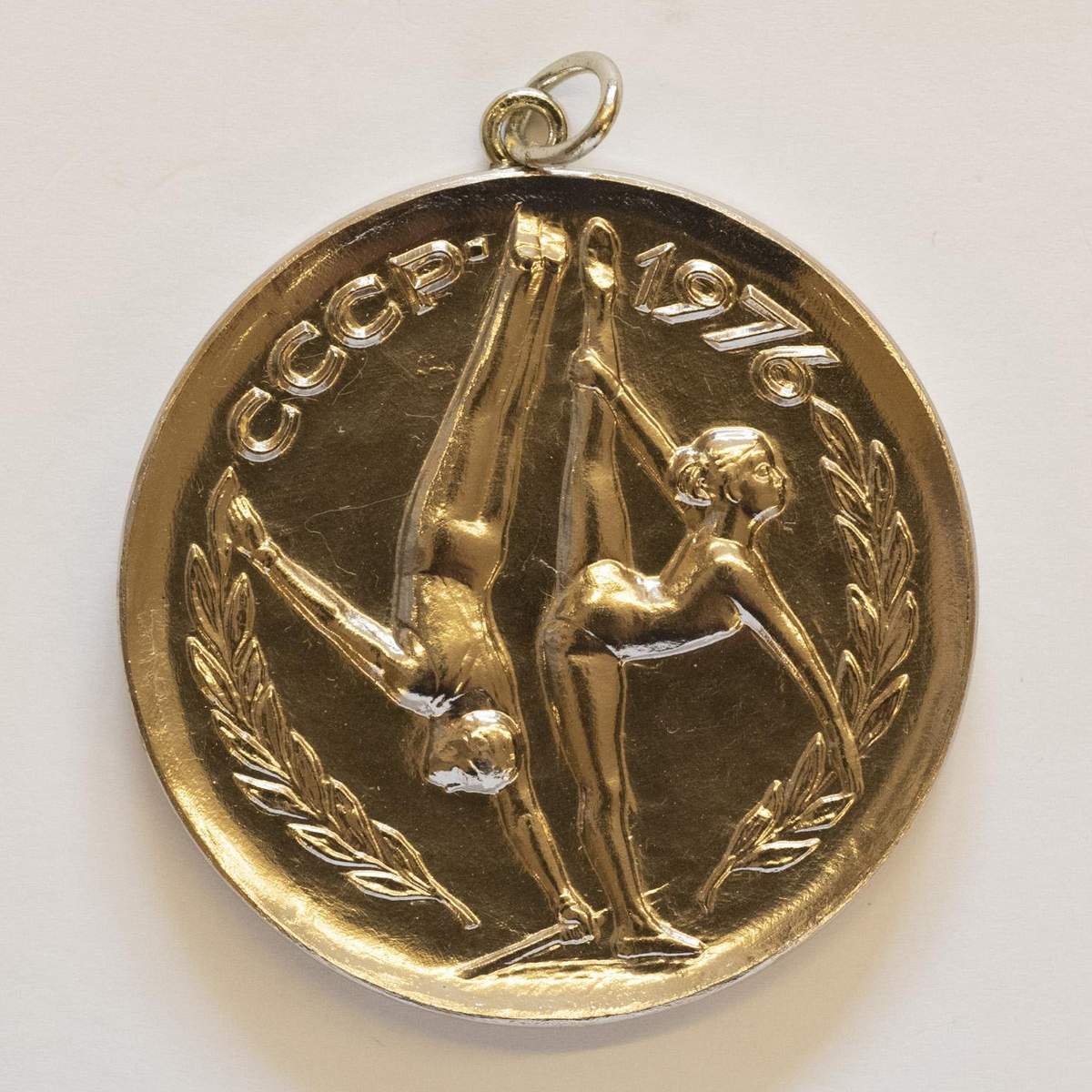
Медаль наградная, Спартакиады Социалистических стран по гимнастике. II место
- 1976
- .
- The State Russian Museum
- Мед.А-16091
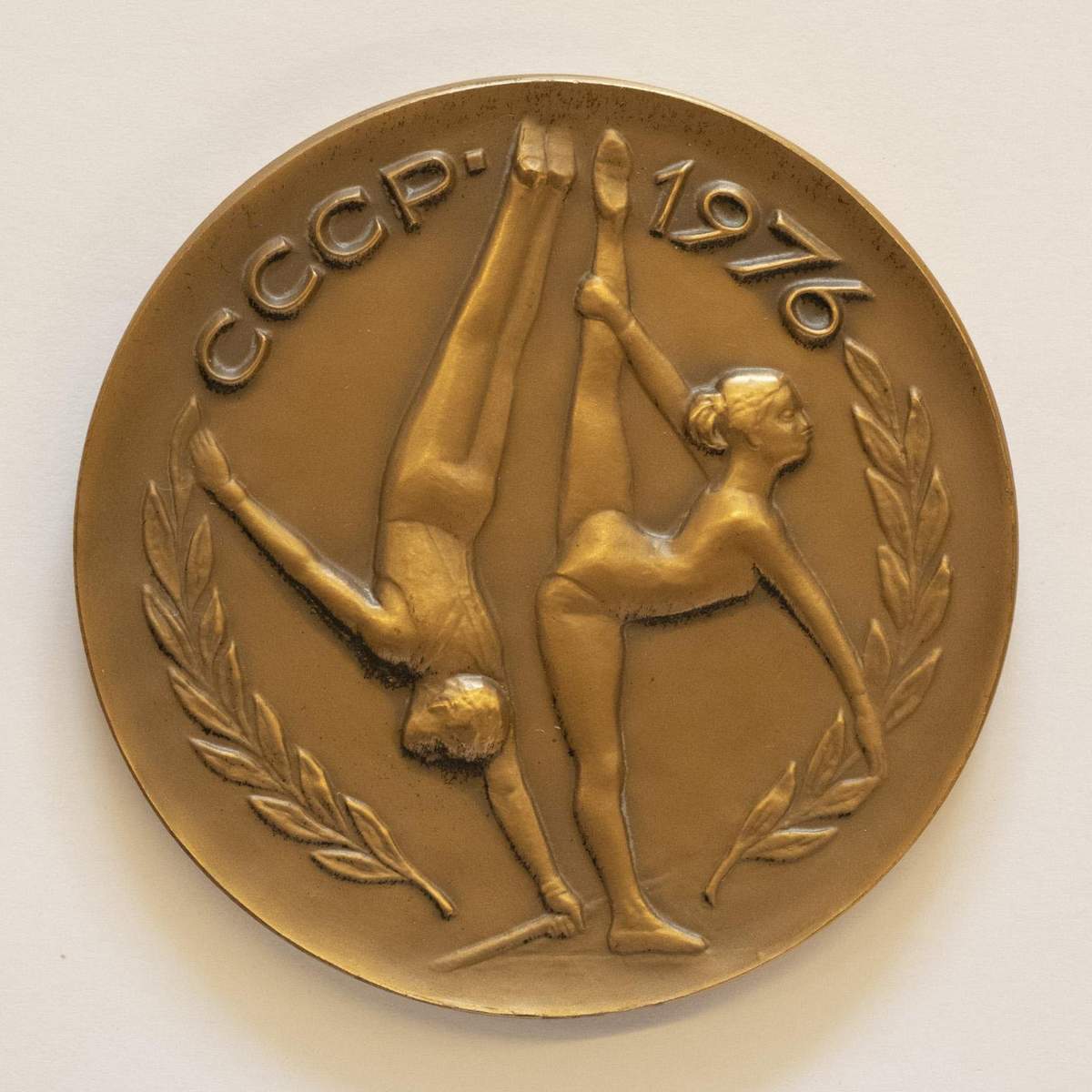
Медаль памятная, Спартакиады Социалистических стран по гимнастике
- 1976
- .
- The State Russian Museum
- Мед.А-16089
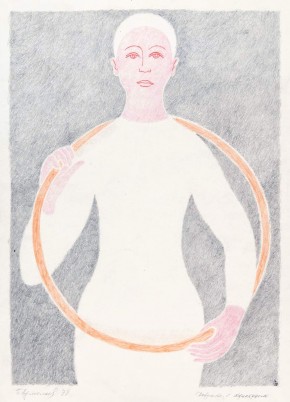
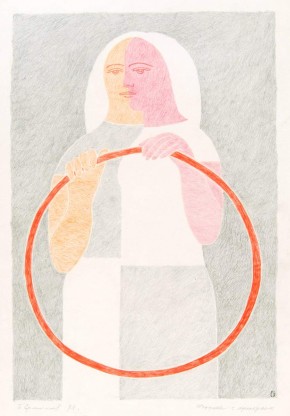
Девушка с хулахупом
- 1978
- Paper, , graphite pencil.
- The State Russian Museum
- РС-19650
Женщины с хулахупом
- 1978
- Paper, .
- The State Russian Museum
- РС-19644
Женщины с хулахупом
- 1978
- Paper, , graphite pencil.
- The State Russian Museum
- РС-19646
Чернов Юрий Львович
Макет книги «Стадион»
- 1929
- Paper, , graphite pencil. 19,1 x 22,4
- The State Russian Museum
- РС-23789
Макет книги «Стадион»
- 1929
- Paper, , graphite pencil, watercolours, whiting. 19,2 х 22,3
- The State Russian Museum
- РС-23790
Макет книги «Стадион»
- 1929
- Paper, , graphite pencil, watercolours, ink. 22,7 x 38
- The State Russian Museum
- РС-23791
Чашка с блюдцем «Гребля»
- Porcelain, .
- The State Russian Museum
- ДФ-1379 а,б
Лодочницы
- Paper, .
- The State Russian Museum
- С.Гр.-17399
Клементьева Ксения Александровна
Бега
- 1928
- Paper, watercolours, ink, graphite pencil. 49 х 39,1
- The State Russian Museum
- РС-2758
Скачки
- 1929
- Paper, ink, nib. 26,2 x 69,5
- The State Russian Museum
- РС-16837
Жокеи
- 1931
- Paper, ink, , nib, brush, graphite pencil, watercolours.
- The State Russian Museum
- РС-16841
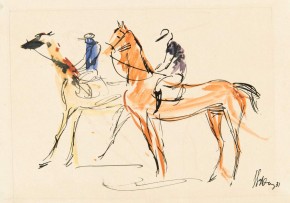
Скачки
- 1931
- Paper, watercolours, graphite pencil. 31,8 x 44
- The State Russian Museum
- РС-11978
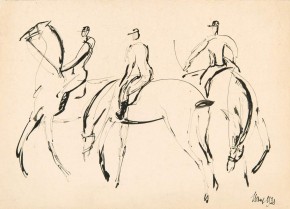
Три жокея
- 1938
- Paper, ink, nib. 27,7 x 38,4
- The State Russian Museum
- РС-16845
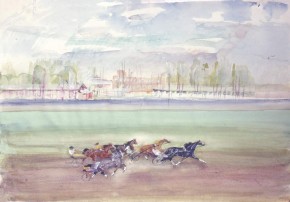
Заезд на дистанции
- 1978
- Paper, watercolours, tempera, whiting. 45,3 x 64,7
- The State Russian Museum
- РС-13195
На старте (Бега на Псковском ипподроме)
- 1978
- Paper, watercolours. 57,5 x 43,2
- The State Russian Museum
- РС-14969
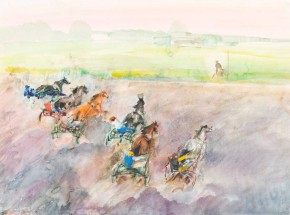
Бега на Псковском ипподроме
- 1979
- Paper, watercolours, tempera, whiting. 46 x 60,4
- The State Russian Museum
- РС-13196
Юстицкий Валентин Михайлович
Алфеевский Валерий Сергеевич
Курдов Валентин Иванович
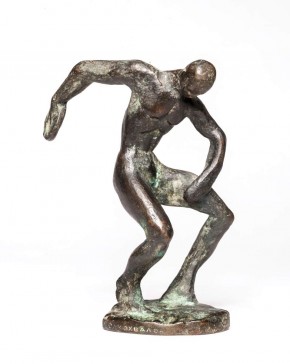
Дискометатель
- 1926
- . 243 x 87 x 85
- The State Russian Museum
- СО-2039
Метание копья
- 1927
- . 40,8 x 19 x 36
- The State Russian Museum
- СО-2053
Фигура «Акробатка с шаром»
- 1927
- faience, , gilding. 39 х 35 х 17
- The State Russian Museum
- СФС-237
Макет книги «Стадион»
- 1929
- Paper, , graphite pencil, watercolours, ink. 22,7 x 38
- The State Russian Museum
- РС-23791
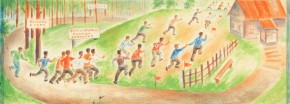
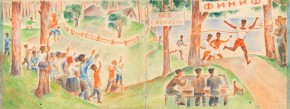
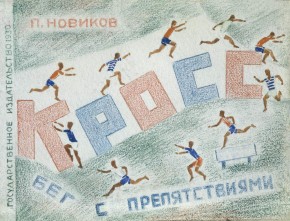
Макет книги «Кросс»
- 1930
- Paper, , watercolours, . 14,2 x 38,5
- The State Russian Museum
- РС-23587
Макет книги «Кросс»
- 1930
- Paper, , watercolours. 14,5 x 38,6
- The State Russian Museum
- РС-23585
Макет книги «Кросс»
- 1930
- Paper, watercolours, . 14,5 x 38,9
- The State Russian Museum
- РС-23590
Макет книги «Кросс»
- 1930
- Paper, watercolours, , graphite pencil. 14,5 x 38,9
- The State Russian Museum
- РС-23589
Метатель копья на Олимпийских играх
- 1930
- Paper, watercolours, graphite pencil. 22,5 х 26
- The State Russian Museum
- РС-23001
Метательница диска
- Paper, graphite pencil. 73,8 x 52,5
- The State Russian Museum
- РС-18128
Метательница дисков
- Graphite pencil.
- The State Russian Museum
- РС-23343
Обложка книги «Кросс»
- 1930
- Paper, , watercolours. 14,5 x 19,3
- The State Russian Museum
- РС-23584
Дискобол
- Bronze. 15,5 x 11,3 x 7,1
- The State Russian Museum
- СО-2067
Легкоатлетические соревнования
- Canvas, oil. 145 х 125
- The State Russian Museum
- Ж-9811
Race
- Variant of the painting of the same name (1930, Galleria d’Arte Moderna di Ca’Pesaro, Venice)
- 1932–1933
- Canvas, oil. 229 х 259
- The State Russian Museum
- Ж-7741
The art of Alexander Deineka reflects the aspiration towards new forms of public life — labour, industry, sport, and images of the new citizen. Race contains all the main formal features of Alexander Deineka’s style — a montage-rhythmic structure of the composition, laconic tones, and an austere and graphic style of painting. Race combines concrete elements, generalisation, symbols, images, the spirit of romanticism, and notes of lyricism. Man personifies the motif of freedom and resolute integrity.
«Работать, строить и не ныть ...»
- 1933
- Paper, chromolithography. 102,2 х 73,3
- The State Russian Museum
- Гр.Пл.-2336
After the Cross-Country Race
- 1934–1935
- Canvas, oil. 143 х 64
- The State Russian Museum
- Ж-8191
Antique sources can be clearly seen in Samokhvalov’s works devoted to the themes of physical training and sports, which he was especially involved with in the latter half of the 30s. The heroine of Soviet athletics in the work After the Cross-Country Race arises like a Venus de Milo come to life, offering her bold nudity to the world with the dignity of a goddess.
At the Stadium
- 1934–1935
- Canvas, oil. 121 х 140,5
- The State Russian Museum
- ЖБ-1723
Sport was one of the most popular themes in Soviet art in the mid-1920s and 1930s. Called upon to form the ideal of the new man, artists discerned its prototype in athletes — handsome young men and women perfecting their bodies and hardening the spirit. Sportsmen became the main characters of the works of Alexander Samokhvalov, who dreamt of uniting them in a grandiose monumental composition. Perhaps that is why so many of his paintings of this period are like details of a large, multi-figure fresco. The artist himself described sport as an “existential joy” helping people overcome difficulties “in the struggle for the creation of a new life” and furthering their “love for humankind”. “I loved sport as the culture of healthy, vivacious and joyful people… I was attracted to the healthy creative spirit in healthy bodies,” he wrote.
Бег
- 1930s
- Bronze. 12,2 x 11 x 4
- The State Russian Museum
- СО-2069
Физкультура (девушка)
- 1935
- .
- The State Russian Museum
- СО/ПФ-13
Загреков Николай Александрович
Почтенный Алексей Петрович
Лыжница
- 1919
- Paper, graphite pencil.
- The State Russian Museum
- РС-809
Эскиз к картине «Лыжники»
- 1922
- сharcoal , whiting. 34,5 х 44,2
- The State Russian Museum
- РС-14479
Лыжник (Верховский В. В.)
- 1926
- Paper, watercolours. 82,5 х 69
- The State Russian Museum
- РС-1170
Лыжники
- 1926
- Canvas, oil. 108 x 96
- The State Russian Museum
- ЖБ-1495
Сливочник с крышкой
- 1927–1930
- Porcelain, . 9,5 х 12,7 х 8,8
- The State Russian Museum
- ДФ-1345 а,б
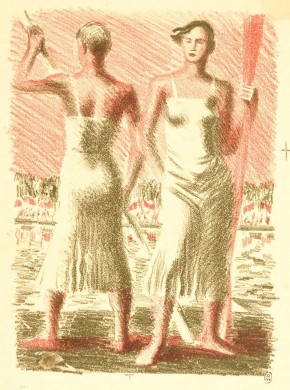
Чашка с блюдцем
- 1927–1930
- Porcelain, .
- The State Russian Museum
- ДФ-1347 а,б
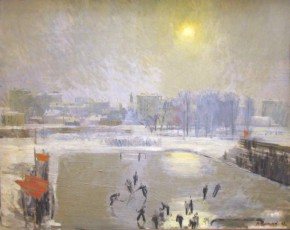
Зимой. Лыжная экскурсия
- 1930
- Canvas, oil. 72 x 124,5
- The State Russian Museum
- Ж-6640
Лыжная вылазка
- 1930
- Paper, chromolithography. 37,2 х 52,0
- The State Russian Museum
- Гр.Пл.-1975
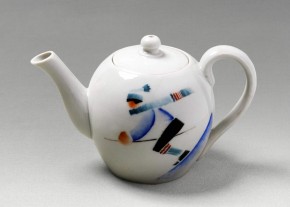
Чайник с крышкой с изображением лыжника
- Porcelain, . 9,7 х 15,4 х 9
- The State Russian Museum
- ДФ-1365 а,б
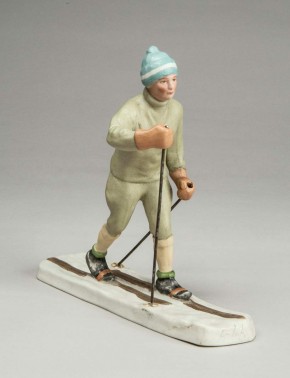
Фигура «Лыжник»
- Bisque, painting. 19,3 х 19,7 х 8,4
- The State Russian Museum
- ДФ-1308
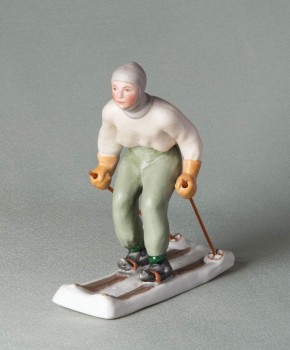
Фигура «Лыжница»
- Bisque, painting. 16,2 х 16,7 х 8,3
- The State Russian Museum
- ДФ-1307
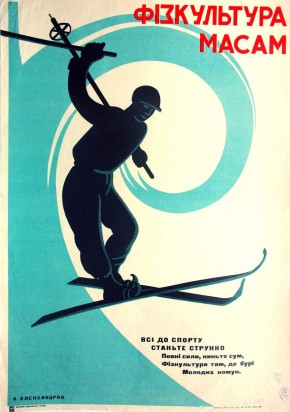
Физкультура массам
- Paper, chromolithography. 72,5 х 51,2
- The State Russian Museum
- Гр.Пл.-10
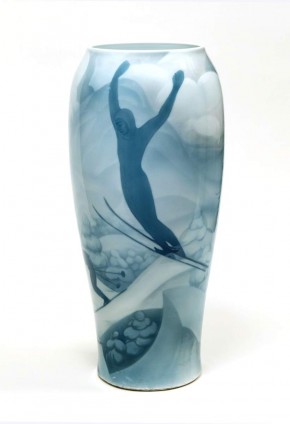
Ваза с изображением лыжников
- Porcelain, . 62 х 27,5
- The State Russian Museum
- СФ-2218
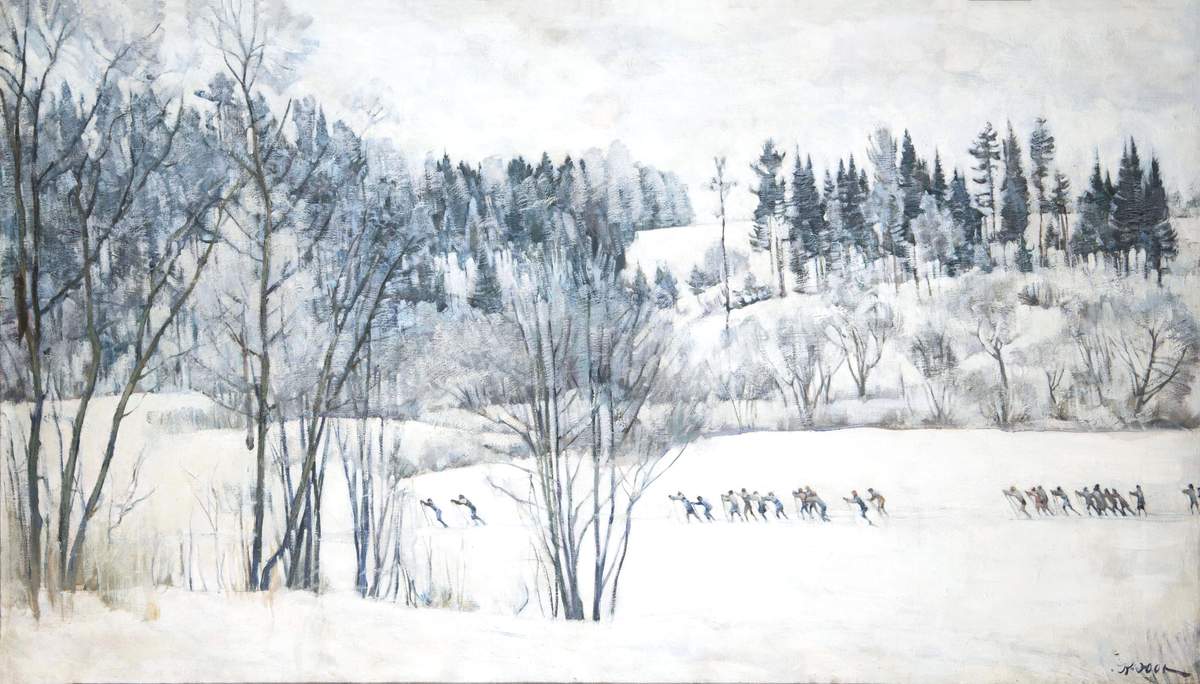
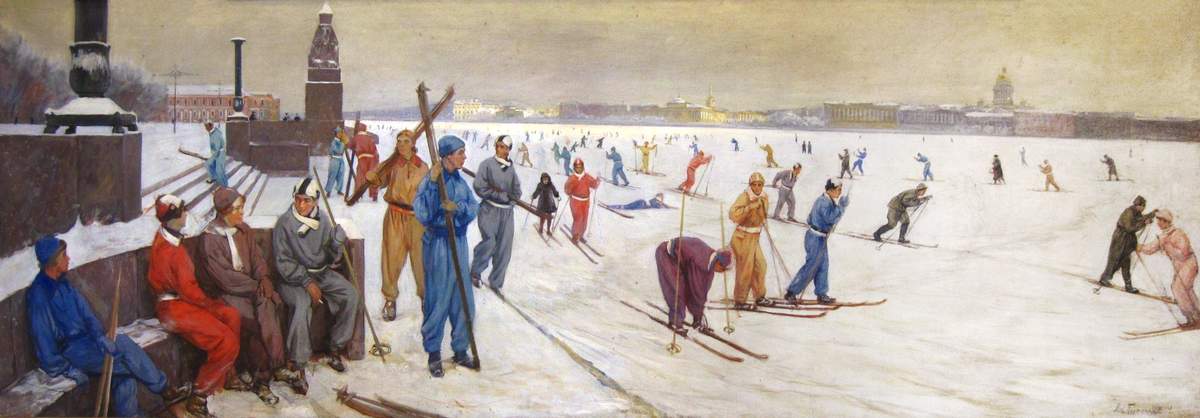
Лыжники на Неве
- 1934
- Canvas, tempera. 105,5 x 300,5
- The State Russian Museum
- ЖБ-1885
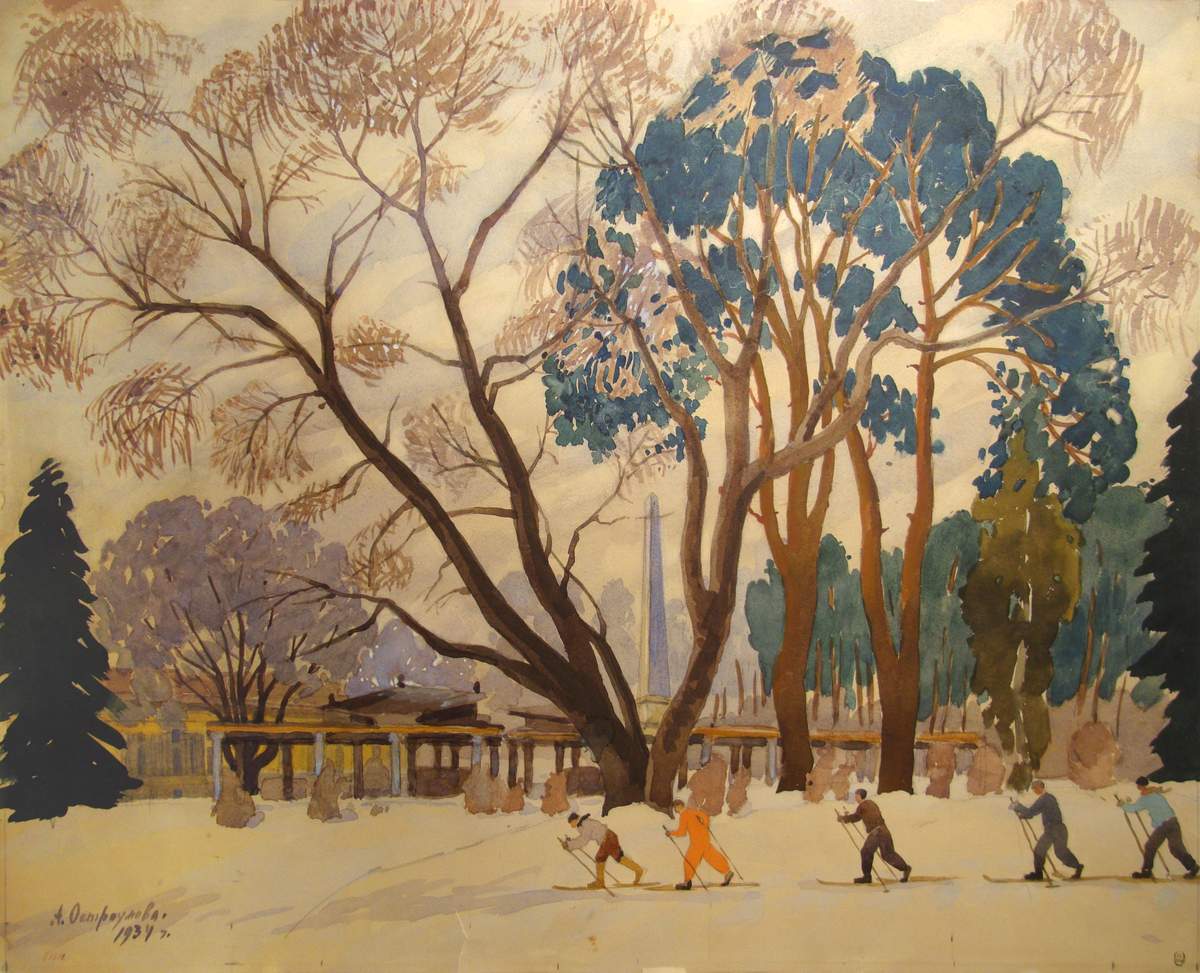
Лыжники. Детскосельский пейзаж
- 1934
- Paper, watercolours.
- The State Russian Museum
- РС-3774
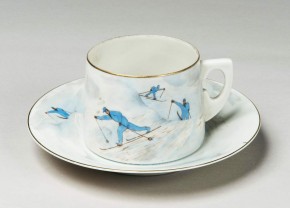
Чашка с блюдцем с изображением лыжников
- 1935
- Porcelain, painting over glaze, gilding.
- The State Russian Museum
- Дф-1204 а,б
Kavgolovo Ski Jump
- 1936
- Canvas, oil. 120 x 90
- The State Russian Museum
- ЖС-1851
The Toksovo-Kavgolovo district near Petersburg (Leningrad) is the true ski center of the Karelian Isthmus. A great number of sporting facilities are located here, including the famous Kavgolovo Ski Jumps and many international-class ski trails. A natural slope around 40 to 50 meters high and extending for several kilometers forms the basis for the downhill ski trails. This is a very small slope by European standards, but thousands of Leningraders of all ages learned and perfected the basics of alpine skiing on it, some achieving the heights of mastery.
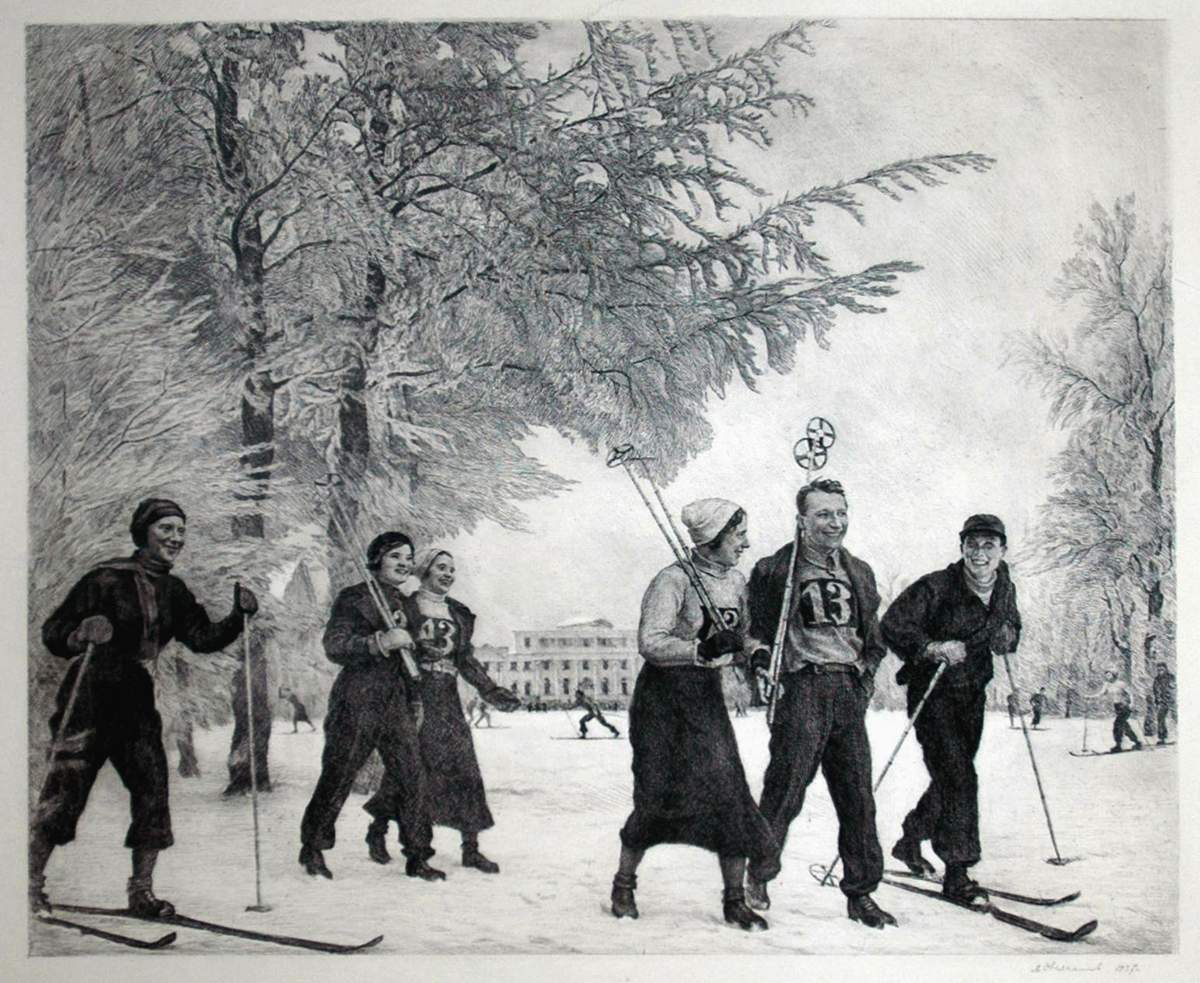
Лыжники в ЦПКО
- 1937
- Paper, etching.
- The State Russian Museum
- С.Гр.-6530
Лыжники
- 1942
- Canvas, oil. 71,5 х 141,5
- The State Russian Museum
- ЖБ-1878
Партизанский отряд (Лесгафтовцы)
- Canvas, oil.
- The State Russian Museum
- Ж-5573
Juon Konstantin Fyodorovich
1875, Moscow — 1958, Moscow
Александров Александр Иванович
Трипольская (Трыпильская, Троепольская) Елизавета (Екатерина) Родионовна (Романовна, Илларионовна)
Вильде (Вильде фон Вильдеман) Рудольф Федорович
Платунов Михаил Георгиевич
Агафонов Андрей Степанович
Овсянников Леонид Федорович
RUTKOVSKY Nikolai Christophorovich
1892, Schoenberg, Courland Province — 1968, LeningradPainter, graphic artist, theatrical designer, monumentalist; master of genre paintings, portraits, landscapes and still lifes. Studied at the School of Drawing, Society for the Encouragement of the Arts (1911–1913) and the Academy of Arts (1913–1915, 1921–1922). Contributed to exhibitions (from 1923). Taught monumental painting at the Institute of Painting, Sculpture and Architecture (1936–1942), headed the monumental painting studio.
SEREBRYANY Joseph Alexandrovich
1907, Horodnia, Chernihiv Province — 1979, LeningradPainter, poster designer. Studied at the Poltava Studio of Art (1922–1923), the Leningrad College of Art and Industry (1924–1927) and VKhUTEIN / Institute of Proletarian Fine Arts (1927–1931) in the theatrical design department, and simultaneously at Vasily Savinsky’s private studio. Contributed to exhibitions (from 1925). Worked as a designer (1931–1937). Contributed to the design of the film Counterplan (1941) at Lenfilm Studios. Lived in besieged Leningrad (1941–1945); worked as a poster designer. Taught at the Ilya Repin Institute of Painting, Sculpture and Architecture (1948–1979). Professor (1946). Chairman of the Leningrad Union of Artists (1948–1952; 1954–1958). Corresponding member of the USSR Academy of Arts (1947). People’s Artist of the USSR (1965).
Водная станция «Динамо»
- 1928
- Paper, watercolours, ink. 24,2 x 33,8
- The State Russian Museum
- РС-484
Макет книги «Стадион»
- 1929
- Paper, , graphite pencil, watercolours, ink. 22,7 x 38
- The State Russian Museum
- РС-23791
Водная станция
- 1930
- Paper, watercolours.
- The State Russian Museum
- РС-1236
Пловчиха
- 1930
- Bronze. 21 x 7,5 x 11,3
- The State Russian Museum
- СО-2070
В бассейне
- 1935
- Paper, ink, watercolours. 34,2 x 38,3
- The State Russian Museum
- РС-8423
Физкультурница после плавания
- 1935
- . 63 х 25 х 15
- The State Russian Museum
- СО-151
В плавательном бассейне
- 1940
- Paper, , graphite pencil. 44 x 28,3
- The State Russian Museum
- РС-11381
Молодежь! На водные станции!
- 1945
- Paper, chromolithography.
- The State Russian Museum
- Гр.Пл.-2066
В ЦПКиО. Вышка для прыжков в воду
- 1954
- Paper, watercolours, . 37 x 51,8
- The State Russian Museum
- РС-24997
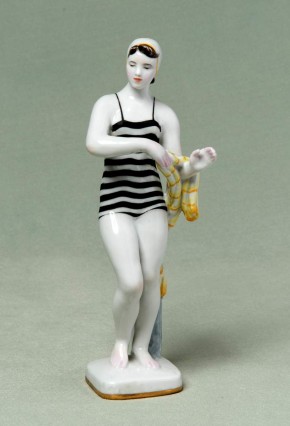
Фигура «У реки. Купальщица»
- 1959
- Porcelain, painting over glaze, gilding. 21 х 7,5 х 7,5
- The State Russian Museum
- СФ-815
Памятных (Кашина) Нина Васильевна
Гендельман Ефим Аронович
Чашка с блюдцем «Стрелок»
- 1927–1930
- Porcelain, painting over glaze.
- The State Russian Museum
- Дф-1223 а,б
Макет книги «Кросс»
- 1930
- Paper, watercolours, . 14,5 x 19,5
- The State Russian Museum
- РС-23588
Militarised Komsomol
- 1931-1933
- Canvas, oil, tempera. 198,5 х 276
- The State Russian Museum
- Ж-8235
In this large painting, Samokhvalov depicted the members of a youth communist organisation, who displayed their determination as a group as they were training in order to defend their country. Samokhvalov painted the picture to celebrate the 15th anniversary of the Red Army. The painter was impressed by what he saw at the shooting range: “there was a group of girls, lying down and improving their sniper skills. The bright and colourful clothes of these young people enhance the painting’s colours. The formation of the Komsomol members comes right at the spectator as the girl with a gas mask brings up the rear. There are studies for this painting: “Komsomol Youth” and “Girl at the Military School”.
«Работать, строить и не ныть ...»
- 1933
- Paper, chromolithography. 102,2 х 73,3
- The State Russian Museum
- Гр.Пл.-2336
Макет книги «Стадион»
- 1929
- Paper, , graphite pencil. 19,3 x 23
- The State Russian Museum
- РС-23786
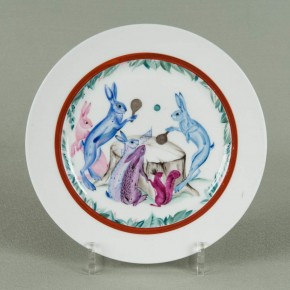
Тарелка «Настольный теннис»
- 1930
- Porcelain, painting over glaze.
- The State Russian Museum
- СФ-2545
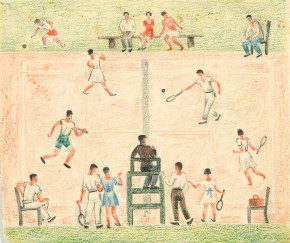
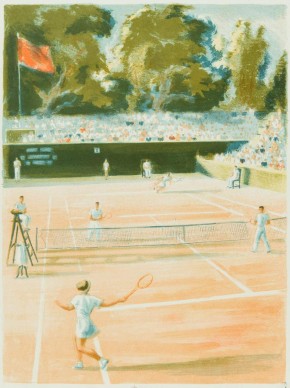
Теннисный матч
- 1940
- Paper, .
- The State Russian Museum
- С.Гр.-17627
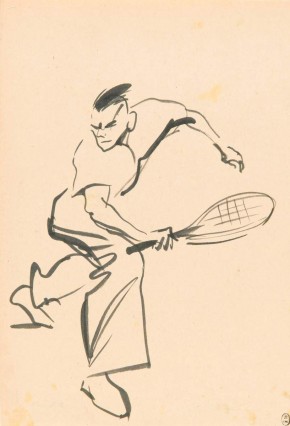
С теннисной ракеткой
- Paper, watercolours. 29,8 x 20,4
- The State Russian Museum
- РС-18568
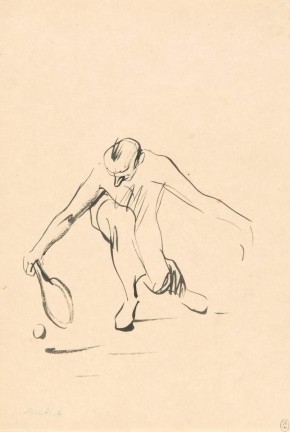
Теннисист
- Paper, watercolours. 29 x 20
- The State Russian Museum
- РС-18570
Ризнич Иван Иванович
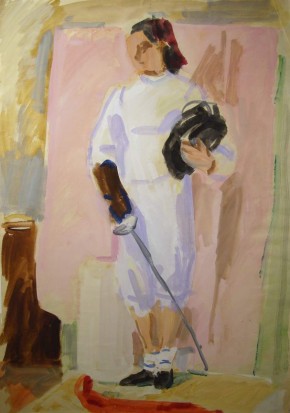
Фехтовальщица
- 1941
- Paper, gouache, whiting. 62,3 x 43,4
- The State Russian Museum
- РС-15732
Grinberg Vladimir Arievich
1896, Rostov-on-Don — 1942, LeningradPainter, graphic artist, sculptor, watercolourist, illustrator, teacher. Studied at the Rostov-on-Don College of Commerce while simultaneously painting and drawing; studied in the Polytechnic Institute and New Studio in St Petersburg (from 1915). Contributed to exhibitions (from 1914). Member of the Union of Artists (1933). Taught at a school of art and workers’ school at the Rostov-on-Don University (1919–1922); Leningrad College of Art and Industry (1926–1927); Leningrad Institute of Communal Construction (1928–1941); Ilya Repin Institute of Painting, Sculpture and Architecture (1932–1933).
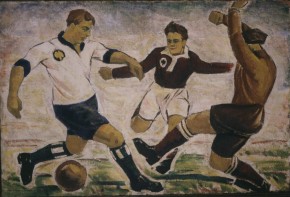
Узбеки-футболисты
- 1920-1924
- Paper, watercolours, ink. 24,8 x 18
- The State Russian Museum
- РС-6671
Тарелка «Футболист»
- 1927–1930
- Porcelain, painting over glaze.
- The State Russian Museum
- ДФ-1336
Макет книги «Стадион»
- 1929
- Paper, , graphite pencil. 19,1 x 22,4
- The State Russian Museum
- РС-23789
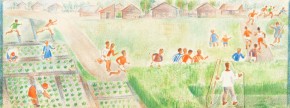
Стадион в деревне
- 1929
- Paper, watercolours, gouache, whiting. 25,8 x 34,2
- The State Russian Museum
- РС-21898
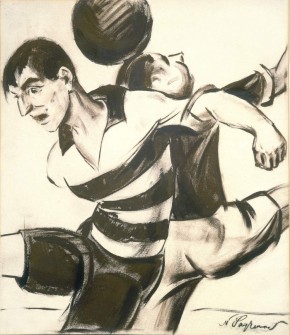
Футбол
- 1929
- whiting. 28,8 x 21,9
- The State Russian Museum
- РС-8397
Футбол
- 1929
- whiting. 28,8 x 21,9
- The State Russian Museum
- РС-8398
«Герта» нападает (с мячом - Ганне)
- 1930
- Canvas, oil. 155 x 230
- The State Russian Museum
- ЖС-1840
Ганне с мячом
- 1930
- Paper, сharcoal , tempera. 65,5 х 50,5
- The State Russian Museum
- РС-23002
Матч Москва - Турция. Футбол
- 1932
- Paper, watercolours.
- The State Russian Museum
- РС-20687
Футболисты
- 1932
- Paper, ink. 32 x 23,5
- The State Russian Museum
- РС-5860
Игра в футбол
- 1936
- Paper, graphite pencil.
- The State Russian Museum
- РС-5248
Игра в футбол
- 1940
- .
- The State Russian Museum
- С.Гр.-10265
Футболист
- 1940
- Paper, graphite pencil.
- The State Russian Museum
- РС-5587
Молодежь! Занимайся спортом...
- 1945
- Paper, chromolithography.
- The State Russian Museum
- Гр.Пл.-2065
Начало игры
- 1957
- Paper, .
- The State Russian Museum
- С.Гр.-17185
Аут
- 1960
- Bronze. 18,5 x 6,5 x 12
- The State Russian Museum
- СО-3073
Вратарь
- 1960
- Bronze. 13,5 x 5 x 11,5
- The State Russian Museum
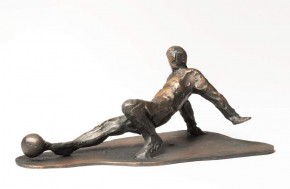
- СО-3072
Подкат
- 1960
- Bronze. 9,5 x 22 x 11,5
- The State Russian Museum
- СО-3071
Футболисты (мастера спорта В. И. Панчихин и Л. Д. Бурчалкин)
- 1964
- Bronze, wood.
- The State Russian Museum
- СО-1372
Возле старых сараев
- 1975
- Canvas, oil. 140 x 150
- The State Russian Museum
- Ж-9347
Milashevsky, Vladimir
Dormidontov Nikolai Ivanovich
1898, St Petersburg — 1962, LeningradPainter, graphic artist. Studied at School of Drawing of the Society for the Encouragement of the Arts (1915–1918); Petrograd State Free Art Studios / VKhUTEMAS (1918–1922). Contributed to exhibitions (from 1922). Member of the Union of Artists (1932).
Нашивочников Юрий Алексеевич
Хоккей
- 1947
- Canvas, oil. 81 х 101
- The State Russian Museum
- Ж-9550
Мальчик-хоккеист
- 1956
- Lacquer. 26,5 x 14,5 x 17
- The State Russian Museum
- СО-2634
Васильев Владимир Александрович
Натюрморт с шахматной доской
- plywood, oil, . 108 x 56
- The State Russian Museum
- Ж-10409
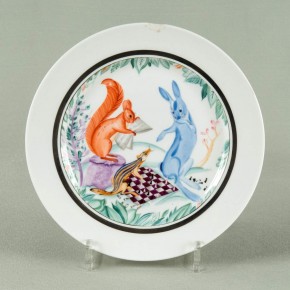
Тарелка «Шахматная партия»
- 1930
- Porcelain, painting over glaze.
- The State Russian Museum
- СФ-2546
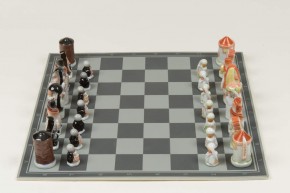
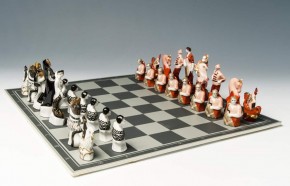
Шахматы «Индустрия и сельское хозяйство»
- 1933–1934
- Porcelain, painting over glaze.
- The State Russian Museum
- СФ-2276–2305
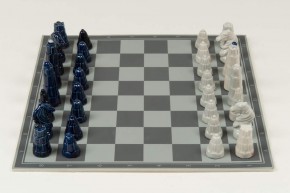
«Красные и белые»
- 1934
- Porcelain, , painting over glaze, gilding, , .
- The State Russian Museum
- СФ-3146–3176
Комплект шахмат
- 1930s
- Porcelain, .
- The State Russian Museum
- СФ-2862–2893
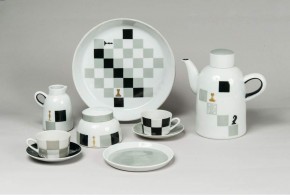
Кофейный сервиз «Шахматы»
- 1963
- Porcelain, painting over glaze, gilding.
- The State Russian Museum
- СФ-1297–1303