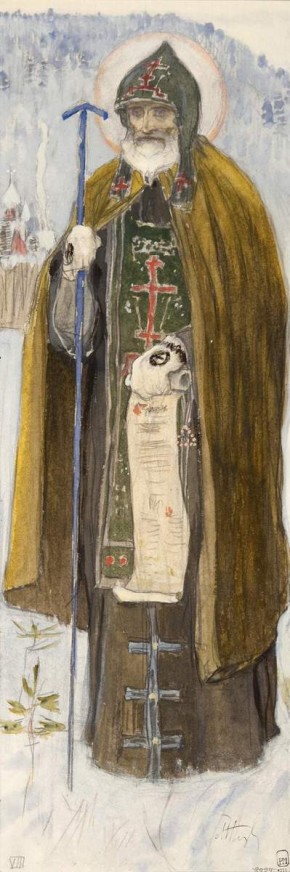
Advanced search collections
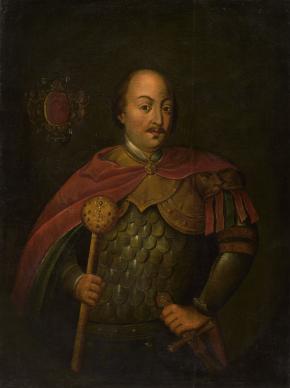
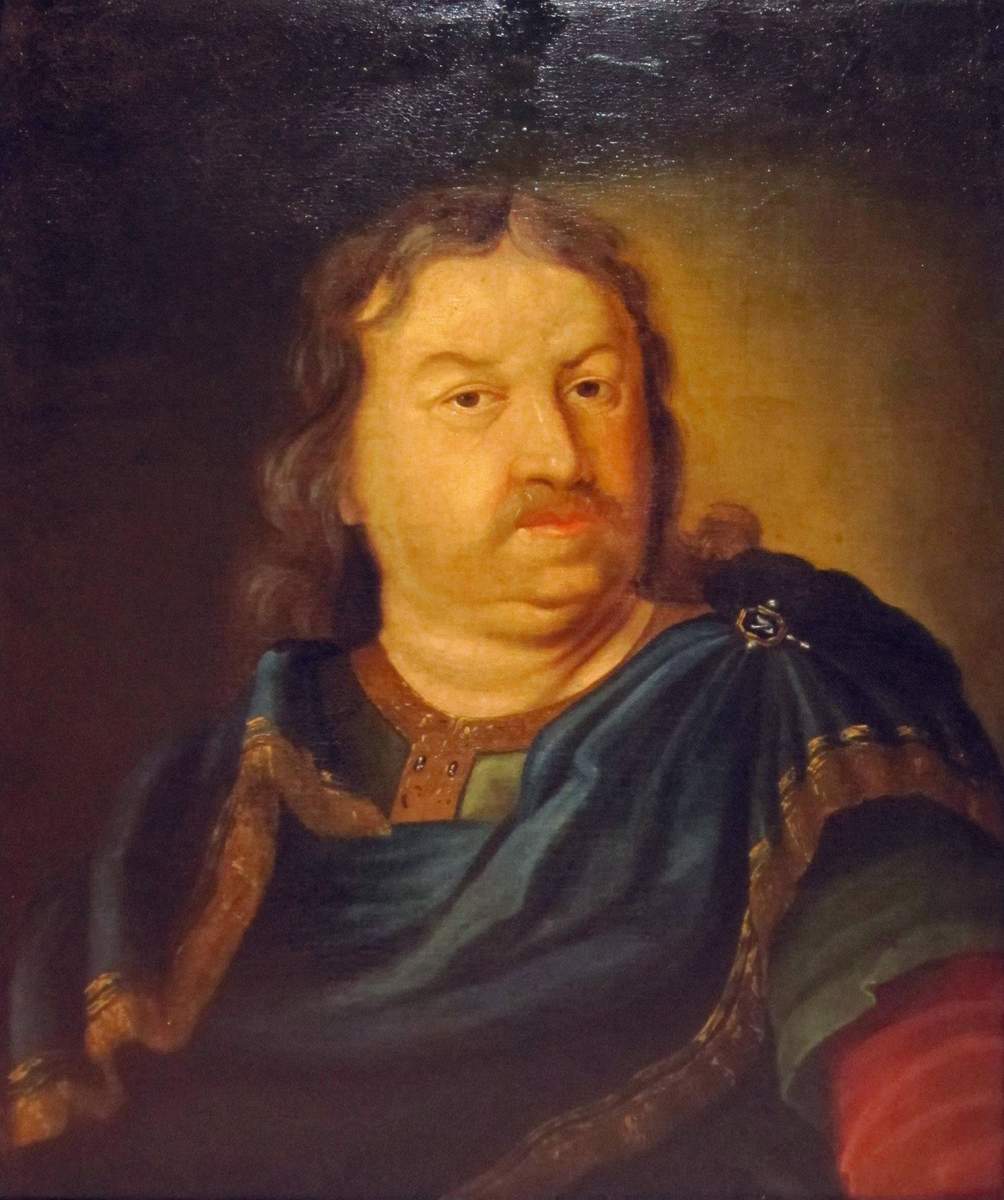
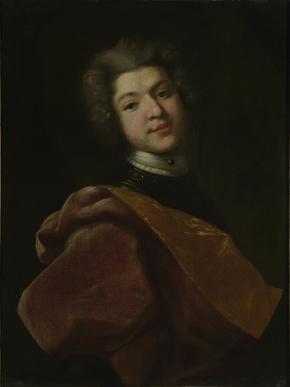
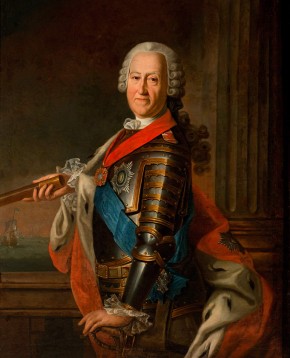
Portrait of Prince Anikita Repnin
- Late 1690s
- Canvas, oil. 181 х 128
- The State Russian Museum
- Ж-3947
Anikita Repnin (1668 – July 3, 1726). Middle son of Ivan Repnin (1615– 1697) who was a boyar close to the tsar and a house steward of Tsar Alexis Mikhailovich, and Ivan’s wife Yevdokia Nikiforovna Pleshcheyeva (? – April 8, 1695). Russian Field Marshal General (1725). From his early years Anikita was close to Peter the Great and took part in the creation of the emperor’s Toy Army. In 1685 he became Lieutenant and within two years he was promoted to Colonel. Repnin participated in the Azov campaigns of 1695–1696. In 1696 he commanded a frigate. In 1699 he became Major General. In the beginning of the Northern War he commanded a division. Following the order of Peter the Great he reconstituted Russian forces withdrawing from Narva after they were defeated in 1700. He took part in the Siege of Nöteborg (1702) and Narva (1704). During the Battle of Poltava (1709) he commanded the centre of the Russian troops. During the years 1709–1710 he commanded the siege and the seizure of Riga. During the years 1712–1713 and 1715–1716 he commanded troops in Pomerania. In 1719 he was appointed Governor General of Livonia, and at the same time he acted as President of the Military College from 1724–1725. After the death of Peter the Great, he supported the enthronement of Catherine I, but shortly afterwards Alexander Menshikov sent him away to Riga.
From the second half of the 19th century to the early 21st century almost all scholars believed the person depicted here to be Ivan Borisovich Repnin; however, this traditional view was recently reconsidered. In 2014 a new version was accepted by the Attribution Council of the Russian Museum.
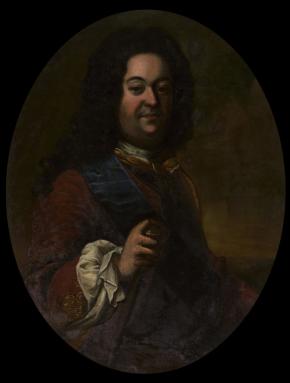
Portrait of Count Boris Sheremetev
- Late 17th century
- Canvas, oil.
- The State Russian Museum
- Ж-3939
Boris Sheremetev (April 25, 1652 – February 17, 1719). Statesman, commander and diplomat. In 1682 he was made Boyar. He took part in the first Azov campaign. He was a close associate of Peter the Great and fought in all the most important battles of the Northen War (Dorpat, Narva, and Riga). He became Field Marshal General in 1701 and was the first Russian count (1706). At the battle of Poltava he commanded the centre of the Russian Army. Peter the Great called Sheremetev his “Turenne” and valued him greatly for his selflessness.
The portrait was dated based on technological research. The upper left corner of the painting features a coat of arms belonging to the Sheremetev family, corresponding to the time when the item was created. Evidence suggests that this painting was used by Leonty Tarasevich, when he created his engraving for a panegyric presented to Sheremetev in 1695, commemorating the Count’s successful seizure of four Ottoman fortresses. Sergei Sheremetev, descendant of Count Boris Sheremetev, maintained that the original painting used for the engraving, was kept in the village of Borisovka, the family estate near Belgorod. It is possible that this particular painting, now in the collection of the State Russian Museum, is the very same work.
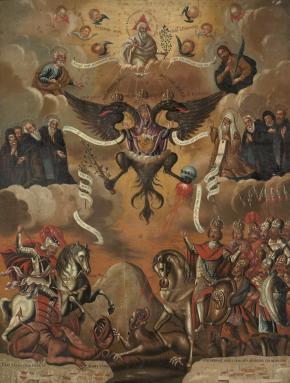
Capture of Azov
- Allegorical painting
- After 1702
- Canvas, oil.
- The State Russian Museum
- Ж-3981
This painting copies the composition of Leonty Tarasevich’s engraving that was placed on the frontispiece of the Kiev-Pechora Patericon, but with some alterations. In the center, there is a double-headed eagle with the Holy Mother and the Christ Child (Our Lady of the Sign icon type). Above them, you can see God the Father surrounded by cherubim. Below them a dove represents the Holy Spirit. To the right and to the left, the artist depicted the patron saints of the imperial family (Saint Peter and Saint Alexius, Man of God). Below on the clouds you can see the Kiev-Pechora saints (Theodosius of Kiev, also called Theodosius of the Caves, and Anthony of Kiev, also called Anthony of the Caves) on the left and on the right there are the Moscow saints (Alexius, Metropolitan of Moscow, Sergius, Nikon and Kirill of Radonezh). An equestrian portrait of Peter the Great is placed in the bottom row of persons depicted together with portraits of Alexei and Boris Sheremetev. Saint George, who has the face of Sheremetev (with no nimbus), is defeating the dragon, which symbolizes the Ottoman Empire; and heaven’s wrath, represented by lighting, is defeating the lion, which is a symbol of Sweden.
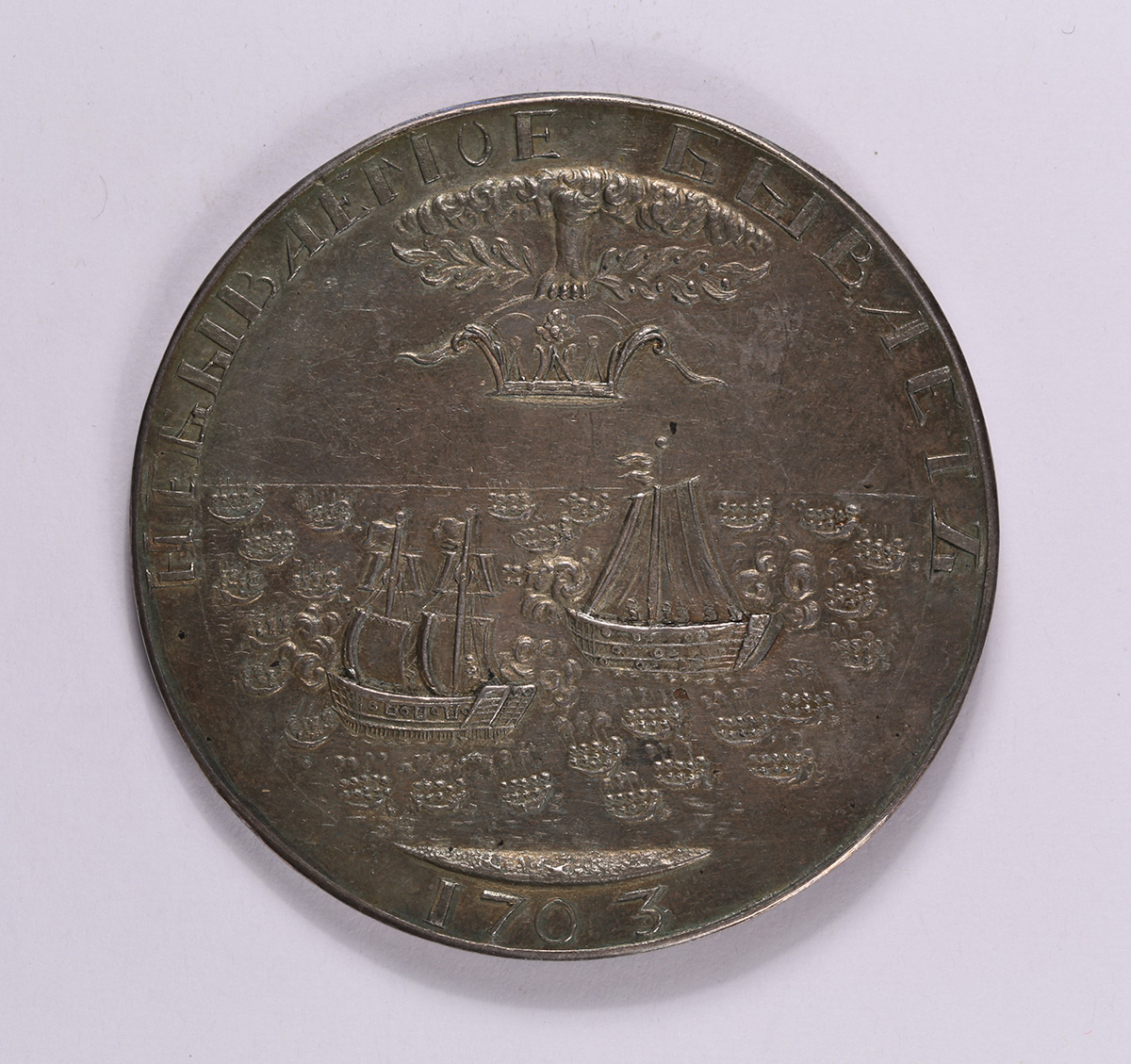
Медаль «Небываемое бывает» / За взятие двух шведских судов 6 мая 1703 г. в устье р. Невы
- 1703
- Silver.
- The State Russian Museum
- Мед.А-522
Portrait of Field Marshal Boris Sheremetev
- After 1710
- Canvas, oil.
- The State Russian Museum
- Ж-5798
Boris Sheremetev (April 25, 1652 – February 17, 1719). Statesman, commander and diplomat. In 1682 he was made Boyar. He took part in the first Azov campaign. He was a close associate of Peter the Great and fought in all the most important battles of the Northen War (Dorpat, Narva, and Riga). He became Field Marshal General in 1701 and was the first Russian count (1706). At the battle of Poltava he commanded the centre of the Russian Army. Peter the Great called Sheremetev his “Turenne” and valued him greatly for his selflessness.
In 1905 the painting was kept in the Sheremetev Palace and exhibited within the Tauride Exhibition as work of Ivan Argunov. Later the portrait was attributed to Schurmann, even though some scholars have doubted the existence of this artist. An inscription recently read on the portrait; “Karl Schurmann pictorducalis curl […]” suggests that during the siege of Riga in 1710, Karl Schurmann was painter to Frederick William, the Duke of Courland, and the future husband of Anna Ioannovna.
Портрет князя Якова Федоровича Долгорукого
- Canvas, oil. 68 x 54
- The State Russian Museum
- Ж-4725
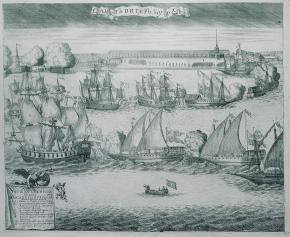
Ввод судов в Петербург после Гангутской победы
- etching.
- The State Russian Museum
- Гр-32299
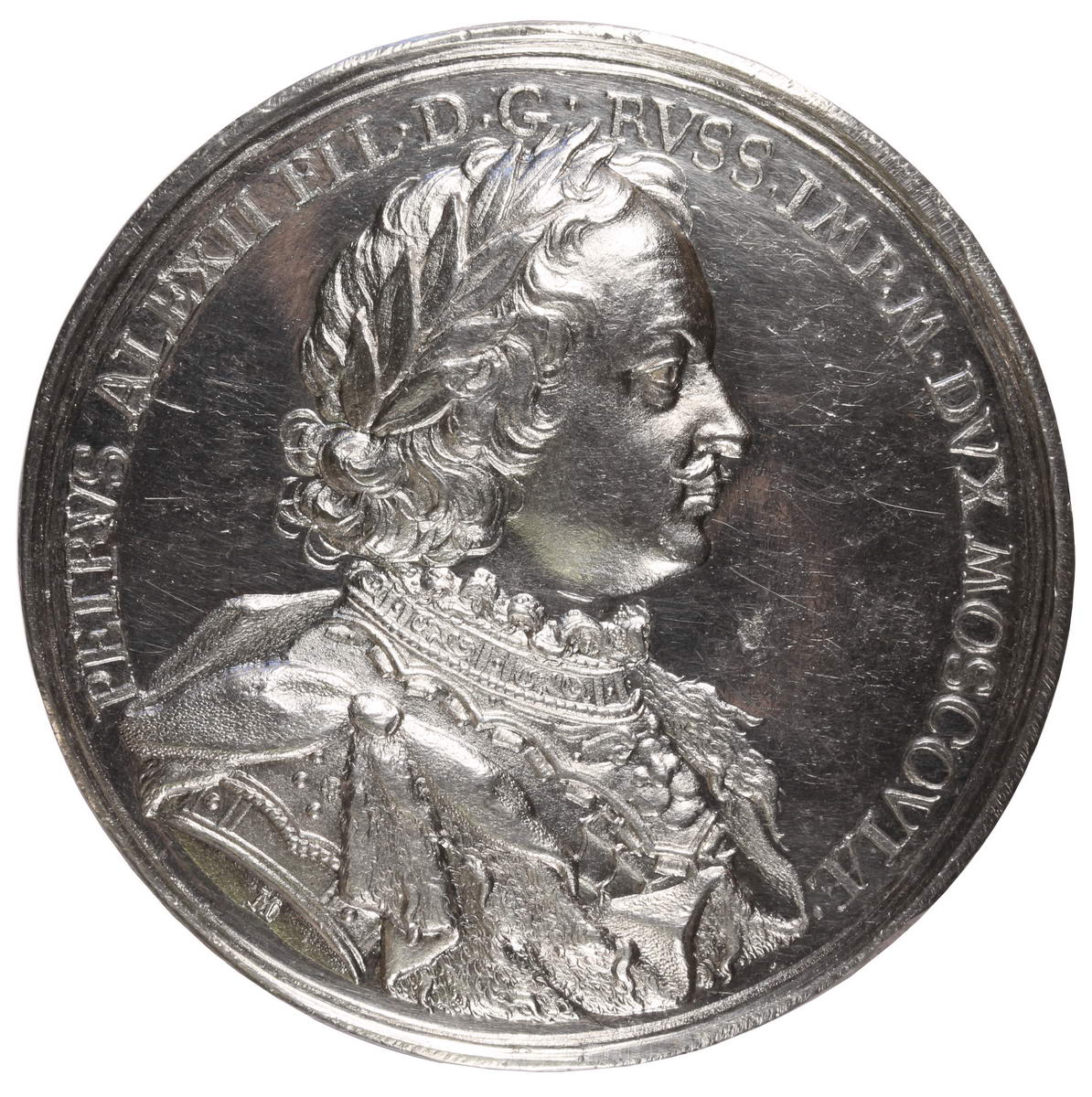
Medal Commemorating the Capture of Nyenschantz in 1703
- 1703
- Silver. D-46. Total weight: 41.93 g.
- The State Russian Museum
- Мед.А-514
The desire of Peter the Great to make Russia one of the European commonwealths initiated the birth of medallic art, which before this was unknown in the Tsardom of Moscow. The famous Nuremberg medallist Philipp Heinrich Müller was ordered to create a series of 26 medals commemorating events of the Northern War. The medals were produced in 1713‒1714 using the highest quality materials and corresponding to European medallic traditions. Beginning in 1716, these commemorative medals were produced in Moscow for presentational purposes: they were presented as gifts to foreigners and senior officers of the state. The letters highlighted in the Latin legend refer to the date, on which the event took place.
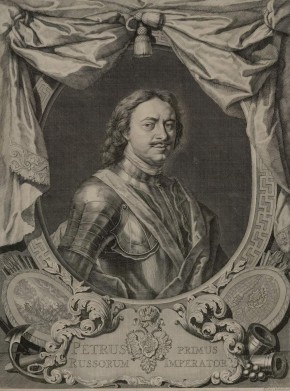
Portrait of Peter I
- 1718
- etching, lathe.
- The State Russian Museum
- Гр-31063
Торжественный ввод в Санкт-Петербург шведских судов после победы при Гренгаме
- etching.
- The State Russian Museum
- Гр-32305
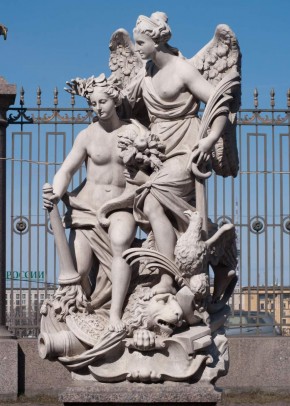
Мир и Победа («Ништадтский мир»)
- 1722-1723
- Marble. 175 х 122 х 72
- The State Russian Museum
- ЛС-1
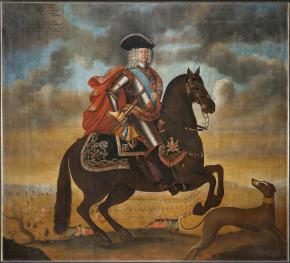
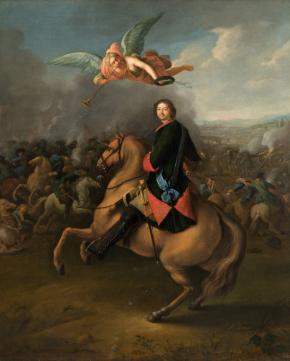
Peter I at the Battle of Poltava
- 1724 (1725?)
- Canvas, oil.
- The State Russian Museum
- Ж-4901
Peter I (the Great; 1672–1725) was the younger son of the Tsar Alexei Mikhailovich. He became Tsar in 1682 (until 1696, he ruled jointly with his brother Ivan V). From 1721, he was the first Emperor of All the Russias.
The painting was created in the European tradition, with the monarch participating in a battle scene. A scholar doing research on Peter’s iconography pointed out as far back as one and a half centuries ago that this “image of the tsar is not so similar to other portraits of his.” In the catalogue of a portrait exhibition organized in 1870, the painting was said to be a “study completed” for a large painting, which was ordered from Tannauer in 1718.
Portrait of Baron Sergei Stroganov, Youngest Son of the Salt manufacturer Grigory Stroganov and his Wife Maria
- 1726
- Canvas, oil.
- The State Russian Museum
- Ж-4908
Sergei Stroganov (August 20, 1707 – September 30, 1756). Youngest son of Grigory Stroganov, a prominent person and salt manufacturer, and his second wife Maria Yakovlevna, née Novosiltseva. Baron (from 1722), actual gentleman-in-waiting, Lieutenant General. Owner of a palace located on Nevsky Prospect, St Petersburg designed by Francesco Bartolomeo Rastrelli. Collector and founder of the Stroganov Art Gallery. In 1735 he married Sofia Kirillovna Naryshkina. His son, Alexander Stroganov, would become president of the Imperial Academy of Arts.
The work was first attributed to Ivan Nikitin in 1804 and there is no question of his authorship. This is one of the few works of the artist that was signed and dated. Researchers note that the technique of the portrait is very good, and it has been preserved better than other works, which makes the individual manner of the artist more apparent. A similar style is visible on his portraits of Prasovia Ioannovna and Anna Petrovna.
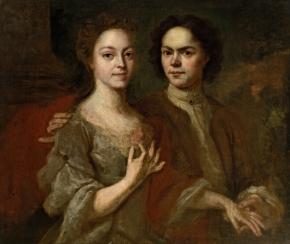
Self-Portrait with Wife
- 1729 (?). After 1727 (?)
- Canvas, oil. 75,5 x 90,5
- The State Russian Museum
- Ж-4913
Andrei Matveyev (1702, (?) – 1739, St Petersburg). Painter, portrait artist, and icon painter, who created allegorical, and decorative and monumental compositions. In 1716, at the request of Peter the Great, he was then sent to study painting in Holland. From September 1717 to September 1723, he studied under Arnold Boonen in Amsterdam, and from December 1723 to May (?) 1727 – in the Antwerp Academy of Fine Arts under (?) Sperwer. In August 1727, he came back to Petersburg and began his work in the Chancellery of Construction. In 1731, Matveyev attained the rank of Master and became the head of the Painting Brigade of the Chancellery of Construction. He participated in creating murals for the Peter and Paul Cathedral, as well as tsarist residences in Petersburg, he also painted icons for the Church of The Holy Righteous Simeon and Anna The Prophetess.
Irina Matveyeva (1712/14–1740s). Daughter of the blacksmith Stepan Antropov. In 1729 (or 1728) she married the artist Andrey Matveyev. She later entered into a second marriage with the merchant Turgenev.
The portrait is thought to have been painted in 1729, the year the artist got married. Some researchers believed that the woman depicted is much older than the artist’s wife (who was only 16 years old when the portrait was painted), and that the people depicted are Princess Anna Leopoldovna and her husband Duke Anthony Ulrich of Brunswick. Modern technical analysis established that the woman’s face was “aged” by alterations introduced after the work was completed.
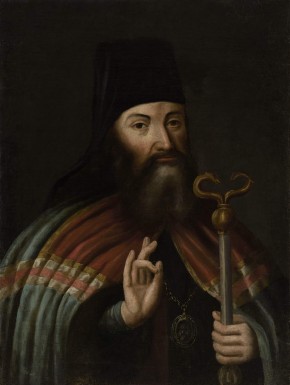
Портрет Феофана Прокоповича
- Canvas, oil. 66,5 x 50
- The State Russian Museum
- ЖБ-2018
Portrait of Admiral Count Nikolai Golovin
- Between 1740 and 1744
- Canvas, oil. 94 x 71 (oval)
- The State Russian Museum
- Ж-3937
Nilolai Fedorovich Golovin (1695 – July 15, 1745). Count, son of Fyodor Golovin; from 1706 he studied at the Naval School. In 1708 Peter the Great sent him to England and Holland to study maritime affairs. Upon his return to Russia in 1715, he was assigned to the Navy in position of Lieutenant. In 1720 he was promoted to Captain Lieutenant; in 1721 upon the conclusion of the Treaty of Nystad he was made Captain 3rd rank. In 1724 he was appointed attendee of the Admiralty Division. During the reign of Empress Catherine I in 1725, he was appointed special envoy to the Swedish court. In 1726 Golovin was promoted to Captain 2nd rank and Adjutant General of the fleet (Captain 1st rank). In 1730 he became Schout-bij-nacht (Rear Admiral), and in 1733 he was appointed Admiral and President of the Admiralty Board. In 1738 he took command of the galley harbor and fleet. After the restoration of the Senate in 1741, he was appointed senator, as he was still president of the Admiralty Board. During the Russo-Swedish War in 1742 he was Governor-General of St Petersburg. As Commander-in-Chief of the troops, he was assigned to protect the capital in the event of Swedish attack. He was married to Sophia Nikitishna (?) with whom he had a daughter named Natalia; Natalia later married Field Marshal General Peter August, Duke of Schleswig-Holstein-Sonderburg-Beck).
It is hard to identify the uniform because rules and regulations concerning navy uniforms constantly changed until 1745. It is possible that Golovin is depicted in civilian dress. The portrait is dated based on him having a ribbon of the Order of St. Andrew the Apostle the First-Called that he received on November 10, 1740, and a decree of Empress Elizabeth Petrovna dated June 18, 1744, according to which Count Nikolai Golovin was placed “on leave so that he can treat his disease.”
Портрет графа Петра Ивановича Шувалова
- Canvas, oil.
- The State Russian Museum
- Ж-44
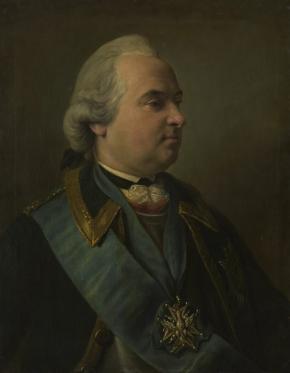
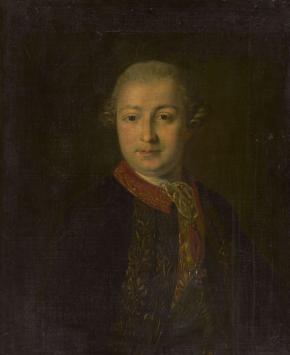
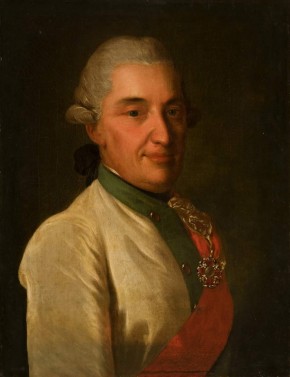
Portrait of Ivan Shuvalov
- Canvas, oil. 71,5 x 56,5
- The State Russian Museum
- Ж-9281
Ivan Shuvalov (1727–1797) was an adjutant general. As he became the favourite of Empress Elizaveta Petrovna in 1749, he had a great influence on Russian foreign and domestic affairs. He was the curator of the Moscow University and the Academy of Art. He took Mikhail Lomonosov under his wing and was acquainted with Voltaire and Helvétius. After the accession of Catherine the Great to the throne, he lived abroad until 1777. After his return to Russia, he became Grand Chamberlain. The painting depicts Shuvalov in uniform with the Orders of St. Anna and the White Eagle. This painting is one of Rokotov’s early works.
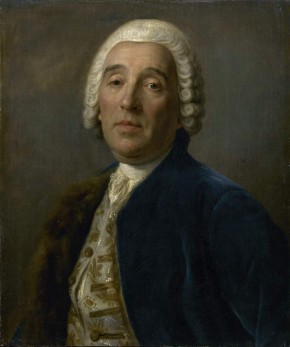
Портрет архитектора Ф.-Б. Растрелли
- Canvas, oil. 56 х 47
- The State Russian Museum
- Ж-4936
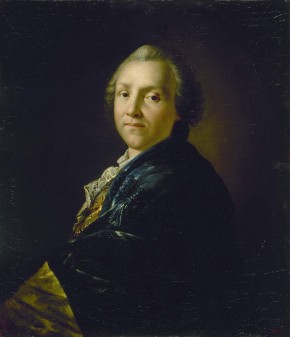
Портрет А. П. Сумарокова
- 1760
- Canvas, oil. 74 х 64,5
- The State Russian Museum
- Ж-4966
Unknown painter
Kalashnikov Osip
Schurmann, Karl
Зубов Алексей Федорович
Müller/ Miller/ Myller Philipp Heinrich
Heu Beracken
Baratta Pietro
1659, Carrara – 1729, VeniceAn Italian sculptor of the Venice school. One of the early Classicism masters in Veneto plastic arts. Born in Carrara, he worked at F. Cabianca\'s workshop in Venice since 1693. Apart from his work in Venice he performed commissions for the Udine Cathedral and the court of Saxony prince-elector in Dresden. He was a nephew of the sculptor Francesco Baratta the Elder (1590–1666), who worked in Lorenzo Bernini\'s laboratory in Rome. Since 1716, already being famous in Veneto, Baratta performed commissions for Russia. The following works are attributed to him: Peace and Justice (Pavlovsk), Winter, Venus, Flora and Adonis (Peterhof), Amphitrite (1717), Galatea, Apollo (1720, all situated in Pushkin). In the Summer Garden collection there are 11 marble sculptures by Pietro Baratta: statues "Mercy", "Justice", "Glory", "Peace and Victory" (The Treaty of Nystad) (1722), busts "Bacchus", "Camilla", "Boy", "Woman in Diadem", "Alexander the Great", "Apollo" (1717), "Young Woman (Roman)". In the period of 2009–2011 these original sculptures were fully renovated and replaced to the Engineers\' Castle (St. Michael\'s Castle) in Saint Petersburg for permanent museum preservation. Since 2012 their exact copies made of marezzo marble are situated in the Summer Garden.
Tannauer (Tanauer, Danhauer, Danauer) Johann Gottfried
1680, Saxony (?) – 1737(3?), St PetersburgGerman painter, portrait artist, and miniaturist. Initially, Tannauer would practice watchmaking and music. He studied painting in Venice under S. Bombelli. Subsequently, he lived in Holland, where he would copy Rubens’s paintings. When Peter the Great was abroad, he invited Tannauer to come to Russia upon the recommendation of Johannes Kupezky. On October 1, 1710 an agreement was signed in Vienna, making Tannauer a painter serving in Russia. In March 1711 the artist came to Smolensk. During the Pruth River Campaign, he accompanied Peter the Great, and then settled down in St Petersburg. He was a court artist. Tannauer painted portraits, historical pictures, and miniatures; he also created ink drawings and fixed clocks. His son, Johann Sebastian Tannauer, studied engraving at the Academy of Sciences.
Nikitin Ivan Nikitich
1680s, Moscow (?) - After 1741Painter, portraitist. Son of a Moscow priest, brother of Roman Nikitin. Possibly educated at the Armoury School of Printing in Moscow. Lived in St Petersburg (from 1711). Studied under Tommaso Redi in Florence as a fellow of Peter the Great (1716-19). Returned to Russia (1720). Court portraitist (from 1721). Painted life portraits of Peter the Great on Kronstadt (1715-21). Married and divorced Maria Fyodorovna Mamens, lady of the bedchamber to Empress Catherine I (1727). Arrested in St Petersburg in connection with the libelling of Archbishop Feofan Prokopovich (1732). Spent five years in the Peter and Paul Fortress. Exiled to Siberia (1737). Released by the Privy Council (1742). Died on the way from Siberia to Moscow.
Matveyev Andrei Matveyevich
1702, ? – 1739, St PetersburgPainter, portraitist, iconpainter, author of allegorical and decorative-monumental compositions. Awarded a fellowship to study in Holland by Peter the Great (1716). Studied under Arnold Boonen in Amsterdam (1717–1723) and under Sperwer at the Antwerp Academy of Arts (1723–1727). Returned to St Petersburg and employed by the Chancellery of Construction (1727). Awarded the title of master and headed the team of painters at the Chancellery of Construction (1731). Helped to decorate the Cathedral of St Peter and St Paul and Imperial residences in St Petersburg. Painted icons for the Church of St Simeon and St Anne.
Rokotov Fyodor Stepanovich
1732 (1735), Moscow -1808, MoscowPainter, portraitist. Believed to have studied in his youth under Moscow icon-painters. Moved to St. Petersburg (17505). Studied at the Imperial Academy of Arts (from 1760). Junior assistant (1762). Academician (1765). Returned to Moscow (17605) and worked there as a free artist.
Rotari Pietro Antonio
Losenko Anton Pavlovich
1757, Glukhov - 1773 St PetersburgHistory painter, portraitist, draughtsman. Studied at Ivan Argunov\'\'s studio (from 1753) and under Jean-Louis de Velly and Louis-Jean-Francois Lagrenee at the Imperial Academy of Arts (1758-60). Taught at the Imperial Academy of Arts. Adjunct (1762). Fellow of the Imperial Academy of Arts in France (1760-62, 1763-65), studied under Jean Restout and Joseph-Marie Vien. Awarded silver medals for drawings by the Academic des Beaux-Arts in Paris (1763, 1764,1765). Studied in Italy (1765-69). Nominated to the Imperial Academy of Arts (1769), academician and professor (1770). Head of the history painting class, director of the Imperial Academy of Arts (1772-73
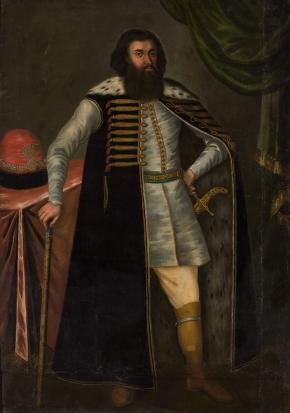
Portrait of Prince Anikita Repnin
- Late 1690s
- Canvas, oil. 181 х 128
- The State Russian Museum
- Ж-3947
Anikita Repnin (1668 – July 3, 1726). Middle son of Ivan Repnin (1615– 1697) who was a boyar close to the tsar and a house steward of Tsar Alexis Mikhailovich, and Ivan’s wife Yevdokia Nikiforovna Pleshcheyeva (? – April 8, 1695). Russian Field Marshal General (1725). From his early years Anikita was close to Peter the Great and took part in the creation of the emperor’s Toy Army. In 1685 he became Lieutenant and within two years he was promoted to Colonel. Repnin participated in the Azov campaigns of 1695–1696. In 1696 he commanded a frigate. In 1699 he became Major General. In the beginning of the Northern War he commanded a division. Following the order of Peter the Great he reconstituted Russian forces withdrawing from Narva after they were defeated in 1700. He took part in the Siege of Nöteborg (1702) and Narva (1704). During the Battle of Poltava (1709) he commanded the centre of the Russian troops. During the years 1709–1710 he commanded the siege and the seizure of Riga. During the years 1712–1713 and 1715–1716 he commanded troops in Pomerania. In 1719 he was appointed Governor General of Livonia, and at the same time he acted as President of the Military College from 1724–1725. After the death of Peter the Great, he supported the enthronement of Catherine I, but shortly afterwards Alexander Menshikov sent him away to Riga.
From the second half of the 19th century to the early 21st century almost all scholars believed the person depicted here to be Ivan Borisovich Repnin; however, this traditional view was recently reconsidered. In 2014 a new version was accepted by the Attribution Council of the Russian Museum.
Portrait of Count Boris Sheremetev
- Late 17th century
- Canvas, oil.
- The State Russian Museum
- Ж-3939
Boris Sheremetev (April 25, 1652 – February 17, 1719). Statesman, commander and diplomat. In 1682 he was made Boyar. He took part in the first Azov campaign. He was a close associate of Peter the Great and fought in all the most important battles of the Northen War (Dorpat, Narva, and Riga). He became Field Marshal General in 1701 and was the first Russian count (1706). At the battle of Poltava he commanded the centre of the Russian Army. Peter the Great called Sheremetev his “Turenne” and valued him greatly for his selflessness.
The portrait was dated based on technological research. The upper left corner of the painting features a coat of arms belonging to the Sheremetev family, corresponding to the time when the item was created. Evidence suggests that this painting was used by Leonty Tarasevich, when he created his engraving for a panegyric presented to Sheremetev in 1695, commemorating the Count’s successful seizure of four Ottoman fortresses. Sergei Sheremetev, descendant of Count Boris Sheremetev, maintained that the original painting used for the engraving, was kept in the village of Borisovka, the family estate near Belgorod. It is possible that this particular painting, now in the collection of the State Russian Museum, is the very same work.
Capture of Azov
- Allegorical painting
- After 1702
- Canvas, oil.
- The State Russian Museum
- Ж-3981
This painting copies the composition of Leonty Tarasevich’s engraving that was placed on the frontispiece of the Kiev-Pechora Patericon, but with some alterations. In the center, there is a double-headed eagle with the Holy Mother and the Christ Child (Our Lady of the Sign icon type). Above them, you can see God the Father surrounded by cherubim. Below them a dove represents the Holy Spirit. To the right and to the left, the artist depicted the patron saints of the imperial family (Saint Peter and Saint Alexius, Man of God). Below on the clouds you can see the Kiev-Pechora saints (Theodosius of Kiev, also called Theodosius of the Caves, and Anthony of Kiev, also called Anthony of the Caves) on the left and on the right there are the Moscow saints (Alexius, Metropolitan of Moscow, Sergius, Nikon and Kirill of Radonezh). An equestrian portrait of Peter the Great is placed in the bottom row of persons depicted together with portraits of Alexei and Boris Sheremetev. Saint George, who has the face of Sheremetev (with no nimbus), is defeating the dragon, which symbolizes the Ottoman Empire; and heaven’s wrath, represented by lighting, is defeating the lion, which is a symbol of Sweden.
Медаль «Небываемое бывает» / За взятие двух шведских судов 6 мая 1703 г. в устье р. Невы
- 1703
- Silver.
- The State Russian Museum
- Мед.А-522
Portrait of Field Marshal Boris Sheremetev
- After 1710
- Canvas, oil.
- The State Russian Museum
- Ж-5798
Boris Sheremetev (April 25, 1652 – February 17, 1719). Statesman, commander and diplomat. In 1682 he was made Boyar. He took part in the first Azov campaign. He was a close associate of Peter the Great and fought in all the most important battles of the Northen War (Dorpat, Narva, and Riga). He became Field Marshal General in 1701 and was the first Russian count (1706). At the battle of Poltava he commanded the centre of the Russian Army. Peter the Great called Sheremetev his “Turenne” and valued him greatly for his selflessness.
In 1905 the painting was kept in the Sheremetev Palace and exhibited within the Tauride Exhibition as work of Ivan Argunov. Later the portrait was attributed to Schurmann, even though some scholars have doubted the existence of this artist. An inscription recently read on the portrait; “Karl Schurmann pictorducalis curl […]” suggests that during the siege of Riga in 1710, Karl Schurmann was painter to Frederick William, the Duke of Courland, and the future husband of Anna Ioannovna.
Портрет князя Якова Федоровича Долгорукого
- Canvas, oil. 68 x 54
- The State Russian Museum
- Ж-4725
Ввод судов в Петербург после Гангутской победы
- etching.
- The State Russian Museum
- Гр-32299
Medal Commemorating the Capture of Nyenschantz in 1703
- 1703
- Silver. D-46. Total weight: 41.93 g.
- The State Russian Museum
- Мед.А-514
The desire of Peter the Great to make Russia one of the European commonwealths initiated the birth of medallic art, which before this was unknown in the Tsardom of Moscow. The famous Nuremberg medallist Philipp Heinrich Müller was ordered to create a series of 26 medals commemorating events of the Northern War. The medals were produced in 1713‒1714 using the highest quality materials and corresponding to European medallic traditions. Beginning in 1716, these commemorative medals were produced in Moscow for presentational purposes: they were presented as gifts to foreigners and senior officers of the state. The letters highlighted in the Latin legend refer to the date, on which the event took place.
Portrait of Peter I
- 1718
- etching, lathe.
- The State Russian Museum
- Гр-31063
Торжественный ввод в Санкт-Петербург шведских судов после победы при Гренгаме
- etching.
- The State Russian Museum
- Гр-32305
Мир и Победа («Ништадтский мир»)
- 1722-1723
- Marble. 175 х 122 х 72
- The State Russian Museum
- ЛС-1
Peter I at the Battle of Poltava
- 1724 (1725?)
- Canvas, oil.
- The State Russian Museum
- Ж-4901
Peter I (the Great; 1672–1725) was the younger son of the Tsar Alexei Mikhailovich. He became Tsar in 1682 (until 1696, he ruled jointly with his brother Ivan V). From 1721, he was the first Emperor of All the Russias.
The painting was created in the European tradition, with the monarch participating in a battle scene. A scholar doing research on Peter’s iconography pointed out as far back as one and a half centuries ago that this “image of the tsar is not so similar to other portraits of his.” In the catalogue of a portrait exhibition organized in 1870, the painting was said to be a “study completed” for a large painting, which was ordered from Tannauer in 1718.
Portrait of Admiral Count Nikolai Golovin
- Between 1740 and 1744
- Canvas, oil. 94 x 71 (oval)
- The State Russian Museum
- Ж-3937
Nilolai Fedorovich Golovin (1695 – July 15, 1745). Count, son of Fyodor Golovin; from 1706 he studied at the Naval School. In 1708 Peter the Great sent him to England and Holland to study maritime affairs. Upon his return to Russia in 1715, he was assigned to the Navy in position of Lieutenant. In 1720 he was promoted to Captain Lieutenant; in 1721 upon the conclusion of the Treaty of Nystad he was made Captain 3rd rank. In 1724 he was appointed attendee of the Admiralty Division. During the reign of Empress Catherine I in 1725, he was appointed special envoy to the Swedish court. In 1726 Golovin was promoted to Captain 2nd rank and Adjutant General of the fleet (Captain 1st rank). In 1730 he became Schout-bij-nacht (Rear Admiral), and in 1733 he was appointed Admiral and President of the Admiralty Board. In 1738 he took command of the galley harbor and fleet. After the restoration of the Senate in 1741, he was appointed senator, as he was still president of the Admiralty Board. During the Russo-Swedish War in 1742 he was Governor-General of St Petersburg. As Commander-in-Chief of the troops, he was assigned to protect the capital in the event of Swedish attack. He was married to Sophia Nikitishna (?) with whom he had a daughter named Natalia; Natalia later married Field Marshal General Peter August, Duke of Schleswig-Holstein-Sonderburg-Beck).
It is hard to identify the uniform because rules and regulations concerning navy uniforms constantly changed until 1745. It is possible that Golovin is depicted in civilian dress. The portrait is dated based on him having a ribbon of the Order of St. Andrew the Apostle the First-Called that he received on November 10, 1740, and a decree of Empress Elizabeth Petrovna dated June 18, 1744, according to which Count Nikolai Golovin was placed “on leave so that he can treat his disease.”
Портрет графа Петра Ивановича Шувалова
- Canvas, oil.
- The State Russian Museum
- Ж-44
Портрет адмирала Семена Ивановича Мордвинова (1701-1777)
- Canvas, oil.
- The State Russian Museum
- Ж-6247
Портрет князя М. М. Голицына младшего, президента Адмиралтейств-коллегии
- 1763
- Canvas, oil. 126 x 102
- The State Russian Museum
- Ж-4928
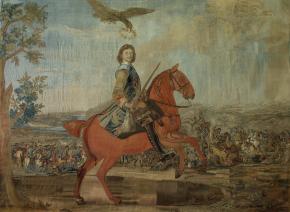
Battle of Poltava
- Tapestry
- Wool, silk, weaving.
- The State Russian Museum
- Тк-1032
The tapestry "Battle of Poltava" is one of the most significant and famous works of St. Petersburg Tapestry Manufactory, which was founded in 1716 on the initiative of Peter the Great. Battle paintings appeared to be a new genre in Russian art, brought to life by the brilliant victories of the Russian army in the Great Northern War. The victory at Poltava was often embodied in all kinds of art, including in weaving. "The Battle of Poltava" is one of the most significant and most famous works of the St. Petersburg Tapestry Manufactory.
In the centre of the tapestry is the equestrian portrait of Peter I, a convincing monumental image of the commander. The figure of the emperor on the rampant bay horse is spectacularly depicted against the background of the battle. The artist and the makers of the tapestry managed to find the necessary degree of generalization and achieve the monumentality necessary for this kind of work, creating an expressive artistic image through the means of carpet making.
Initially, the tapestry was surrounded by a wide frame with the images of the coats of arms of Russian towns. It is difficult to say, when and under what circumstances the tapestry lost this spectacular frame. Until 1863 the St. Petersburg furniture manufacturer Karl Tur owned the carpet. Then until 1912 the carpet decorated the rooms of the Petrovsky palace on Petrovsky island.
The fragments of the frame are currently kept in the State Russian Museum and the Historical Museum in Moscow.
The tapestry is an example of the most interesting monumental Russian decorative art of the 18th century thanks to the mastery of its performance.
Portrait of Admiral Alexei Senyavin
- 1770s
- Canvas, oil.
- The State Russian Museum
- Ж-4951
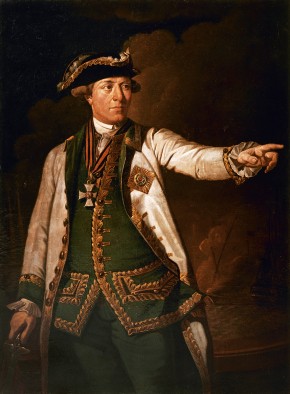
Portrait of Rear Admiral Samuel Greig
- Canvas, oil.
- The State Russian Museum
- Ж-6295
Портрет графа С. Р. Воронцова
- Canvas, oil.
- The State Russian Museum
- Ж-5384
Christinecke Carl Ludwig
1732 (3?), St. Petersburg - between 1792 and 1794, St. PetersburgImperial Tapestry Manufactory
Argunov Ivan Petrovich
1771, St Petersburg - After 1829Painter, portraitist. Studied art under his father Ivan Argunov, a Sheremetyev serf artist. Copied the paintings of West European artists in the Imperial Hermitage. Freed from serfdom (1816). Made an academician (1818) for his portrait of Pavel Runich (1817). Painted miniature portraits.
Voille Jean Louis
1744, Paris – after 1803, ?Self-Portrait with Wife
- 1729 (?). After 1727 (?)
- Canvas, oil. 75,5 x 90,5
- The State Russian Museum
- Ж-4913
Andrei Matveyev (1702, (?) – 1739, St Petersburg). Painter, portrait artist, and icon painter, who created allegorical, and decorative and monumental compositions. In 1716, at the request of Peter the Great, he was then sent to study painting in Holland. From September 1717 to September 1723, he studied under Arnold Boonen in Amsterdam, and from December 1723 to May (?) 1727 – in the Antwerp Academy of Fine Arts under (?) Sperwer. In August 1727, he came back to Petersburg and began his work in the Chancellery of Construction. In 1731, Matveyev attained the rank of Master and became the head of the Painting Brigade of the Chancellery of Construction. He participated in creating murals for the Peter and Paul Cathedral, as well as tsarist residences in Petersburg, he also painted icons for the Church of The Holy Righteous Simeon and Anna The Prophetess.
Irina Matveyeva (1712/14–1740s). Daughter of the blacksmith Stepan Antropov. In 1729 (or 1728) she married the artist Andrey Matveyev. She later entered into a second marriage with the merchant Turgenev.
The portrait is thought to have been painted in 1729, the year the artist got married. Some researchers believed that the woman depicted is much older than the artist’s wife (who was only 16 years old when the portrait was painted), and that the people depicted are Princess Anna Leopoldovna and her husband Duke Anthony Ulrich of Brunswick. Modern technical analysis established that the woman’s face was “aged” by alterations introduced after the work was completed.
Портрет Феофана Прокоповича
- Canvas, oil. 66,5 x 50
- The State Russian Museum
- ЖБ-2018
Портрет архитектора Ф.-Б. Растрелли
- Canvas, oil. 56 х 47
- The State Russian Museum
- Ж-4936
Портрет А. П. Сумарокова
- 1760
- Canvas, oil. 74 х 64,5
- The State Russian Museum
- Ж-4966
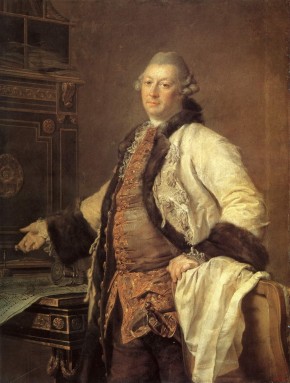
Портрет А. Ф. Кокоринова
- 1769
- Canvas, oil. 134 x 102
- The State Russian Museum
- Ж-4985
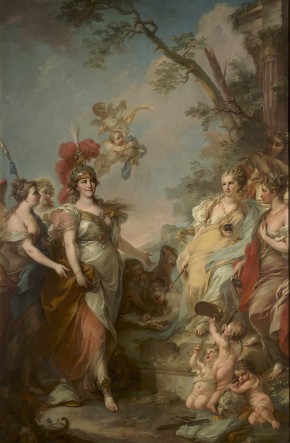
Catherine II as Minerva, Patroness of the Arts
- Canvas, oil.
- The State Russian Museum
- Ж-5490
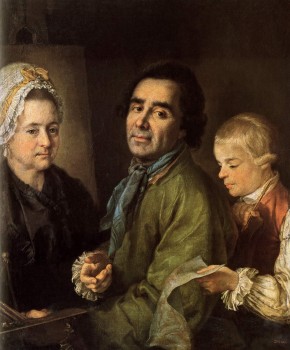
Портрет художника А. П. Антропова с сыном перед портретом жены
- 1776
- Canvas, oil. 84 х 70,5
- The State Russian Museum
- Ж-4929
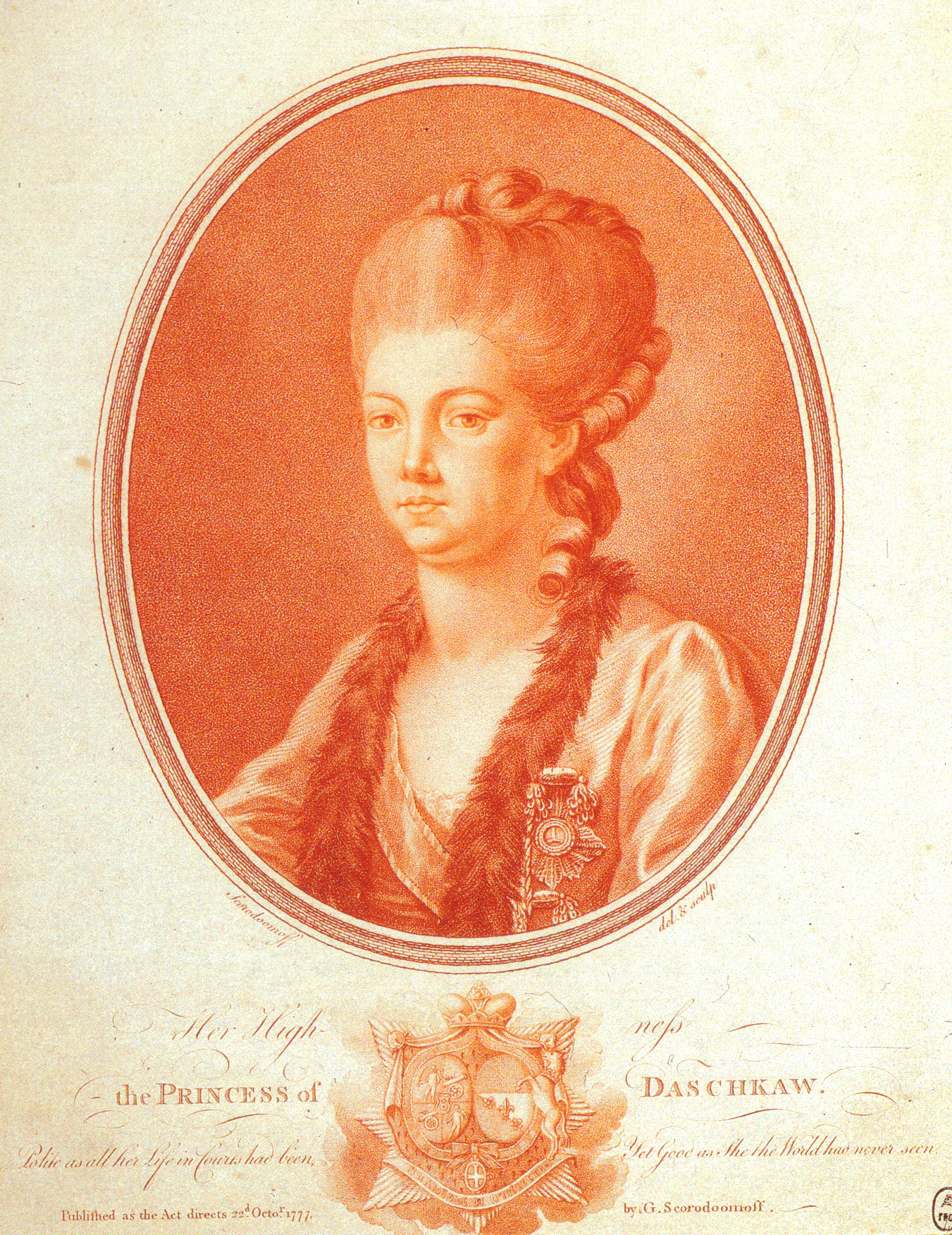
Портрет Е. Р. Дашковой (урожд. Воронцовой)
- 1777
- etching. 25,4 х 18,9
- The State Russian Museum
- Гр-30657
Portrait of the Writer Alexander Khrapovitsky
- 1781
- Canvas, oil. 60,5 х 49
- The State Russian Museum
- Ж-4994
Khrapovitsky Aleksandr Vasilyevich (1749–1801) – a writer. He graduated from the Overland Gentry Corps, from a young age he was fond of literature. He was acquainted with M.V. Lomonosov. Khrapovitsky Aleksandr Vasilyevich was a friend of G.R. Derzhavin. From 1782 to 1793 he was the State Secretary of Catherine II. Since 1793 he was a senator. Mason. The author of the well-known "Memorandum Pads".
Khrapovitsky is depicted with the Order of St. Vladimir. He received the Order of St. Vladimir of the 3rd Class in 1783, and 2nd Class – in 1785.
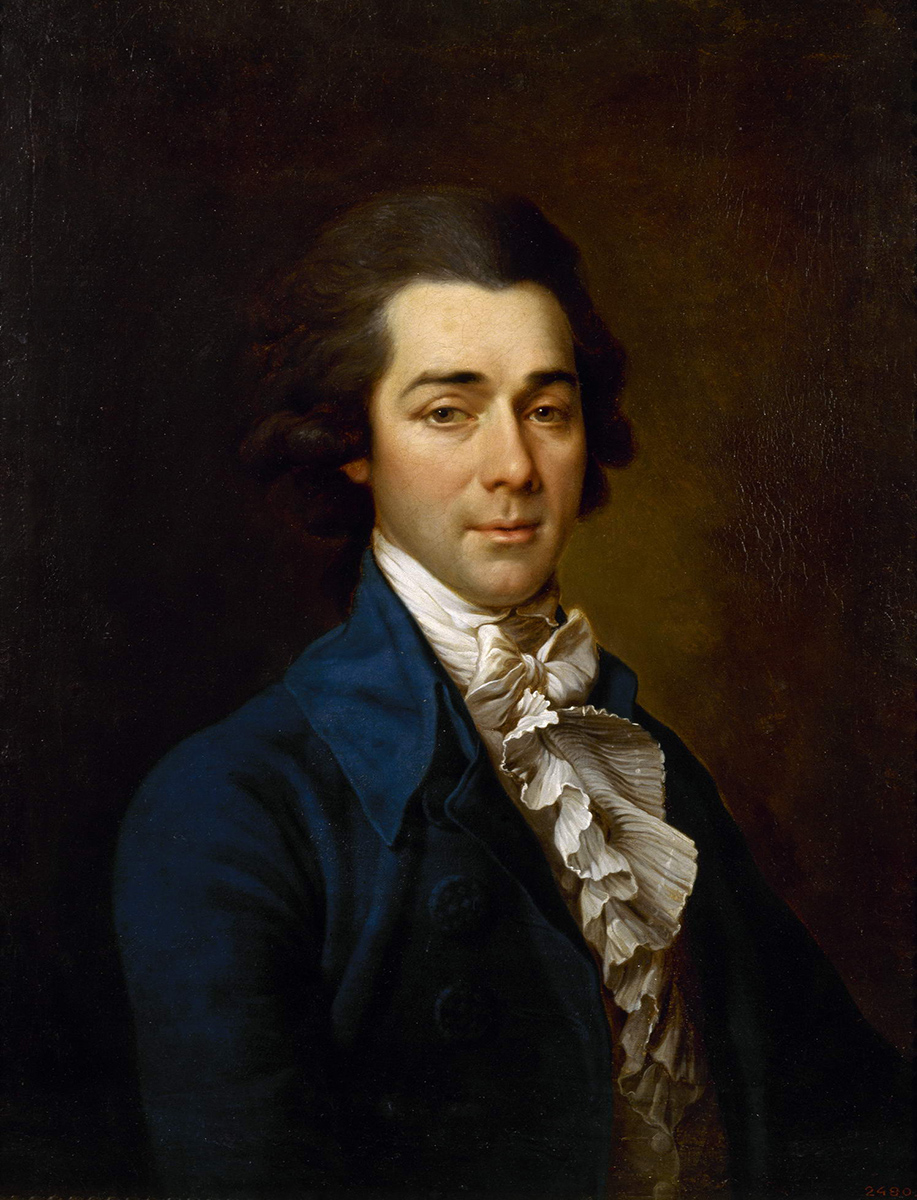
Портрет Н. А. Львова, архитектора, художника и поэта
- 1780s
- Canvas, oil. 71 x 55,5
- The State Russian Museum
- Ж-5002
Portrait of the Architect and Adjunct Rector of the Academy of Arts Georg Friedrich Felten
- Canvas, oil. 60 х 47
- The State Russian Museum
- Ж-3229
Портрет И. П. Елагина
- Canvas, oil.
- The State Russian Museum
- Ж-5388
Портрет императрицы Екатерины II с аллегорическими фигурами Сатурна и Истории
- Canvas, oil. 60 х 50
- The State Russian Museum
- Ж-4554
Портрет адъюнкт-ректора Академии художеств И. Е. Старова
- Canvas, oil. 129 x 103
- The State Russian Museum
- Ж-3199
Автопортрет
- 1804
- Paper, watercolours, , nib, graphite pencil. 21,4 х 13,8
- The State Russian Museum
- Р-6792
Портрет архитектора А. Д. Захарова
- Canvas, oil. 59 х 54
- The State Russian Museum
- Ж-5029
Portrait of Alexei Tomilov
- 1808
- Canvas, oil. 68 х 55,5
- The State Russian Museum
- Ж-5131
Alexei Romanovich Tomilov (1779-1848) was an artillery officer by education and a commander during the building of a fortress in Kronstadt (1799). He left the service in 1808. Alexei Romanovich was a collector and an art amateur, one of the founders and a committee member of the Artists Support Society (since 1820) and a honored free member of the Imperial Academy of Sciences (1833).
Portrait of the Member of the State Council and Collector Count Alexander Stroganov
- 1814
- Canvas, oil. 251 х 184
- The State Russian Museum
- Ж-5497
Alexander Stroganov (1733–1811) was a Count and the son of Sergei Stroganov and Sofia Stroganova (née Naryshkina). From 1752 through 1757, he studied abroad. In 1761, he was created Count of the Holy Roman Empire. In 1762 he was made Chamberlain and in 1770, privy councillor; he was a senator and was made Great Chamberlain in 1796, and in 1798 Count of the Russian Empire, and he was Director of the Public Library. He was made President of the Imperial Academy of Arts in 1800. From 1784 until 1811, he was the Province Marshal of the Nobility for St Petersburg, and was made a member of the State Council in 1801. He was a collector. He personally compiled and published a small portion of his collection under the title “Catalogue raisonné des tableaux, que composent la collection du comte A. de Stroganoff”. He was married twice. His first wife was Anna Vorontsova, and his second was Princess Yekaterina Trubetskaya.
Self-Portrait
- 1810s
- Canvas, oil. 52,5 x 42,5
- The State Russian Museum
- Ж-3408
Автопортрет в бархатном берете, с рейсфедером
- 1810s
- Canvas, oil. 62,5 x 52,5
- The State Russian Museum
- Ж-5232
Levitsky Dmitry Grigoryevich
1735, Kiev - 1822, St PetersburgLeading Russian eighteenth-century painter and portraitist. Son of Grigory Levitsky Nos, a priest and Ukrainian engraver. Moved to St Petersburg (c. 1758). Studied under Alexei Antropov. Worked in Moscow (17605). Nominated to the Academy (c. 1769). Academician (1770). Headed the portraiture class at the Imperial Academy of Arts (1771-87). Councillor (1776), member of the Academy council (1780). Retired for unknown reasons (1787). Worked as a free painter. Returned to the Academy council (1807).
Torelli Stefano
Drozhdin Pyotr Semyonovich
174(5?), ?– 1805, St Petersburg (?)Painter; portraitist. Studied at the icon-painting studio of Trinity Lavra of St Sergius, then under Alexei Antropov in St Petersburg and later under Dmitry Levitsky. Appointed academician (1776), academician (1785). Copied paintings by Guido Reni, Pietro Testa, Jacopo Amigoni.
Скородумов Гаврила Иванович
SHCHUKIN, Stepan Semyonovich
1762, Moscow - 1828, St PetersburgPainter, portraitist, miniaturist, author of church paintings, teacher. Son of an army corporal Semyon Petrov and Euphemia Evlampieva. After the death of his parents, entered the Orphan House in Moscow (1765), where he received his prima
Lampi Johann Baptist I
1751, Romeno, Southern Tyrol — 1830, ViennaAustrian painter, miniaturist, portraitist, author of compositions on historical and mythological themes. Son of the Tyrolean artist Matteo Lampi. Studied under F. Kb\'nig and F. N. Streicher in Salzburg, thereafter under F. and D. Lorenzi in Verona. Worked in Italy (1770-1780), Austria (1781-1788), Poland (1788-1791) at the invitation of the King Stanistaw August Poniatowski, and in Russia (1792-1797). Member of the Verona Academy of Arts (from 1773), professor of the Vienna Academy of Arts (from 1786) for the portrait of Joseph II as a Grand Master of the Order of the Golden Fleece; honoured associate member of the St Petersburg Academy of Arts (from 1794). Taught Russian artists. Head of the Council of the Verona Academy of Arts (from 1800). Handed over his studio to Johann Baptiste Lampi the Younger and practically stopped working (1822).
Камеженков Ермолай Дементьевич
Tolstoy Fyodor Petrovich
1783, St. Petersburg - 1873, St. PetersburgKiprensky Orest Adamovich
1772, Nezhinskaya (St Petersburg Province) - 1836, RomePortraitist, history painter, draughtsman.
Illegitimate son of a serf woman, Anna Gavrilova, who gave him the name Kipreisky, later changed to Kiprensky. Grew up in the family of his foster father Adam Schwalde. Emancipated from serfdom and enrolled in the Imperial Academy of Arts (1788). Studied history painting under Grigory Ugryumov and Gabriele-Francois Doyen. Fellow of the Imperial Academy of Arts (1803-09). Worked in St Petersburg, Moscow and Tver. Academician of portrait painting (1812), councillor of the Imperial Academy of Arts (1815). Contributed to the exhibitions of the Imperial Academy of Arts. Lived in Italy (1816-23, 1828-36). Contributed to the Paris Salon (1822). Donated Self-Portrait (1820) to the Galleria degli Uffizi in Florence (1825). Appointed second-class professor of history and portrait painting with automatic member¬ship of the nobility (1831). Councillor of the Accademia di Belle Arti in Naples (1831). Buried at Sant\'\' Andrea delle Fratte in Rome.
Bruni Fidelio (Fyodor Antonovich)
1801, Milan -1875, St PetersburgPainter, engraver, author of religious and history compositions, portraitist. Son of the painter and sculptor Antonio Baroffi-Bruni. Moved to Russia with his father (1807). Studied under Alexei Yegorov, Andrei Ivanov and Vasily Shebuyev at the Imperial Academy of Arts (from 1809). Graduated with a first-class degree (1818). Moved to Rome to con¬tinue his art education (1819). Returned to Russia and painted portraits and icons for churches and cathedrals in St Petersburg and environs (1835-38). Lived and worked in Rome (1838-43, 1843-45). Honorary member of the Academies of Art of Bologna and Milan, professor of the Florentine Academy of Arts and St Luke\'\'s Academy in Rome. Taught at the Imperial Academy of Arts (1836-38, 1846-71). Second-class professor (1836), first-class professor (1846), rector of painting and sculpture (1855-71). Curator of the Imperial Hermitage picture gallery (1849-64), headed the mosaic studio at the Imperial Academy of Arts (from 1866
Warnek Alexander Grigoryevich
1782, St Petersburg - 1843, St PetersburgPainter, draughtsman, portraitist. Son of Georg Dietrich Warnek, a mahogany furniture maker. Studied at the Imperial Academy of Arts (1795-1803). Fourteenth-class artist. Awarded a fellowship to Italy (1804-09). Academician of portraiture for Portrait of the Writer, Historian, Ethnographer, Geographer, Archaeologist and Honorary Member of the Imperial Academy of Arts Ivan Pototsky (1810). Painted icons for the iconostasis of the Kazan Cathedral (1810). Taught portraiture at the Imperial Academy of Arts (from 1810) and miniature painting (from 1815). Councillor (1814), second-class professor (1831), first-class professor (1832), professor emeritus (1834). Curator of drawings and prints at the Imperial Hermitage (from 1824). Contributed to the work of the Society for the Encouragement of Arts. Contributed to the exhibitions of the Imperial Academy of Arts (1814-24).
Portrait of Baron Sergei Stroganov, Youngest Son of the Salt manufacturer Grigory Stroganov and his Wife Maria
- 1726
- Canvas, oil.
- The State Russian Museum
- Ж-4908
Sergei Stroganov (August 20, 1707 – September 30, 1756). Youngest son of Grigory Stroganov, a prominent person and salt manufacturer, and his second wife Maria Yakovlevna, née Novosiltseva. Baron (from 1722), actual gentleman-in-waiting, Lieutenant General. Owner of a palace located on Nevsky Prospect, St Petersburg designed by Francesco Bartolomeo Rastrelli. Collector and founder of the Stroganov Art Gallery. In 1735 he married Sofia Kirillovna Naryshkina. His son, Alexander Stroganov, would become president of the Imperial Academy of Arts.
The work was first attributed to Ivan Nikitin in 1804 and there is no question of his authorship. This is one of the few works of the artist that was signed and dated. Researchers note that the technique of the portrait is very good, and it has been preserved better than other works, which makes the individual manner of the artist more apparent. A similar style is visible on his portraits of Prasovia Ioannovna and Anna Petrovna.
Портрет Феофана Прокоповича
- Canvas, oil. 66,5 x 50
- The State Russian Museum
- ЖБ-2018
Portrait of Ivan Shuvalov
- Canvas, oil. 71,5 x 56,5
- The State Russian Museum
- Ж-9281
Ivan Shuvalov (1727–1797) was an adjutant general. As he became the favourite of Empress Elizaveta Petrovna in 1749, he had a great influence on Russian foreign and domestic affairs. He was the curator of the Moscow University and the Academy of Art. He took Mikhail Lomonosov under his wing and was acquainted with Voltaire and Helvétius. After the accession of Catherine the Great to the throne, he lived abroad until 1777. After his return to Russia, he became Grand Chamberlain. The painting depicts Shuvalov in uniform with the Orders of St. Anna and the White Eagle. This painting is one of Rokotov’s early works.
Портрет И. И. Шувалова
- 1760
- Canvas, oil. 85 х 70,5
- The State Russian Museum
- Ж-4965
Portrait of Alexander Stroganov
- Canvas, oil. 115,5 х 87
- The State Russian Museum
- Ж-4541
Alexander Roslin (1718-1793) was a Swedish painter, who worked in St. Petersburg from 1775 until 1777. He painted many portraits of members of the imperial family and the high nobility.
Alexander Stroganov (1733–1811) was count and son of Sergei Stroganov and Sofia Kirillovna (née Naryshkina). He was a privy councilor, senator, Great Chamberlain and member of the State Council. He was also Director of the Public Library and President of the Imperial Academy of Arts, as well as a collector. He is depicted with the Orders of the White Eagle (ribbon and star) and St. Anne (cross).
Портрет Василия Алексеевича Злобина
- Canvas, oil.
- The State Russian Museum
- Ж-4809
Portrait of Prince Nikolai Yassupov, Senator and Honorary Lover of the Academy of Art
- 1794
- Canvas, oil. 71 х 56,5
- The State Russian Museum
- Ж-4552
Nikolai Yusupov (1750–1831) was a Prince. He was a collector, an honourary amateur of the Imperial Academy of Arts, an actual councillor of state, senator, member of the State Council under Catherine II. He was the director of the Imperial Theatres, was in charge of the Imperial Hermitage. He was the owner and architect of the Arkhangelskoye estate, and a patron of the arts. He was married to Tatyana Potemkina (née von Engelhardt; 1769–1841). He is depicted with the Orders of the White Eagle (ribbon) and St Stanislaus (cross).
The Anointing of the Grand Duchess Elizabeth Alexeyevna
- 1795
- Canvas, oil. 268 х 392
- The State Russian Museum
- Ж-5786
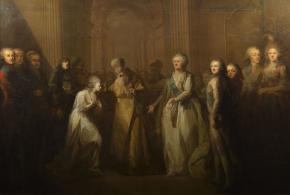
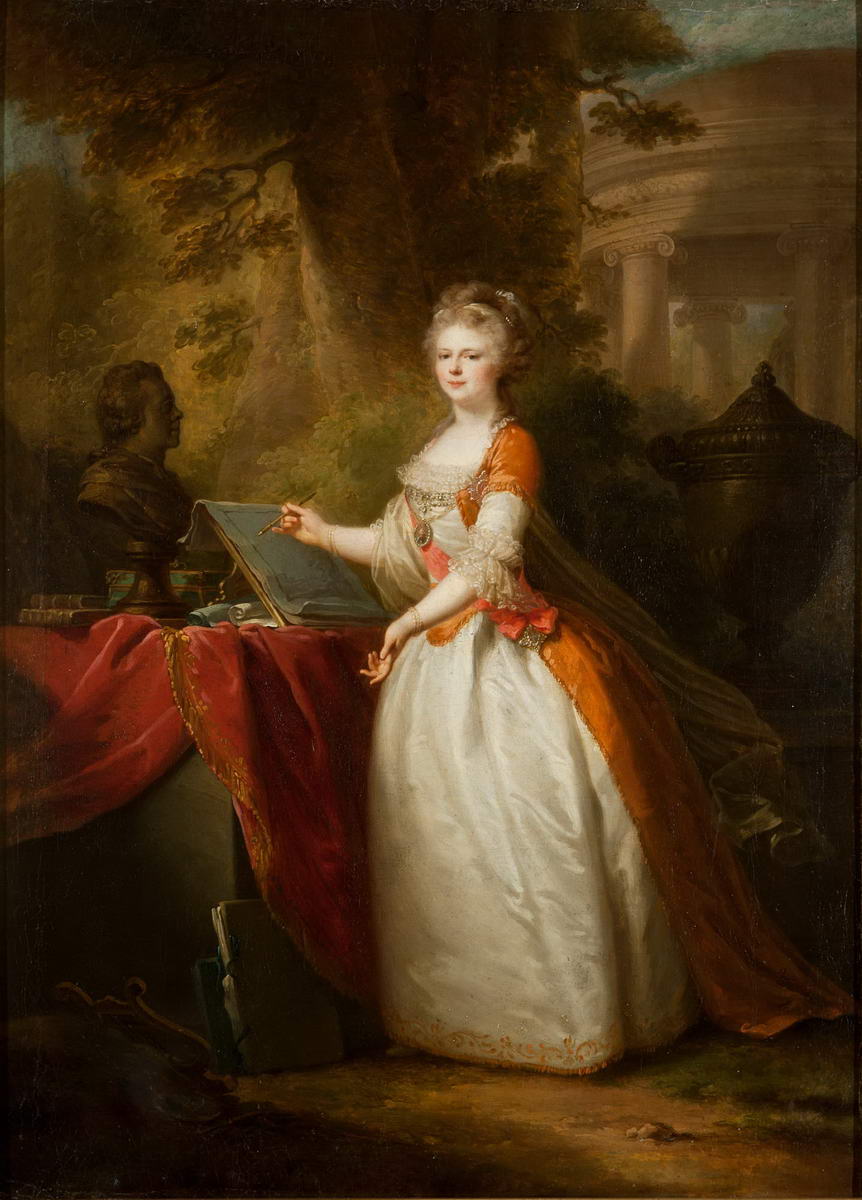
This scene represents the baptism of Louise Maria Augusta, daughter of Margrave Karl Ludwig of Baden, in Orthodoxy of Elizabeth Alexeyevna. The ceremony took place on 9th of May 1793 in the Grand Church of the Winter Palace. Metropolitan Gabriel performed the anointing in the centre of the painting, and on the right, there are Grand Dukes Alexander Pavlovich, Konstantin Pavlovich, Pavel Petrovich and Grand Duchess Maria Fedorovna. On the left, there are the Mother Superior of the Syrkov Monastery in Novgorod, Alexandra Shubina, their Highnesses Princes Platon Zubov and Alexander Bezborodko and the teacher of the older sons of Paul, Baron Andrei Budberg. Most of the characters are from the original painting of Johann Baptist Lampi the Elder.
Портрет великой княгини Марии Федоровны
- Canvas, oil. 55 x 40
- The State Russian Museum
- Ж-4560
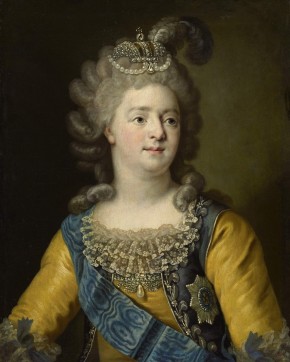
Portrait of the Empress Marie Fyodorovna
- Iconographic type of Jean Louis Voille
- 1797
- Canvas, oil. 71 х 57,5
- The State Russian Museum
- Ж-73
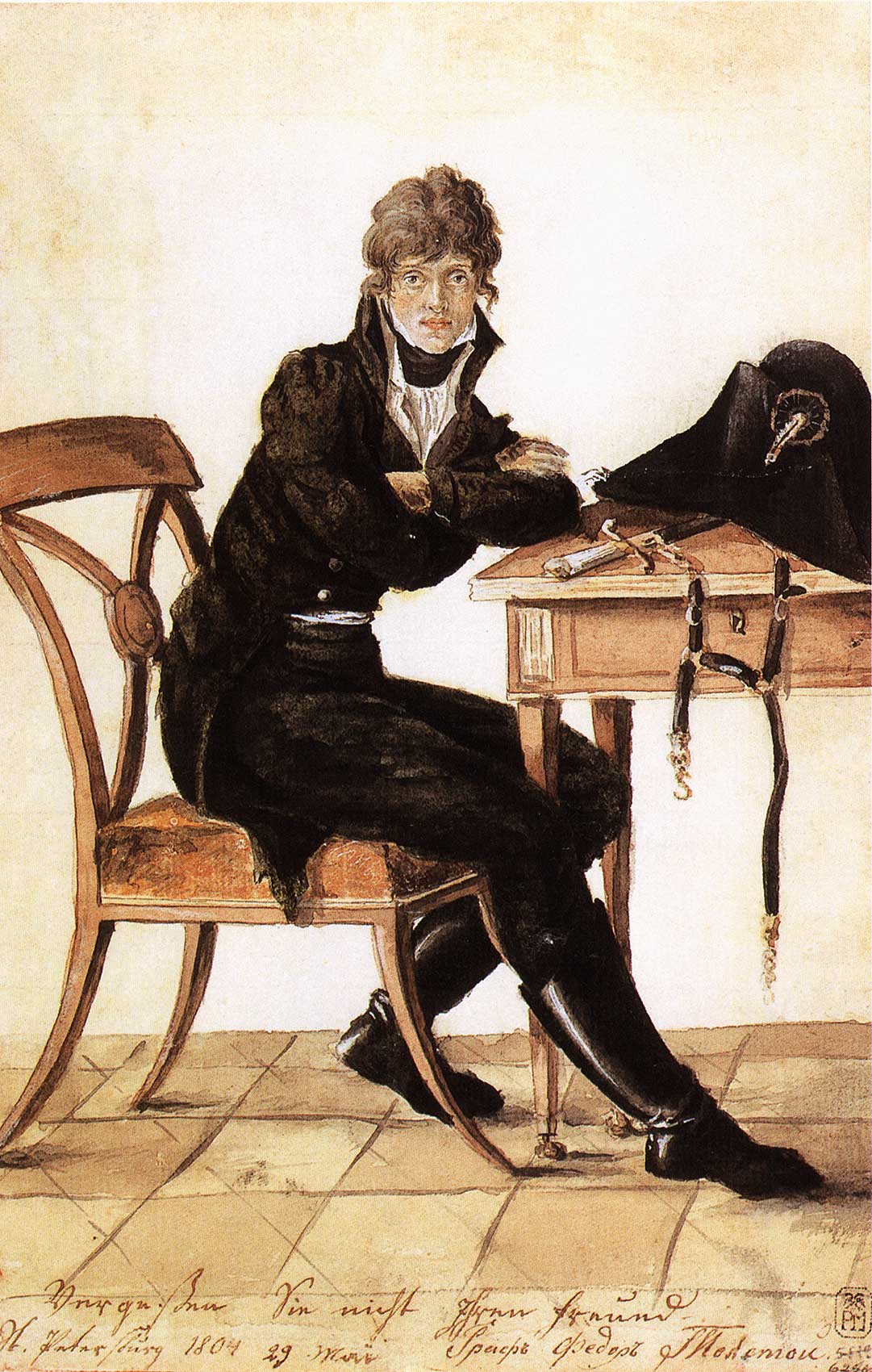
Portrait of Alexei Tomilov
- 1808
- Canvas, oil. 68 х 55,5
- The State Russian Museum
- Ж-5131
Alexei Romanovich Tomilov (1779-1848) was an artillery officer by education and a commander during the building of a fortress in Kronstadt (1799). He left the service in 1808. Alexei Romanovich was a collector and an art amateur, one of the founders and a committee member of the Artists Support Society (since 1820) and a honored free member of the Imperial Academy of Sciences (1833).
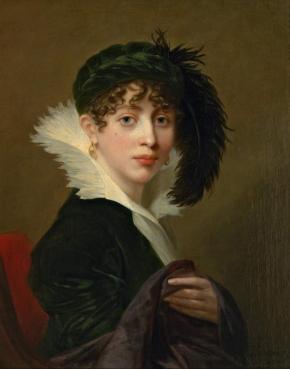
Portrait of Countess Sofia Stroganova
- 1808
- Canvas, oil. 69 х 56
- The State Russian Museum
- Ж-4595
Jean-Laurent Mosnier was a court painter of Louis XVI. He worked in Russia from the middle of 1790s until 1808, where he painted portraits of people of the nobility. As he was an Academician of Painting, he headed the studio of portrait painting from 1806.
Sofia Stroganova (1775–1845) was countess, wife of Pavel Stroganov. She distinguished herself by her beauty, her gentle heart and by her intellectual and wide education. After the death of her husband, as she had management qualities, she administered estates in the Novgorod and Perm provinces. She tried to improve the situation of the serfs by founding several schools, introducing the “Right to Retire” and established a period of time, after which the serfs received their freedom without paying a redemption fee.
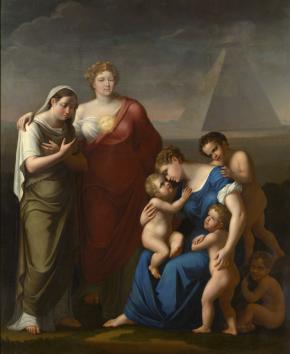
Благодетельное призрение и попечение императрицы Марии Федоровны о бедных
- Canvas, oil.
- The State Russian Museum
- ЖБ-762
Портрет А. Р. Томилова (в форме ополченца)
- Paper, .
- The State Russian Museum
- Р-13136
Портрет графа С. Г. Строганова
- 1815–1825
- Bone, watercolours, gouache. 6,4 х 5,3
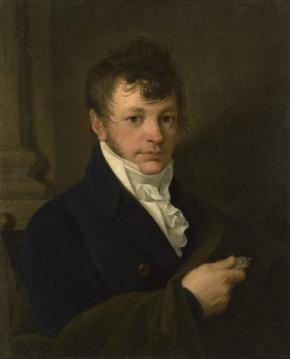
- The State Russian Museum
- Ж-376
Portrait of Empress Marie Feodorovna
- Before 1828
- Canvas, oil. 88 х 60
- The State Russian Museum
- Ж-6205
Marie Feodorovna (1759–1828), née Sophie Marie Dorothea Auguste Louise of Württemberg, was the second wife of Grand Duke Paul Petrovich, later Emperor Paul I (from 26 September 1776), and the mother of Emperors Alexander I and Nicholas I. She devoted most of her time to philanthropic work and setting up schools. She organised Russia’s first literary salon in her residence in Pavlovsk, she painted and drew, and made ornaments out of ivory and amber on a lathe.
Портрет Алексея Романовича Томилова (1779-1848)
- Cardboard, oil.
- The State Russian Museum
- Ж-5140
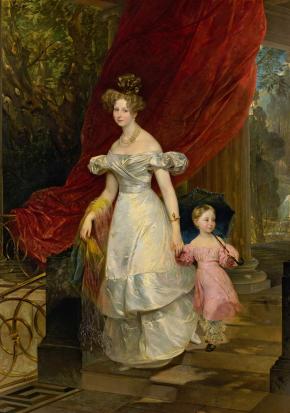
Portrait of Grand Duchess Elena Pavlovna, née Princess Friederike Charlotte of Württemberg, Wife of Grand Duke Mikhail Pavlovich, with her Daughter Grand Duchess Maria Mikhailovna
- 1830
- Canvas, oil. 265 x 185
- The State Russian Museum
- Ж-5082
Grand Duchess Elena Pavlovna (1806–1873), born Princess Friederike Charlotte Marie of Württemberg, became the wife of Grand Duke Michael Pavlovich in 1824. She was educated in Paris at a private boarding school. She was famous for her charity work. During the Crimean War, she organised the Holy Cross Fellowship of Sisters of Mercy, which would become the prototype for the Red Cross. She was a patroness of composers, musicians, writers, and scientists. In 1858, she began the first conservatory classes led by composer and conductor Anton Rubinstein at her home in the Mikhailovsky Palace. She was one of the founders of the Russian Musical Society (1859). She was a strong supporter of liberal reforms and contributed to the liberation of peasants from serfdom.
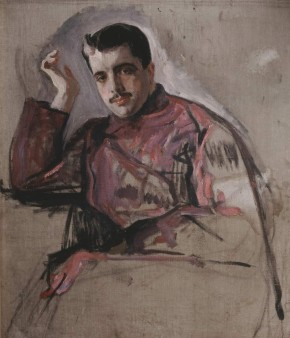
Портрет Сергея Павловича Дягилева (1872–1929)
- 1904
- Canvas, oil. 97 х 83
- The State Russian Museum
- Ж-1922
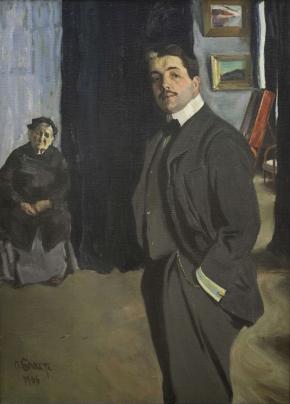
Portrait of Sergei Diaghilev and his Nanny
- 1906
- Canvas, oil. 161 x 116
- The State Russian Museum
- Ж-2117
Sergei Pavlovich Diaghilev (1872–1929) was one of the central figures of fin-de-siècle cultural life in St Petersburg. Before launching the Saisons Russes in Paris, he founded and published the World of Art (Mir iskusstva) magazine (1898–1904), curated a series of important art shows and wrote articles on art and the theatre.
One of Léon Bakst’s most outstanding works of portraiture, Portrait of Sergei Diaghilev and his Nanny is, perhaps, the most famous image of the legendary Russian impresario, who was a close friend of the artist. Diaghilev’s slightly fastidious pose, raised eyebrows and appraising glance betray a self-confident and authoritative personality. The figure of the old nanny sitting in the corner was a typical feature of the way of life of the old Russian nobility. Contrasting the figure of Diaghilev, she offers a clearer insight into the personality of the sitter — a former provincial whose energy and talent helped him to not only conquer the Russian capital, but the whole of Europe as well.
Roslin Alexander
Moshkov (Mashkov) Yevstafy (Yevstify, Yevstefei, Yevtikhy) Vasiliyevich
Mosnier Jean Laurent
1743 (4?), Paris — 1808, St PetersburgFrench painter, portraitist, miniaturist. Pupil of Louis-Jean-François Lagrenée the Elder. Court painter to Queen Marie Antoinette and Louis XVI. Contributed to the Paris Salon. Admitted into the Paris Academy of Arts in 1788. Fled to London during the French Revolution. Worked in Russia (1795(6?)–1808). Moved to St Petersburg (1795(6?)). Academician of the Imperial Academy of Arts (1802), headed the portrait class (from 1806).
Олешкевич Иосиф (Юзеф) Иванович
Росси Петр Осипович (Pierre de Rossi)
Dawe George Edward
1781, London — 1829, Kentish Town (near London)Painter, draughtsman; portraitist. Son and student of engraver F. Dawe. Elder brother of engraver Henry Edward Dawe. Studied at the Royal Academy of Arts in London (1803). Academician (1813). Honourary member of the academies of arts of Florence, Dresden, Stockholm and Paris. Worked in Russia at the invitation of Emperor Alexander I (1819). Together with his Russian assistances Alexander Polyakov and Vasily Golike created 322 portraits of Russian generals for the Military Gallery in the Winter Palace. Produced many paintings on commission. Honourary associate member of the Imperial Academy of Arts in St Petersburg (1820). First portrait painter of the Imperial Court (1828). Returned to London (1829).
Brullov (Bruleau) Karl Pavlovich
1799, St Petersburg -1852, Manziana (near Rome)Painter, watercolourist, draughtsman, history painter, portraitist, genre painter, mural painter. Born into an artistic family. Studied under Anton Ivanov, Alexei Yegorov and Vasily Shebuyev at the Imperial Academy of Arts (1809-22), graduated with a first-class gold medal. Sent to Italy by the Society for the Encouragement of Arts (1822-35). Worked in Milan, Naples and Rome. Won fame in Europe as a portraitist and history painter for such works as The Last Day of Pompeii (1827-33, Russian Museum. St Petersburg)- Returned to Russia and lived in St Petersburg. Honorary freeman (1834), second-degree professor (1835) and first-degree professor (1846) of the Imperial Academy of Arts, where he taught history painting, enjoying the love and respect of his many students. Professor of the Accademia di Belle Arti in Florence. Contributed to exhibitions in Rome, Milan, Paris and St Petersburg. Went abroad on the advice of doctors (1849), settled in Italy (1850).
Serov Valentin Alexandrovich
1865, St Petersburg - 1911, MoscowPainter, graphic artist, teacher, portraitist, landscapist, history painter. Son of the composer Alexander Serov. Studied under Ilya Repin in Paris and Moscow (1874-75, 1878-80) and under Pavel Chistyakov at the Imperial Academy of Arts (1880-85). Academician of painting (1898), full member of the Imperial Academy of Arts (1903-05). Member of the Abramtsevo circle (from the 18705). Contributed to exhibitions (from 1889). Contributed to the exhibitions of the Society of Travelling Art Exhibitions (1890-99; member from 1894), Munich Sezession (1896, 1898,1899; member from 1899), Exhibition of Russian and Finnish Artists (1898), World of Art (1896-1906, member from 1900; 1911-12, founding member), Berlin Sezession (1903), Exhibition of Historical Russian Portraits at the Tauride Palace in St Petersburg (1905), Union of Russian Artists (1905-10; member from 1903), Sergei Makovsky Salon (1909), Exposition Universelle in Paris (1900, grand prix), International Exhibitions in Munich (1909), Vienna (1902), Venice (1907), Brussels (1910) and Rome (1911) and the Exhibitions of Russian Art in Paris (1906, 1910), Berlin (1906) and Vienna (1908). Member of the board of the Tretyakov Gallery. Taught at the Moscow School of Painting, Sculpture and Architecture (1897-1909). Designed for theatres in Moscow and St Petersburg and Sergei Diaghilev\'\'s Saisons Russes (from 1886).
Bakst Leon (Lev Samoilovich)
1866, Hrodno - 1924, ParisPainter, graphic artist, theatrical designer. Studied at the Imperial Academy of Arts (1883-87) and the Atelier dc Jean Louis Gerome and Academic de Rodolphe Julian in Paris (1893-96). Taught at the Elizaveta Zwantseva School of Drawing and Painting in St Petersburg (1906-09). Member of the Society of Russian Waterecolourists (1891-1907), World of Art (1899-1903, 1906, 1913) and the Union of Russian Artists (1903-1910). Life member of the Salon d\'\'\'\'Automne (from 1906). Academician (1914). Contributed to many exhibitions of theatrical design and one-man shows. Designed sets and costumes for the Mariinsky Theatre and Alexandrinsky Theatre in St Petersburg, Paris Opera and theatres in London and New York. Leading designers of Sergei Diaghilev\'\'\'\'s Ballets Russes (from 1909) and the ballet companies of Anna Pavlova and Ida Rubinstein. Emigrated to Paris (1909).
Портрет Феофана Прокоповича
- Canvas, oil. 66,5 x 50
- The State Russian Museum
- ЖБ-2018
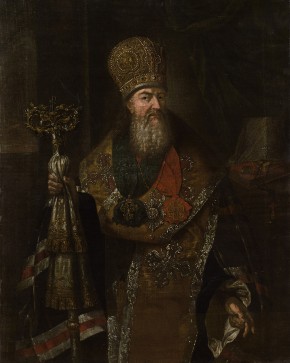
Портрет митрополита Гавриила (Петрова) (1730-1801)
- Canvas, oil. 66 x 53
- The State Russian Museum
- ЖБ-2016
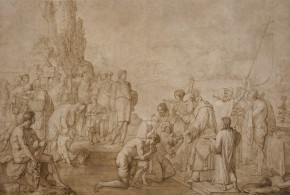
Крещение Российского народа при великом князе Владимире
- 1804
- Sepia, brush, nib. 55,9 х 82
- The State Russian Museum
- Р-5979
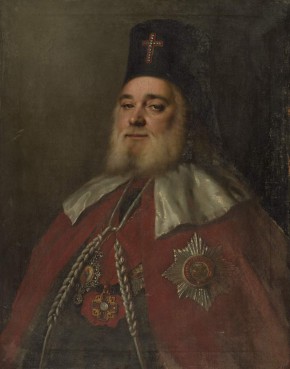
Портрет архиепископа Псковского Иринея Клементьевского (1751-1818) в мантии ордена Александра Невского
- Canvas, oil. 87,6 x 68
- The State Russian Museum
- Ж-5972
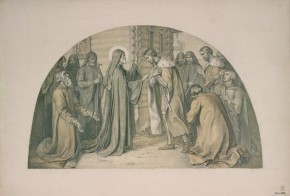
Сергий Радонежский благословляет Дмитрия Донского на побоище и с ним отпускает двух иноков Ослябю и Пересвета
- 1840s
- Paper, graphite pencil, sepia. 29,8 х 43,8
- The State Russian Museum
- Р-916
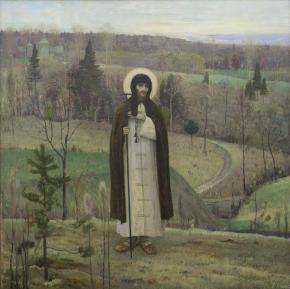
Venerable Sergius of Radonezh
- 1899
- Canvas, oil. 248 х 248
- The State Russian Museum
- Ж-1848
M.V. Nesterov believed that the salvation of Russia lied in a moral ideal. For the artist the embodiment of such an ideal of Venerable Sergius of Radonezh, the founder of the Trinity Lavra of St. Sergius, a hermit, a wonder-worker, a patron saint of all Russian lands. The image of Sergius of Radonezh attracted the artist’s attention during his whole life. Nesterov studied his deeds in chronicles and annals, and the results of these studies were 15 major paintings dedicated to the “hegumen of all Russia”. Among them there are Vision to Young Varfolomey and Youth of Venerable Sergius created in 1892—1897; a triptych Deeds of Venerable Sergius dated back to 1896—1897; Venerable Sergius 1899; studies for the work Venerable Sergius Bids Farewell to Dmitry Donskoy created in 1898—1899 and many others. The painter himself wrote about his favourite character: “I painted the life of a good Russian man of the 14th century, a man who sensed Nature and its beauty, and a man who loved his motherland and strived for truth. I illustrated a legend that my people made long ago about a person who was worth their love and memory”.
Преподобный Сергий Радонежский
- 1899-1900
- Paper, gouache, watercolours, whiting, graphite pencil.
- The State Russian Museum
- Р-40881
Vasily Shebuev
Borovikovsky Vladimir Lukich
1757, Mirgorod - 1825, St PetersburgPainter, draughtsman, miniaturist, icon painter, portraitist. Born into a family of low rank Cossacks. Studied painting under his father, the icon painter Luke Borovik, in Mirgorod. Listed "above the specified number" in the Mirgorod regiment where his father and relatives served (1774). Awarded the rank of "comrade of the colours" (1783), resigned with the rank of lieutenant. Moved to St Petersburg (1788) and studied under Dmitry Levitsky and Johann Baptiste I Lampi. Nominated to the Imperial Academy of Arts (1794), academician of portrait painting (1795). Councillor of the Imperial Academy of Arts (1802). Contributed to the iconostasis of the Kazan Cathedralin St Petersburg (1804). Mason and member of Ekaterina Tatarinova\'\'s mystical sect.
Завьялов Федор Семенович
Nesterov Mikhail Vasilyevich
1862, Ufa - 1942, MoscowPainter, portraitist, landscape artist, genre painter, author of memoirs and essays on artists. Studied at the Moscow School of Painting, Sculpture and Architecture (1877-81, 1884-86) and the Imperial Academy of Arts (1881-84). Full member of the Imperial Academy of Arts (1910). Member of the Society of Travelling Art Exhibitions (1896) and founding member of the Union of Russian Artists (1903). Contributed to the exhibitions of the Society of Travelling Art Exhibitions (1889-1901), World of Art (1899-1901), 36 Artists (1901-03), Union of Russian Artists (1922, 1923), All-Russian Exhibition in Nizhny Novgorod (1896), Exposition Universelle in Paris (1900), International Exhibitions in Munich (1898,1909) and Rome (1911), Die erste russische Kunstausstellung in Berlin (1922) and the Exhibition of Russian Art in New York (1924). Honoured Artist of the RUSSIAN SOVIET FEDERATED SOCIALIST REPUBLIC (1942).