Sculpture
in section










Collection history
The Russian Museum holds the largest collection of sculpture in Russia. It began to take shape in 1897–1898, when works by Russian masters were transferred to the museum from the Hermitage and the Academy of Arts, and further pieces were bought from private owners. Before 1917 the museum's sculpture collection numbered just 184 items. Today it contains more than five thousand works.
The 18th and 19th centuries are represented by Fedot Shubin's gallery of portraits and his statue "Catherine II the Legislatress", along with works by Kozlovsky, Schedrin, Orlovsky, Vitali and Antokolsky. More than half of the collection belongs to the 20th century: Golubkina, Konenkov, Matveyev and his school, the avant-garde of the 1920s, the sculpture of Leningrad and Moscow. In front of the Marble Palace stands the equestrian statue of Alexander III by Paolo Troubetzkoy. The museum took it into safekeeping in 1939 and so saved it from being melted down. The collection continues to grow with the work of 21st-century sculptors.
The Russian Museum’s holdings include several major single-artist collections. Foremost among them is the extensive gallery of portraits by Fedot Shubin (1740–1805), which includes the marble statue Catherine II the Legislatress (1789), commissioned by His Serene Highness Prince Grigory Potemkin-Tavrichesky for the newly built Tauride Palace in St Petersburg. Closely related in conception to Dmitry Levitsky’s famous painting Catherine II the Legislatress in the Temple of the Goddess of Justice (1783), the statue embodies the lofty ideals of the Enlightenment.
The same ideals inform the statue Yakov Dolgorukov (1797) by Mikhail Kozlovsky (1753–1802). It depicts a “historical episode” from the reign of Peter I, when Senator Dolgorukov dared to tear up the tsar’s decree that weighed heavily on the people. In keeping with the conventions of Classicism, the work is rich in allegory: the Christian Torch of Truth in the hero’s hand, the scales of Justice, and attributes (a mask and a writhing serpent) signifying “righteousness that tramples on treachery and malice”.
Another eighteenth-century masterpiece is the marble statue Diana (1789) by Feodosy Schedrin (1751–1825). Together with Schedrin’s Venus (1792), also on display at the museum, it is one of the first depictions of the female nude in Russian sculpture.
The early nineteenth century is represented by the virtuoso terracotta Volkhov and Neva (1801) by Ivan Prokofiev (1758–1828). It was made for Count Alexander Stroganov, the patron, collector and President of the Imperial Academy of Arts, who was then directing the renovation of the sculptural decoration of the Grand Cascade at Peterhof.
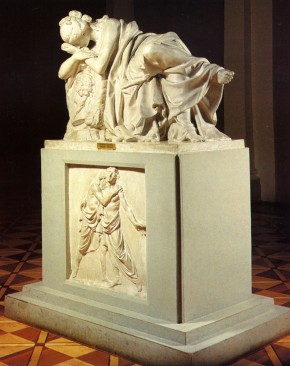
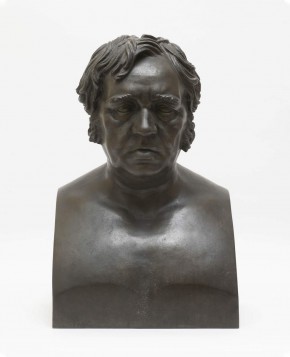
Rare mastery in carving marble distinguishes such celebrated masterpieces of the Russian Museum as Faun and Bacchante (1837) by Boris Orlovsky (1797–1837) and Venus Taking Off Her Sandal (1852) by Ivan Vitali (1794–1855). A harmonious blend of Classical and Romantic tendencies marks the work of Samuil Galberg (1787–1839), the finest portraitist of Pushkin’s time.
Russian sculpture of the second half of the nineteenth century, with its characteristic variety of genres and overall realist orientation, is extensively represented in the collection by the works of Fyodor Kamensky (1836–1913), Yevgeny Lanceray (1848–1886) and Mark Antokolsky (1842–1902). Portraiture took on particular importance. Among the many masters working in this genre was Vladimir Beklemishev (1861–1919), who captured many of his contemporaries in busts and statues. One of his finest achievements is the marble portrait of the architect Paul Suzor (early 1890s).
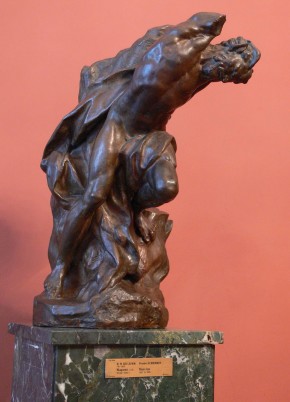
Three of the outstanding sculptors of the twentieth century began their careers in the 1900s: Anna Golubkina (1864–1927), Sergei Konenkov (1874–1971) and Alexander Matveyev (1878–1960). The Russian Museum acquired their best works of those years, which fully reflect the significance and originality of their talents and the innovative character of their artistic explorations.
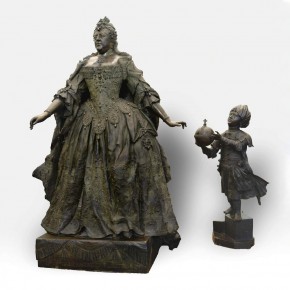
Alongside gallery sculpture, the collection has also been enriched at various times by unique monumental works. In 1898 the Academy of Arts transferred to the museum the bronze group Empress Anna Ioannovna with a Young Black Page by the Italian sculptor Carlo Bartolomeo Rastrelli (1667–1744), who came to Russia under Peter I. Dated 1741 and conceived as a monument for a public square, this composition was the master’s last major achievement.
In 1925 the Academy of Arts transferred to the museum a large plaster model of the monument to Emperor Alexander I erected in Taganrog in 1831. This unique original model was used in 1998 to recreate the monument, which had been destroyed in the late 1920s.
In 1939 the museum took custody of the equestrian statue of Emperor Alexander III created by Paolo Troubetzkoy (1866–1938) for the monument unveiled in 1909 on Znamenskaya Square in St Petersburg. This effectively saved a celebrated masterpiece of European monumental sculpture, which now stands in the forecourt of the Marble Palace, a branch of the Russian Museum.
The State Russian Museum holds the largest collection of twentieth-century Russian sculpture, numbering more than 3,000 works. Virtually every major name and key development in Russian sculpture of the Soviet period is represented. This comprehensive approach to collecting has made it possible to preserve many unique works. A distinctive feature of the collection is its focus on acquiring original plaster models. Wood sculpture also forms a significant part of the holdings. Generations of artists were drawn to wood both because the material was widely available and because of a deep-rooted affinity with Old Russian and folk sculpture traditions.
The collection of Soviet sculpture can be roughly divided into two large parts, retrospective and contemporary. Outstanding sculptors of the Soviet period, among them Sergei Konenkov, Vera Mukhina, Vasily Vatagin, Stepan Erzia, Sarra Lebedeva, Vera Isayeva and Matvey Manizer, are represented in depth. The collection includes both works that have become classics of Soviet sculpture (for example, Ivan Shadr’s Cobblestone, the Weapon of the Proletariat, Vera Mukhina’s Worker and Kolkhoz Woman and Sergei Konenkov’s Stepan Razin and His Men) and little-known pieces: studies, sketch models (maquettes) and designs for monuments.
A special place belongs to the collection of works by Alexander Matveyev, unrivalled in its completeness. Matveyev was a master who defined an entire era in the development of sculpture. Alongside it stands the collection of the Matveyev school, one of the most fruitful currents in twentieth-century Russian sculpture. The Matveyev school is a broader phenomenon than the circle of Matveyev’s own pupils. It sought to preserve classical traditions, strict architectonics, a laconic sculptural language and freshness of observation from life. It is represented by Matveyev’s pupils of the 1920s and 1930s (L. Ivanovsky, I. Klassep, A. Strekavin, L. Mess, B. Kaplyansky, T. Kuchkina, N. Koltsov) and by sculptors of the postwar years (N. Mogilevsky, A. Malakhin, A. Ignatyev, L. Kholina, M. Vainman, M. Kharlamova, V. Stamov, M. Anikushin, V. Rybalko), who reached creative maturity in the 1960s and 1970s and shaped the character of the Leningrad school of sculpture.
The museum owns a valuable collection of 1920s avant-garde sculpture, above all the Cubist works of Boris Korolev, as well as works by P. Bromirsky, I. Chaikov, B. Sandomirskaya, N. Niss-Goldman, I. Suvorov and V. Izdebsky.
The collection of sculpture by the indigenous peoples of the North is unique. From 1928 to 1941 an experimental art workshop operated at the Faculty of Northern Peoples of the Institute of Oriental Languages under the direction of Leonid Mess, a pupil of Matveyev. The work of these artists revealed a genuine feeling for sculptural form.
Twentieth-century sculpture makes up the greater part of the collection. It is represented by works of the Moscow and Leningrad (St Petersburg) schools. Works by A. Pologova, T. Sokolova, N. Bogushevskaya, A. Krasulin, D. Shakhovskoy, V. Dumanyan, L. Gadayev, V. Soskiev, I. Blumel and N. Zhilinskaya reflect such features of the Moscow school as a more assertive artistic language, theatricality, vivid imagery and expressiveness. Leningrad sculpture is also expressive, and this quality emerges with particular force in the work of sculptors as different as L. Lazarev, L. Lanets, O. Godes and L. Smorgon. The works of V. Stamov, E. Nikolayev, B. Svinin, I. Kochukov, M. Kazakov and I. Nikonova strike a different note, with their commitment to classical traditions and particular restraint of form. M. Yershov turns to the archaic in his female figures, while B. Sergeyev and K. Suvorova draw on the traditions of Russian wood sculpture. Innovation and a metaphorical artistic language distinguish the works of K. Simun. Grotesque expressiveness and unconventional solutions to spatial and compositional problems mark the works of D. Kaminker and the sculptors of the Ozerki group: L. Kolibaba, V. Danilov, A. Pozin, M. Spivak, G. Pisareva and O. Zhogin.
At the beginning of the twenty-first century the collection was enriched by works of young sculptors: P. Tikhomirov and D. Fedin, who work in traditional techniques and materials, and D. Karev, P. Brat and A. Lyublinsky, whose works express a contemporary perception of sculpture and experiment with form at the intersection of different media.
Media resources


Virtual tour of the exhibition, held in the Russian Museum from 30 April 2020 to 10 May 2021.

Virtual tour of the exhibition, held in the branch of the Russian Museum in Málaga (Spain) from February 10, 2018 to February 03, 2019.

Virtual tour of the exhibition, held in the Russian Museum from 13 February to 12 June 2019.


Biblical themes are eternal for worlds history of art, Russian artists often depicted events from Old and New Testaments. This film tells us about history of Russian Christianity through the works of Russian artists


This documentary film tells about creation of the main building of The State Russian museum - The Mikhailovsky Palace.
The Art collection of the State Russian museum has developed through many phases and expansions. This collection has been forming since the opening of the State Russian museum in 1898




Multimedia program combines about 500 works of Russian artists who worked in Italy and of Italian masters who left their trace in Russian art, including those who contrib¬uted greatly to the architectural image of the Russian Museum palaces.


The program presents the oldest St. Petersburg park, which has been part of the Russian Museum since 2003. The Summer Garden is the favourite brainchild of Peter the Great. It was created at the beginning of the 18th century following the traditions of the best examples of European Parks and Gardens.


Multimedia program «Artists of Estonia in Russia, Russian Artists in Estonia» is the first project aimed is identifying and presenting works of the 18th and 19th century painters associated with the national art school of the Republic of Estonian that are stored in the collections of the Russian Museum.


The theme of this publication is Russian portraits over the past hundred years, painting a vivid picture of every period in the twentieth century. The more than 400 illustrations were all taken from the collection of the State Russian Museum in St Petersburg, home to the world's largest collection of Russian art.


In March 1998 the centenary of the State Russian Museum – the first state museum of Russia containing the national art collection – was celebrated. This program represents the outstanding works of national painting, graphics and sculpture, it the history of the museum and its collections and shows the palaces belonging to the united museum complex.
Divisions: “Masterpieces”, “The Mikhailovsky Palace”, “The Marble Palace”, “The Stroganov Palace”, “The St.Michael’s Castle”, “History in Photographs” and “Jubilee Celebrations”